When you're shopping for new sunglasses in Glendale Heights, the biggest difference you'll hear about is polarized vs. nonpolarized. It all comes down to one thing: glare reduction.
Polarized lenses have a special chemical filter that’s designed to stop the intense, horizontal glare that bounces off surfaces like water, snow, or a wet road. This makes your vision sharper and much more comfortable. On the other hand, nonpolarized lenses simply reduce the overall brightness of your surroundings, but they don't do anything to eliminate that specific, eye-straining glare.
Breaking Down Polarized vs. Nonpolarized Sunglasses
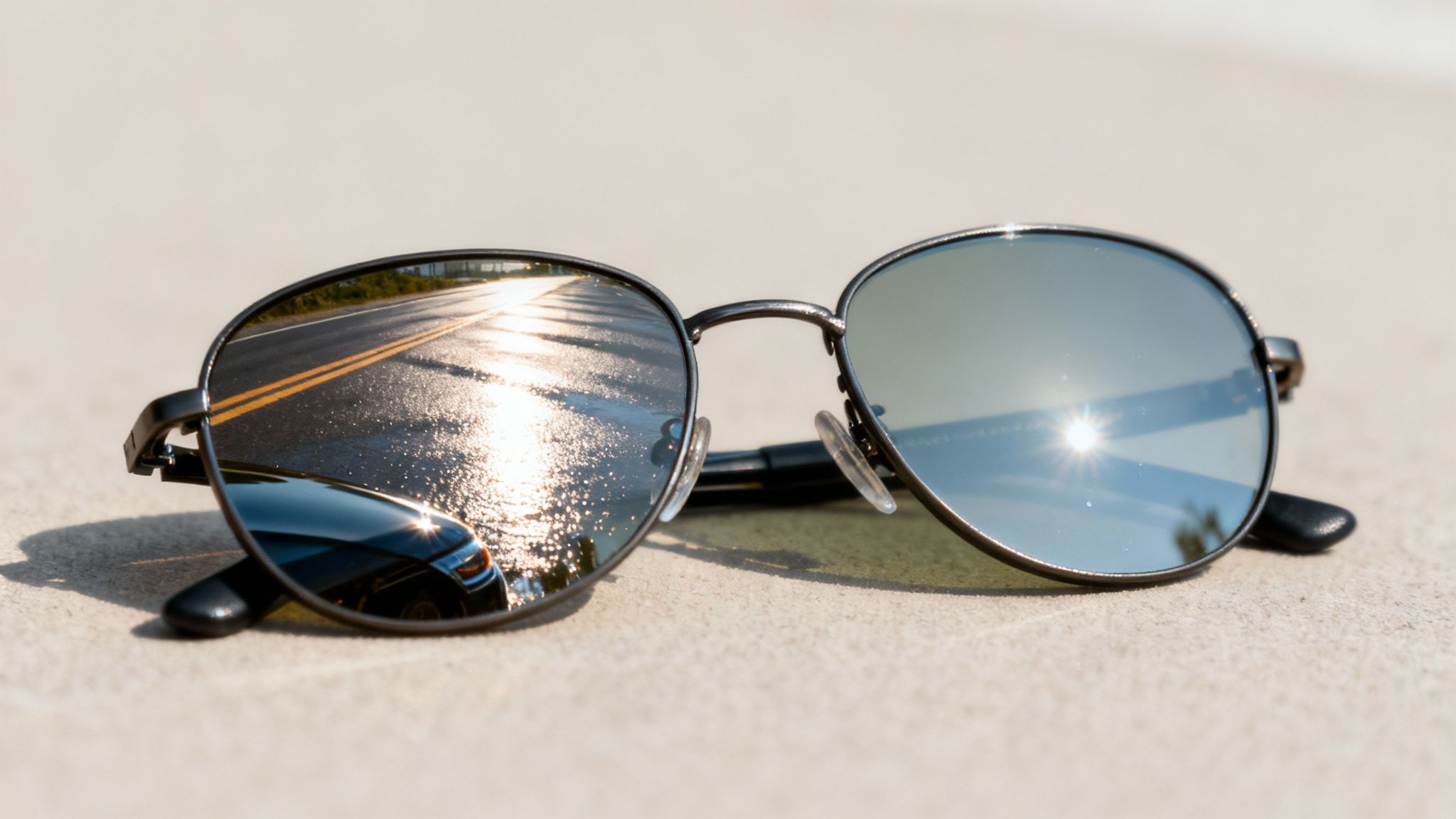
Anyone who's driven down North Avenue in Glendale Heights on a bright, sunny afternoon knows that blinding glare isn't just an inconvenience—it can be downright dangerous. This is exactly where the choice between polarized and nonpolarized lenses becomes more than a preference; it’s about your comfort and safety.
It's important to know that both lens types offer crucial 100% UV protection, which is non-negotiable for protecting your eyes from damaging radiation. Where they part ways is in how they manage the light that actually reaches your eyes. Figuring out that difference is the key to picking the right sunglasses for your life.
Quick Comparison: Polarized vs Nonpolarized Lenses
To make the decision a bit easier, here’s a quick rundown of what sets polarized and nonpolarized lenses apart. This table cuts through the jargon and shows you what each type really does.
| Feature | Polarized Lenses | Nonpolarized Lenses |
|---|---|---|
| Glare Reduction | Excellent; specifically targets and blocks horizontal glare. | Minimal; only darkens the scene without filtering glare. |
| Visual Clarity | High; significantly improves contrast and sharpness. | Standard; reduces overall brightness without enhancing detail. |
| Eye Comfort | Superior; dramatically reduces squinting and eye fatigue. | Basic; offers some relief from bright light. |
| LCD Screen Viewing | Can distort or black out screens on phones or car displays. | No interference; screens remain perfectly clear. |
Think of it this way: nonpolarized lenses are like putting a simple dimmer on the world. They make everything darker, but they don’t fix the annoying and sometimes painful glare. Polarized lenses are more of a smart filter, selectively removing the most disruptive light waves to give you a clearer, more comfortable view.
The real magic of polarized lenses is their ability to boost visual clarity and comfort in situations with a lot of glare. They are engineered to stop you from squinting, which helps prevent eye strain and keeps your eyes feeling relaxed.
You’ll really notice the difference when you're driving, fishing at Camera Park, or even just crossing a shiny parking lot. For anyone curious about the nitty-gritty of lens technology, our guide on the different kinds of eyeglass lenses goes into even more detail. Here at iDoctor, your trusted eye doctor in Glendale Heights, we know that getting the right lens is just as important as finding a frame you love.
How Each Lens Technology Manages Light and Glare
To really get to the bottom of the polarized vs. nonpolarized debate, you first have to understand a little bit about how light works. Sunlight travels in waves that vibrate in all directions. When these waves bounce off an uneven surface, they scatter, which is no big deal for our eyes.
But everything changes when light hits a flat, reflective surface. Think about a wet patch on Army Trail Road, the shimmering surface of a pond, or even the hood of the car in front of you. The light reflects off these surfaces and becomes organized, streaming in a concentrated horizontal direction. That intense, focused light is what we call glare.
The Polarized Approach: A Smart Filter
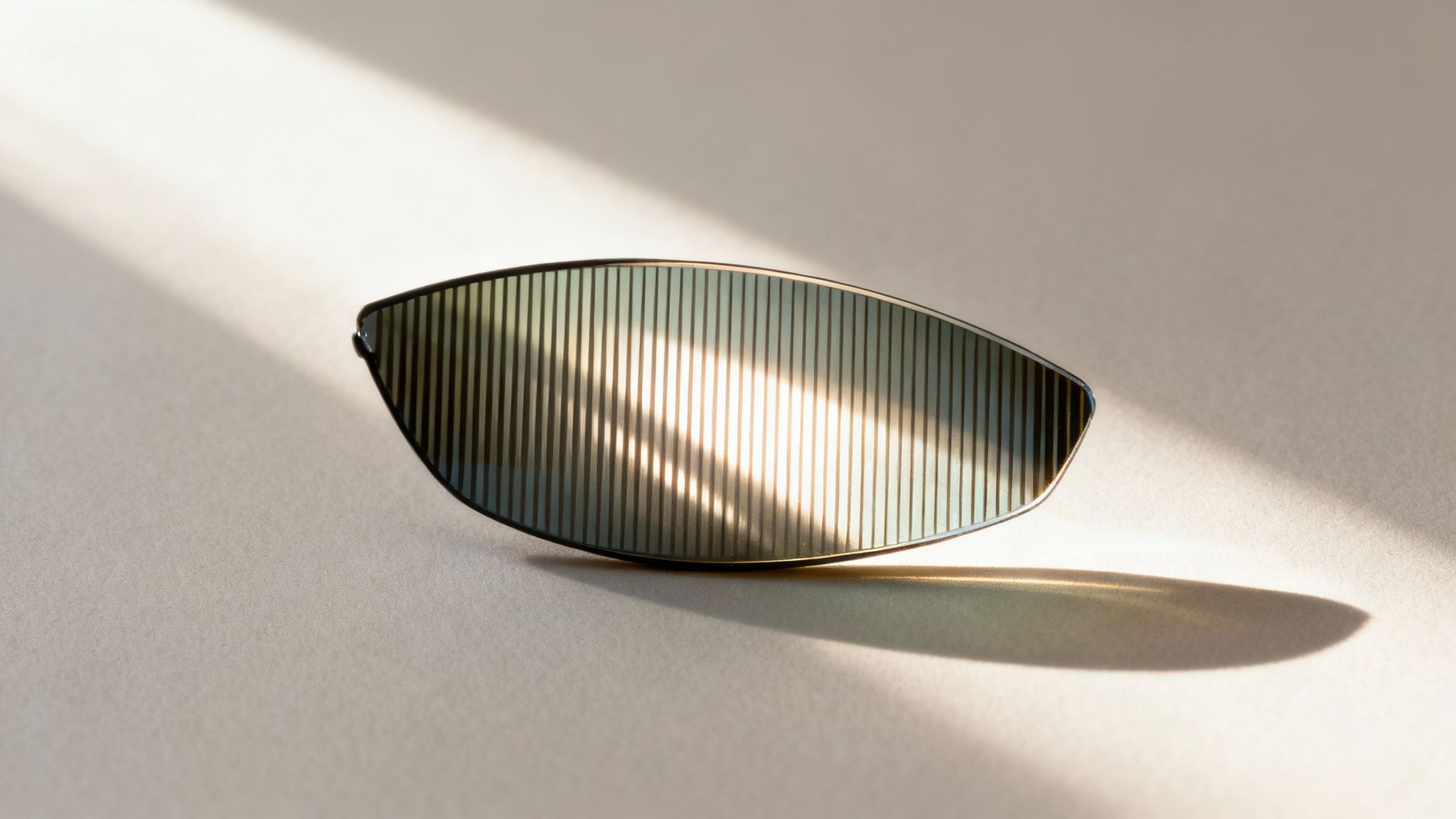
Polarized lenses are pretty clever. They’re built with a special chemical film that contains molecules all lined up in a neat vertical pattern. You can imagine it as a set of microscopic Venetian blinds.
This vertical alignment is the secret sauce. It acts as a gatekeeper, blocking the intense, horizontal light waves—the glare—from getting through to your eyes. Meanwhile, it lets the useful vertical light pass through, which is what allows you to see everything else with crisp detail. The result is a much clearer, more comfortable view without all that painful squinting.
The Nonpolarized Method: A Simple Dimmer
Nonpolarized lenses are far more straightforward. They use a standard dark tint to reduce the total amount of light that reaches your eyes across the board.
It’s like turning down the brightness on your entire field of view. While this definitely provides relief on a sunny day, it doesn't do anything to specifically target and eliminate the harsh, horizontal glare that causes the most eye strain and visual disruption.
The core difference is selectivity. Polarized lenses are engineered to specifically combat glare by blocking horizontal light, while nonpolarized lenses just darken everything you see without making a distinction.
This distinction makes a world of difference for both your comfort and safety in many situations. It’s similar to how other lens treatments work, like those that reduce reflections. To see how other coatings can improve your vision, you might find our guide on the benefits of anti-reflective lens coatings helpful.
Understanding how these technologies manage light is the first step in making a smarter choice for your next pair of sunglasses in Glendale Heights.
Comparing Real-World Performance and Visual Quality
Forget the technical jargon for a moment. The real difference between polarized and non-polarized lenses is something you feel the moment you put them on and step outside. It’s not just about making things darker; it’s about the quality and comfort of what you see.
Polarized lenses are the undisputed champions when it comes to fighting harsh, reflective glare. Picture this: you're driving west on Fullerton Avenue as the sun is setting, and the light bouncing off the cars ahead is absolutely blinding. Polarized lenses are built specifically to cancel out that exact kind of horizontal glare, making your drive safer and dramatically cutting down on eye strain.
This filtering process does more than just stop glare. By cutting through all that "visual noise," polarized lenses make colors pop and details look sharper. It's an enhanced level of contrast that genuinely changes how you see the world around you.
Glare Reduction and Visual Comfort
The core mission of polarized sunglasses is to eliminate glare, and they do it exceptionally well. This is a game-changer for any activity where reflected light is a constant battle.
- For Drivers: They slice through the dangerous glare coming off wet roads and other vehicles, which can improve your reaction time and reduce eye fatigue on long trips.
- For Water Activities: Whether you're at Hidden Lake Forest Preserve or out on Lake Michigan, polarized lenses cut the blinding reflections off the water, letting you see what’s swimming just below the surface.
- For Winter: They are incredibly effective at minimizing the intense, disorienting glare that reflects off snow and ice, making winter sports much safer and more enjoyable.
Non-polarized lenses, on the other hand, offer a more basic function. They simply dim your entire field of view, reducing overall brightness. While helpful, they do nothing to stop the specific, harsh glare that causes the most visual discomfort.
A Critical Drawback: Screen Visibility
For all their advantages in the great outdoors, polarized lenses have one significant weakness: viewing LCD and LED screens.
Because polarized lenses are designed to block horizontal light waves—and many digital screens emit them—looking at your phone, GPS, or even the gas pump display can be a challenge. The screen might look distorted, dark, or completely black from certain angles.
This is a huge consideration for anyone who needs to glance at a screen throughout the day. In fact, for pilots and heavy machinery operators who must have an unobstructed view of their instrument panels, non-polarized lenses are often required for safety. For the rest of us, it’s a trade-off.
Even with this drawback, consumer preference is clear. Polarized sunglasses commanded an 81.31% share of the global market, largely because their ability to boost clarity and reduce eye strain outweighs the screen issue for most people.
Deciding what works for you as a driver around Glendale Heights can be tricky. Our detailed guide on the best sunglasses for driving in Glendale Heights dives deeper into this to help you make the right call. Ultimately, the choice comes down to what matters more in your daily routine: superior glare reduction or seamless screen compatibility.
Choosing the Right Lenses for Your Lifestyle
When it comes to picking the right sunglasses, the technology behind the lenses is only half the story. The real question is: what does your daily life look like? The perfect pair for you hinges on where you go and what you do. Here at iDoctor, our job is to match your eyewear to your life, so your vision is at its best, no matter the situation.
Think about your daily commute. If you're driving on I-355 or Army Trail Road, especially when the sun is low or the pavement is wet, polarized lenses are a non-negotiable. They are engineered to slice through the blinding horizontal glare that bounces off asphalt and other cars. This dramatically boosts safety and cuts down on eye strain, making them an essential tool for anyone who drives around Glendale Heights.
This quick decision tree helps simplify the main trade-off.
As you can see, it really comes down to one thing: is uninterrupted screen time more important than superior glare reduction for everything else?
Lenses for Sports and Outdoor Activities
Nowhere is the difference between polarized and non-polarized lenses more obvious than in the world of sports. The numbers speak for themselves—polarized lenses dominate the sports sunglasses market, holding a staggering 74.9% market share. With nearly 80% of Americans enjoying the outdoors, the need for high-performance eye protection is clear. You can dig deeper into these market trends to see how this plays out across different activities.
Getting specific, your sport of choice makes the decision crystal clear:
- Fishing and Boating: Spending a day out on the water at Hidden Lake Forest Preserve? Polarized lenses are a must. They cut the glare right off the surface, letting you see the fish and obstacles below.
- Golfing: Most golfers I talk to swear by polarized lenses. They help reduce the shimmer off water hazards and bright sand traps, making it easier to read the green and follow your ball against the sky.
- Skiing and Snowboarding: On the slopes, "snow blindness" is a real thing. Polarized lenses are game-changers, cutting the intense, disorienting glare that reflects off the snow and improving your ability to see the contours of the terrain.
That said, they aren't for everyone. Some athletes, like mountain bikers who are constantly moving between bright sun and deep forest shadows, might actually prefer non-polarized lenses. For them, preserving every last bit of depth perception on tricky terrain is more important than cutting glare.
When Non-Polarized Lenses Are the Better Choice
While polarized lenses win out in most outdoor scenarios, there are definitely times when non-polarized lenses are the smarter—and safer—choice.
The biggest reason? Screens. Pilots and some boat captains are often required to use non-polarized lenses because they need to see their LCD instrument panels without any of the distortion or blackouts that polarization can cause. The same logic applies to you if your work involves constantly looking at a laptop, tablet, or phone while outdoors.
In the end, it’s all about matching the lens to your life. The team at iDoctor, the premier best optometrist in Glendale Heights, is here to walk you through the options. Whether you’re looking at Ray-Ban or Cartier, we'll help you find the perfect pair that fits what you do every day.
Finding Your Perfect Sunglasses in Glendale Heights
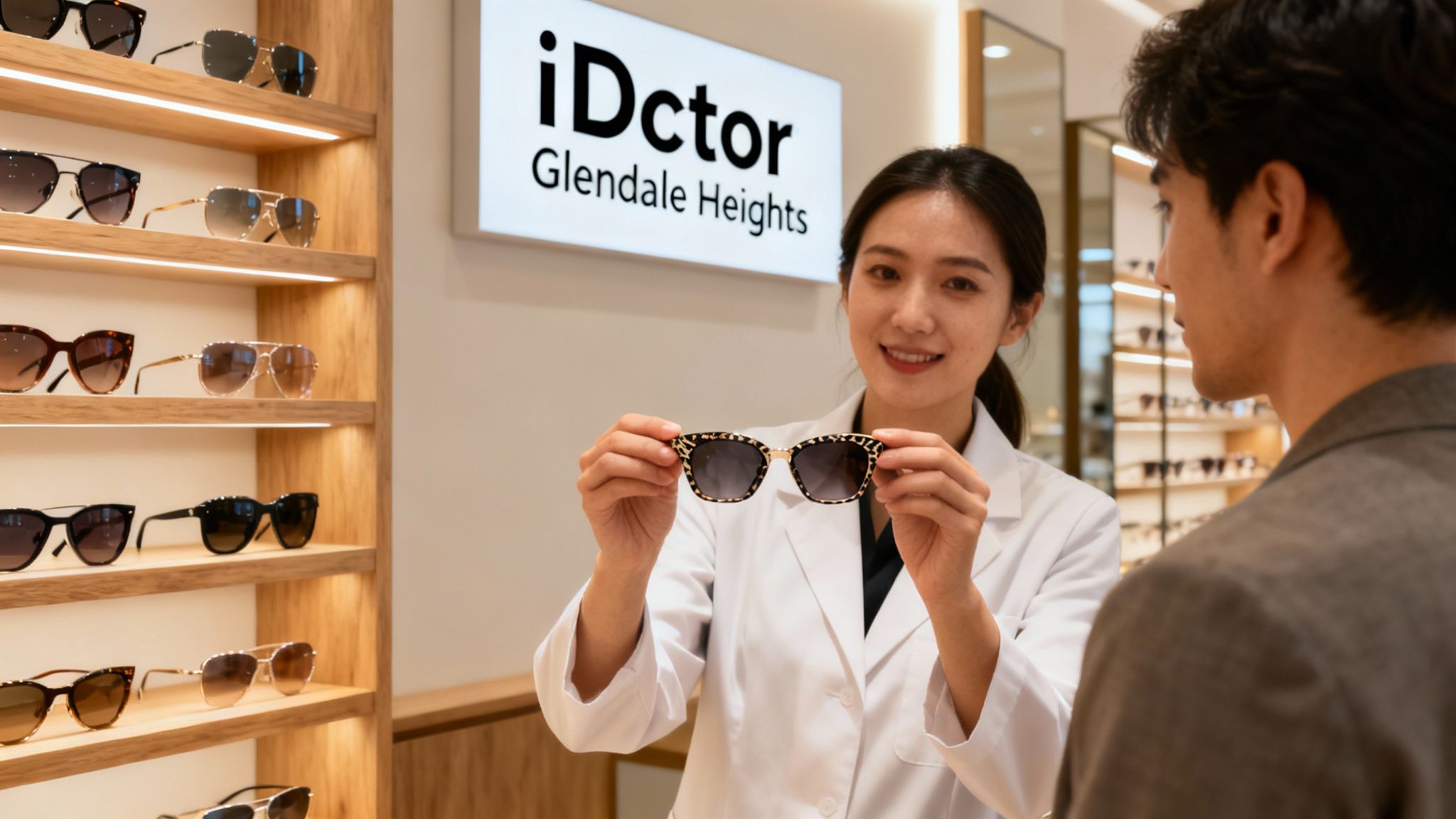
Knowing the science behind polarized and nonpolarized lenses is a great start, but the real test is finding the pair that feels right for you. It’s a personal journey. Here at iDoctor in Glendale Heights, our team lives and breathes eyewear, and we specialize in matching you with sunglasses that hit that sweet spot between performance, style, and your unique vision needs.
We think picking out glasses should be enjoyable, not a chore. That’s why we’ve carefully curated a collection of beautiful designer frames, any of which can be fitted with your choice of polarized or nonpolarized lenses. So whether you're drawn to the classic cool of Ray-Bans or the refined elegance of Cartier, we'll make sure the lenses are perfect for your life.
Expert Guidance for Your Lifestyle
Often, the best choice boils down to the little things in your day-to-day. Are you constantly on I-355 dealing with road glare? Or maybe you’re someone who needs to glance at your phone or GPS frequently while you're outside. During one of our detailed eye exams in Glendale Heights, we'll talk through these exact situations to help pinpoint the right lens for you.
Our opticians can show you the real-world difference between lens types right here in our boutique. We’ll help you figure out if a polarized upgrade is a smart investment for your prescription or non-prescription sunglasses. It’s no surprise that more and more people are demanding better performance from their lenses. In fact, the polarized sunglasses market is expected to hit USD 12.18 billion by 2032, which shows just how many people now prioritize both high-end eye protection and fashion. It’s a clear sign that we all understand how much advanced lenses can improve our comfort and how we see the world.
A Curated Collection for Every Taste
Your sunglasses are a key part of your look, and our collection is built around that idea. We carry an incredible selection of both luxury and affordable brands, so you're sure to find a frame you'll be excited to wear. A great example of fashion meeting function is something like these Dolce & Gabbana Silver Plated Round Sunglasses, which blend a high-end look with practical lens technology.
At iDoctor, we don't just sell eyewear; we provide a complete vision solution. From the initial eye exam to the final fitting, our goal is to ensure you leave seeing clearly and feeling confident.
We also believe premium eye care should be accessible, which is why we accept all major vision insurance plans. Come visit our Glendale Heights boutique today and browse designer eyewear from iconic brands like Gucci, Tom Ford, and Oliver Peoples. Let our team help you find that perfect pair of sunglasses—the ones that not only look fantastic but also give you the best possible protection and visual clarity for your life.
Frequently Asked Questions About Polarized vs. Nonpolarized Lenses
At our Glendale Heights boutique, we get asked about polarized and nonpolarized lenses all the time. To help you sort through the options, here are answers to the most common questions we hear from our clients.
Are polarized sunglasses better for driving around Glendale Heights?
Without a doubt. If you're driving around Glendale Heights, especially when the sun is out or after it rains, polarized lenses are a game-changer. They cut the blinding glare that bounces off the wet asphalt on roads like North Avenue or reflects off the hoods of other cars. This isn't just about comfort—it's about safety. By eliminating that intense glare, you squint less, your eyes don't get as tired, and you can see road hazards more clearly.
Can I get prescription sunglasses with polarized lenses at iDoctor?
Yes, absolutely! At iDoctor, we specialize in putting custom polarized lenses into prescription sunglasses. It’s the perfect solution for anyone who needs vision correction but also wants the full glare-blocking benefits for their time outdoors. We can fit custom polarized lenses into a huge selection of designer frames from brands like Cartier, Gucci, and Ray-Ban. Swing by to see our selection of designer eyeglasses in Glendale Heights and let's find the perfect pair for you.
Do I need polarized lenses for everyday use in the Chicagoland suburbs?
For most people living in Glendale Heights and the surrounding Chicagoland suburbs, polarized lenses are fantastic for everyday wear. Whether you’re walking through East Branch Forest Preserve or just running errands, you're constantly dealing with glare from windows, pavement, and other cars. Polarized lenses make everything sharper and more comfortable on your eyes. The only time you might prefer non-polarized lenses is if your job requires you to view older, unprotected LCD screens, which can appear distorted. For the vast majority of daily life, the reduced eye fatigue and enhanced clarity make them a much better option. Wondering if other lenses have this feature? We break down if transition lenses are polarized in another guide.
Does iDoctor accept vision insurance for designer sunglasses?
Of course. We believe everyone deserves premium eye care and eyewear, which is why we accept all major vision insurance plans. You can use your benefits toward our curated collection of luxury and affordable designer sunglasses, including brands like Tom Ford, Fendi, Oliver Peoples, and Ray-Ban. Our team in Glendale Heights will help you understand and maximize your coverage, making it easy to get the high-quality, stylish sunglasses you want.
Ready to see the world more clearly and comfortably? Visit iDoctor in Glendale Heights to explore our exclusive collection of designer eyewear and find the perfect polarized or nonpolarized lenses for your lifestyle. Schedule your personalized consultation today at https://idoctoril.com.