Glaucoma Testing

You might be surprised at how many tests eye doctors use to diagnose glaucoma. A proper diagnosis requires careful evaluation of many aspects of your eye’s health – from eye pressure to cornea thickness to the health of your optic nerve. This article describes how your eye doctor assesses your risk and all the tests needed to properly diagnose glaucoma.

Risk Factor Assessment

Your eye doctor will begin by assessing your risk level for developing glaucoma. This will help determine the frequency and extent of testing needed. Through a family history and medical questionnaire, the eye doctor is looking for the following risk factors:

  • Over the age of 60
  • Ethnic background such as African or black Caribbean descent, Hispanic, or Asian
  • Family history of glaucoma, such as a sibling or parent with glaucoma
  • History of eye conditions, injuries or surgeries
  • Prolonged corticosteroid use (eye drops, pills, inhalers or creams)
  • Chronic conditions that affect blood flow, such as migraines, diabetes, low blood
    pressure or hypertension
  • Current or former smoker

If you’ve already had a comprehensive eye exam, your eye doctor will also consider these risk factors:

  • Eye pressure higher than normal (above 21 mm Hg)
  • Thin corneas (less than 0.5 millimeters)

Your type of eyesight is also important. People with farsightedness are at a higher risk for narrow-angle glaucoma, a more serious type that can advance quickly. While nearsightedness is associated with open-angle glaucoma, which progresses slowly without any symptoms.

Standard Glaucoma Tests

During a comprehensive eye exam, your eye doctor will always check for glaucoma, regardless of the risk level. This provides a baseline for comparison as you age. There are two tests: tonometry and ophthalmoscopy.

Tonometry

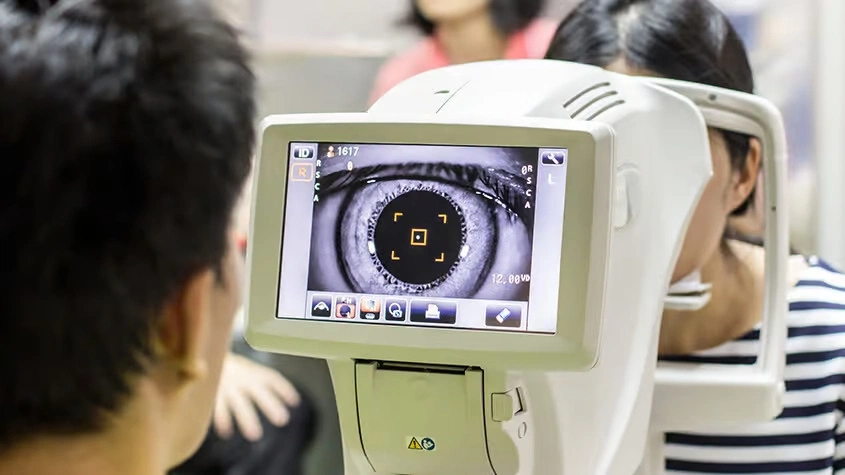
Tonometry measures the pressure within your eye. Your eye doctor will give you drops to numb your eyes. Then he/she will use a device called a tonometer, which applies a small amount of pressure with a warm puff of air.

Eye pressure is unique to each person, so it’s not always a reliable indicator for glaucoma. It’s simply another piece of information to help your eye doctor assess your eyes. The range for normal pressure is 12-22 mm Hg (“mm Hg” in millimeters of mercury, a scale for recording eye pressure). Most glaucoma cases are diagnosed with pressure over 20mm Hg. However, some people can have glaucoma at pressures between 12 -22mm Hg.

Ophthalmoscopy

This is an examination of your optic nerve. Your eye doctor will use eye drops to dilate the pupil, which makes it possible to see through your eye to examine the shape and color of the optic nerve. Then, using a small device with a light on the end, your optic nerve is magnified. Based on the results of these tests, your doctor may ask you to have more glaucoma exams.


Supplemental Glaucoma Tests

Perimetry

Perimetry is a visual field test. It creates a map of your complete field of vision. During this test, you’ll look straight ahead and then indicate when a moving light passes your peripheral (or side) vision. Try to relax and respond as accurately as possible. To ensure accuracy, your doctor may repeat the test to see if the results are the same the next time. If you’ve been diagnosed with glaucoma, a visual field test is usually recommended at least once per year to assess changes to your vision.

Gonioscopy

This diagnostic exam helps determine the angle of your iris and cornea. First, you’ll receive eye drops to numb the eye. A hand-held contact lens is gently placed on the eye. A mirror on the contact lens shows the doctor if the angle is closed and blocked (a possible sign of angle-closure or acute glaucoma) or wide and open (a possible sign of open-angle, chronic glaucoma).

Pachymetry

Last, your eye doctor may want to use pachymetry as another way to confirm a diagnosis. Pachymetry measures the thickness of your cornea, the clear window at the front of the eye. A probe called a pachymeter is gently placed on your cornea to measure its thickness. Pachymetry can help clarify your diagnosis because corneal thickness has the potential to influence eye pressure readings.
Glaucoma diagnosis is not as simple as you might expect. Be sure to have regular eye exams, especially if you have any of the risk factors, to detect glaucoma early.

Questions before booking?

Quick answers for your visit.

Team hours: Mon–Fri, 9 am–5 pm.
How do I book an eye exam?

Use our online scheduler to choose a date and review appointment options, even when the office is closed. Follow the steps in the scheduler to book your visit.

If your first selected day has no appointments, try another date. Open the online scheduler (opens in a new tab) →

Can’t find a suitable appointment?

If the scheduler doesn’t show a time that works for you, send our team your preferred days and times using the website contact form. We’ll follow up within one business day.

Sending a request does not reserve an appointment.

Which vision plans do you accept?

We accept major vision plans, including VSP, EyeMed, Davis Vision, Superior Vision, Spectera and NVA. Individual benefits, copays and allowances depend on your plan and require verification by our team.

View insurance information →

What if I don’t have vision insurance?

You can visit iDoctor with or without vision insurance. For current eye-exam and contact-lens service fees, send our team a question before your visit. We can also help you explore eyewear options for your budget.

What should I bring to my first visit?

Bring your current glasses or contact lenses, insurance card or plan information, photo ID and a list of your medications. Bring any questions you’d like to discuss, too.

How much time should I allow?

We schedule 30-minute eye exams so there is time for your questions. Allow extra time after the exam if you plan to choose glasses or contact lenses.

When will your team reply?

Our regular office hours are Monday–Friday, 9 am–5 pm, with weekends closed. We reply to form messages within one business day. Holiday hours may vary.

You can also call or text (630) 454-6899. Messages sent while we are closed are available for our team to review when we return.