Finding the perfect frames is exciting, but choosing the right lenses is what truly brings your world into focus. Think of your frames as the car's body, but the lenses as the engine—they do all the heavy lifting. This guide will walk you through the different types of lenses we offer right here at our Glendale Heights boutique, cutting through the jargon so you can feel confident about your choice.
It's easy to feel a bit lost with all the options out there. But every type of lens is designed to solve a specific problem—whether that’s seeing the TV clearly, reading a book without squinting, or cutting down on glare during your commute. Here at iDoctor in Glendale Heights, our whole focus is on finding the perfect solution for you, pairing advanced lens technology with luxury eyewear from brands like Cartier, Gucci, and Tom Ford.
Why the Right Lenses Matter So Much
The right lenses don't just correct your vision; they genuinely improve your day-to-day life. A great pair of glasses should feel like they’re not even there, all while supporting everything you do.
For instance:
- For Professionals: If you spend hours staring at a screen, blue-light filtering lenses can be a game-changer for reducing eye fatigue.
- For Active Lifestyles: For anyone spending time outdoors, whether at Camera Park or just running errands, impact-resistant materials and polarized coatings are a must.
- For All-Around Convenience: Progressive lenses are the modern answer for seamless vision at any distance, eliminating the need to constantly switch glasses.
We believe that the best eyewear starts with a real conversation about your life. During one of our detailed eye exams in Glendale Heights, we'll talk about your work, hobbies, and even your drive down North Avenue. This helps us recommend lenses that are truly made for you.
At iDoctor, our mission is simple: to pair world-class lens technology with the exceptional frames you love. We ensure your eyewear performs as beautifully as it looks, providing crystal-clear vision tailored just for you.
New glasses are an investment in your well-being. By understanding the different lens types, you're empowered to make a choice you’ll love for years. Our team is always here to guide you through the options, making sure your vision is the best it can be.
Single Vision, Bifocals, and Trifocals: The Building Blocks of Clear Vision
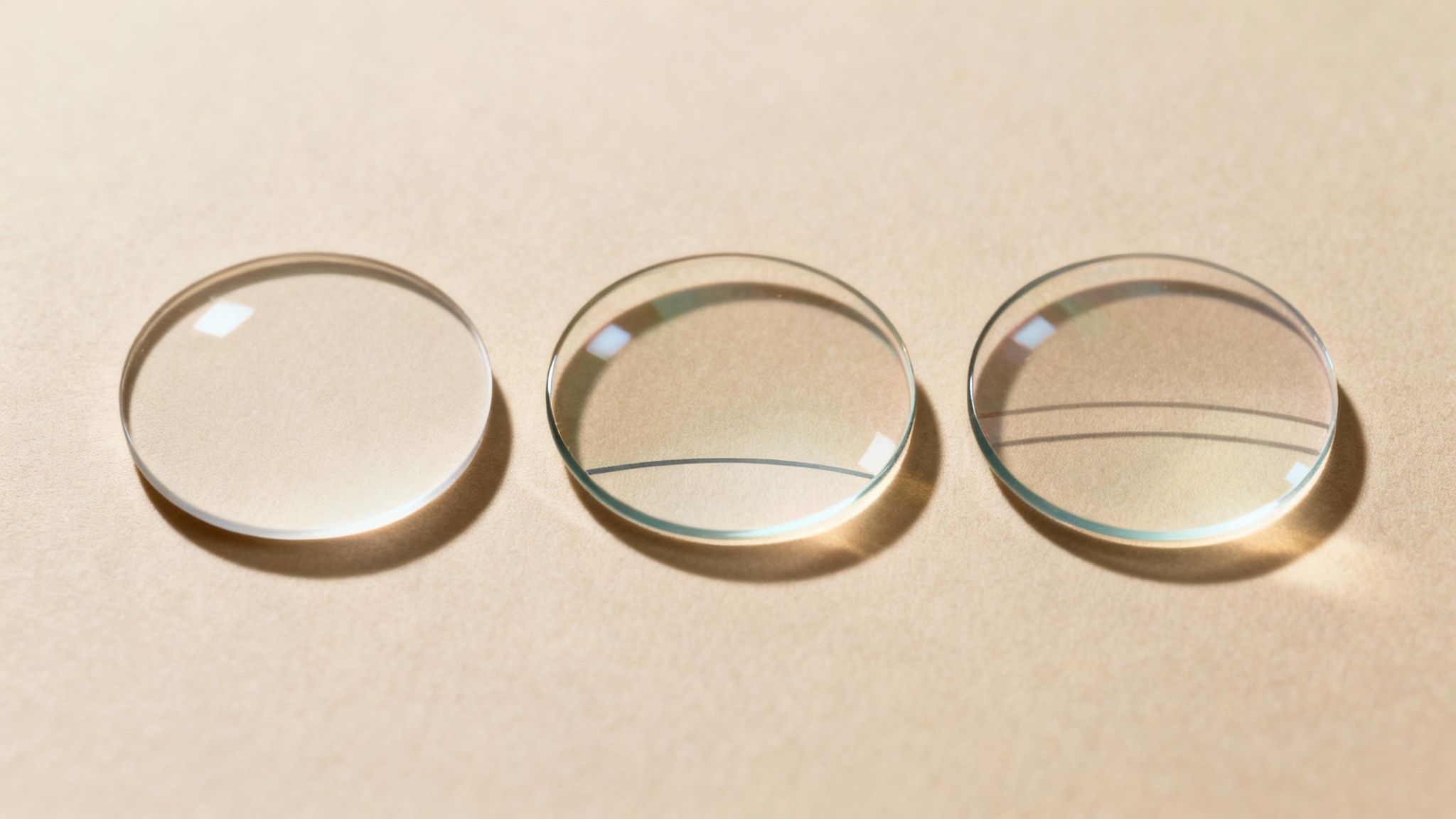
Let's start with the classic lens designs that have been helping people see clearly for decades. Each of these lens types is built for a specific job, and figuring out which one you need is the first step to finding your ideal eyewear.
Single Vision: The One-Job Specialist
The most common and straightforward lens is the single vision lens. Just think of it as a lens with one single focus. It's crafted to correct your vision at one specific distance—either up close, far away, or for intermediate tasks like computer work.
If you struggle to read street signs on Army Trail Road but can read a book just fine, a single vision lens is your fix. They have one consistent prescription across the entire surface to correct for common issues like nearsightedness (myopia) or farsightedness (hyperopia). For a closer look, you can learn more about how single vision lenses work in our dedicated guide.
Bifocals: The Power of Two Lenses in One
But what if you need help with both reading and driving? That’s where bifocal lenses step in. Picture a lens with a built-in "split-screen" for your vision.
Bifocals cleverly combine two different prescriptions into one lens. The top, larger part of the lens handles your distance vision, while a smaller, distinct segment at the bottom gives you the power you need for reading or other close-up activities. You can spot a bifocal by the visible line that separates these two zones.
A bifocal lens means you can stop juggling two pairs of glasses. It's a practical, all-in-one solution for anyone who needs correction for both near and distant vision.
That visible line and the "jump" in vision as your eye moves across it can take a little time to get used to. Still, for many of our Glendale Heights patients, the sheer convenience makes bifocals a fantastic and time-tested choice.
Trifocals: Adding That Crucial Middle Ground
Trifocal lenses are the next evolution, building on the bifocal design. As the name implies, they feature three distinct visual zones, each separated by a visible line on the lens.
This design essentially adds a dedicated "lane" for your intermediate vision, which is anything at about arm's length.
- Top Section: For distance vision, letting you see clearly across the room or down the street.
- Middle Section: For intermediate vision, which is perfect for computer screens or your car's dashboard.
- Bottom Section: For close-up vision, giving you the focus you need to read a book or send a text.
This multi-zone lens is a lifesaver for people who have developed presbyopia—the common age-related change that makes focusing up close more difficult—but who also need correction for their intermediate and distance vision.
Here at iDoctor, our job is to help you figure out which of these foundational lens types fits your life. Whether it’s a simple pair of single vision glasses or a more complex trifocal design, we’re focused on making sure you see your world with total clarity. During our detailed eye exams in Glendale Heights, we take the time to really understand your daily needs before we recommend the perfect lenses for your frames.
The Modern Advantage of Progressive Lenses
Think of progressive lenses as the elegant, modern upgrade to old-school bifocals. Instead of having that tell-tale line across the lens, progressives offer a completely seamless, invisible transition between different viewing distances. There are no sudden "jumps" in your vision.
The lens works like a smooth ramp, gradually shifting power from your distance prescription at the top, through an intermediate zone in the middle, all the way down to your reading power at the bottom. This gives you a much more natural visual experience and a clean, modern look. For our patients here in Glendale Heights, they're often the perfect blend of function and style.
How Do Progressive Lenses Actually Work?
It might sound complex, but the idea is simple. The lens is mapped out into three zones that flow into one another without any lines.
- The top portion is your "driving and walking around" zone, set for clear distance vision.
- The middle section is for intermediate distances, like looking at your computer screen or the car's dashboard.
- The bottom part is where your full reading power sits, perfect for books, menus, or your phone.
Your brain and eyes quickly learn to work together to find the right spot on the lens. You’ll naturally start pointing your nose toward what you want to see clearly, using small head movements to navigate the different zones.
Most people get the hang of it in a few days, and the payoff is huge. You get effortless, clear vision at every distance without ever having to swap out your glasses. It’s a real game-changer.
Who Benefits Most from Progressive Lenses?
Progressive lenses are the go-to solution for anyone with presbyopia, which is the completely normal, age-related change in near vision that usually starts around age 40. But honestly, they're a fantastic choice for anyone who needs correction for more than one distance and doesn't want to be bothered with multiple pairs of glasses.
At iDoctor, our expertise is in fitting these advanced lenses perfectly. We take incredibly precise measurements to make sure your new progressives are optimized for your eyes and your specific frames, whether you choose a bold Tom Ford or a timeless Oliver Peoples.
This lens is a perfect match for:
- Office Professionals: Move your focus from your monitor to paperwork to a colleague across the room without a hitch.
- Active Parents: You can watch the kids playing at East Branch Forest Preserve one moment and read a text message the next.
- Busy Multitaskers: Effortlessly go from driving down Bloomingdale Road to glancing at your GPS, all with the same pair of glasses.
The freedom from constantly taking glasses on and off is one of the biggest perks our patients rave about.
Getting Used to Your New Lenses
The secret to loving your progressive lenses is a perfect fitting. This isn't something you can eyeball; the visual zones have to be aligned exactly with your pupils. That’s why during our detailed eye exams in Glendale Heights, we take meticulous measurements to get this spot-on.
When you first start wearing them, the trick is to use small head movements. Instead of just darting your eyes side-to-side, you’ll learn to turn your head to find the "sweet spot" of the lens. It becomes second nature very quickly. For a deeper dive into making the adjustment period even smoother, check out our guide on how to use progressive lenses. A little bit of practice is all it takes to unlock a truly superior way of seeing.
How Lens Materials and Coatings Enhance Your Vision
Once we've figured out the right type of lens for your prescription, the next step is picking the material and coatings. A good way to think about it is this: your prescription is the software, the lens material is the hardware, and the coatings are the essential upgrades that protect your investment and boost performance. These choices make a huge difference in how clear, comfortable, and durable your glasses will be.
The world of optical lenses is constantly evolving. In fact, the global market was valued at $15.21 billion in 2023 and is expected to grow by 6.1% each year through 2033. This growth is fueled by incredible innovations that make lenses lighter, thinner, and more effective than ever. We're always keeping up with these advancements to bring you the best possible vision.
Choosing the Right Lens Material
The material your lens is made from impacts its weight, thickness, and how well it protects your eyes. Each option has its own distinct benefits, so the best choice really depends on your prescription and lifestyle. What works for a student at Glenbard West High School is going to be different from what a professional with a strong prescription needs.
Here’s a breakdown of the most common materials we recommend at iDoctor:
- Standard Plastic (CR-39): This is a tried-and-true classic. It's affordable, lightweight, and offers fantastic optical clarity, making it a great starting point for people with lower-strength prescriptions.
- Polycarbonate: Originally designed for things like astronaut helmet visors, this material is incredibly tough and impact-resistant. It’s our number-one recommendation for children’s glasses, safety eyewear, or anyone who leads an active life.
- High-Index Plastics: If you have a stronger prescription, high-index lenses are a game-changer. They bend light much more efficiently, which means your lenses can be significantly thinner and lighter. This not only makes them more comfortable but also looks much better in today's stylish designer frames.
This infographic shows how different zones in a progressive lens work together to give you clear vision at any distance. That seamless technology works even better when paired with a modern, lightweight lens material.
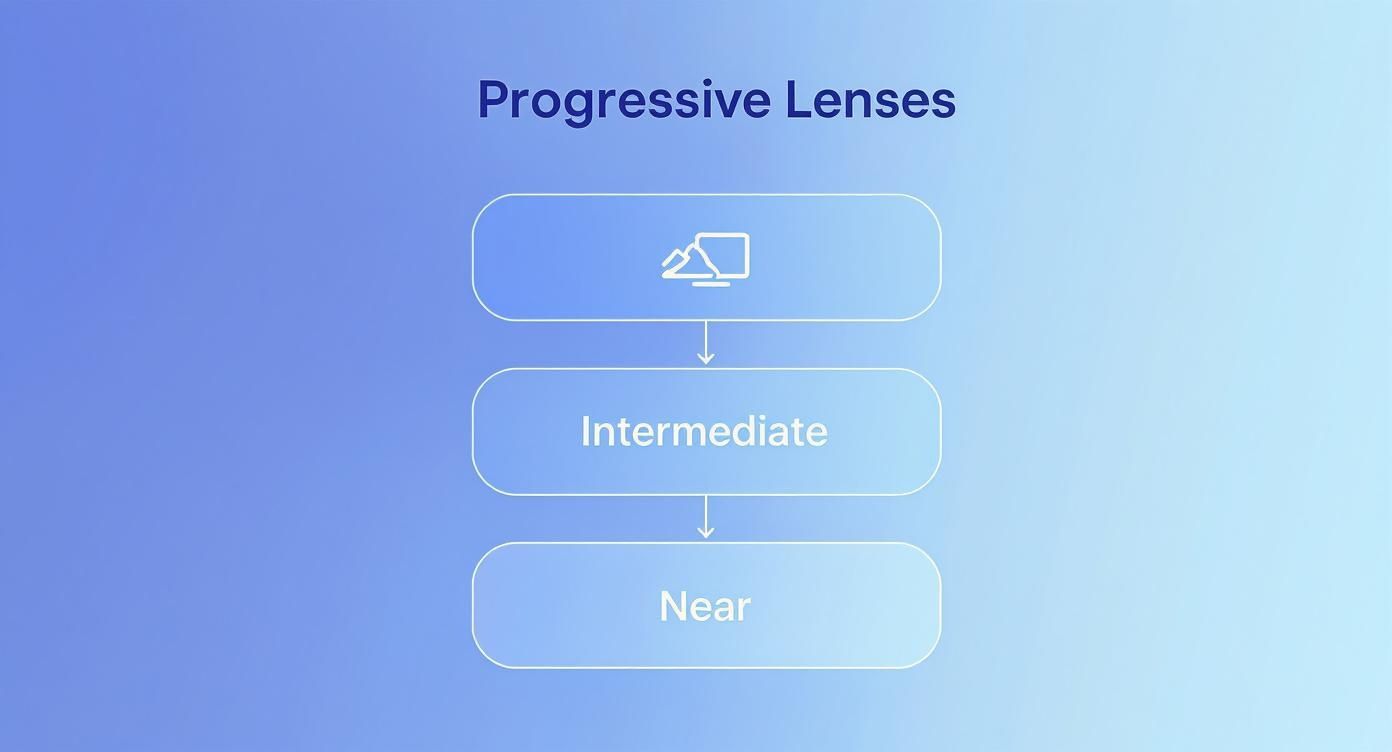
The smooth transition from looking far away to reading up close feels much more natural when the lens itself isn't heavy or bulky.
To make things even clearer, we've put together this quick comparison table. It's designed to help you see, at a glance, which material might be the best fit for you.
Comparing Eyeglass Lens Materials
| Material | Key Benefit | Best For | UV Protection |
|---|---|---|---|
| Standard Plastic (CR-39) | Excellent optical clarity & affordability | Mild to moderate prescriptions | Needs a separate UV coating |
| Polycarbonate | Superior impact resistance & lightweight | Kids, safety glasses, active lifestyles | Built-in 100% UV protection |
| High-Index Plastic | Thinnest & lightest option available | Strong prescriptions, aesthetic appeal | Built-in 100% UV protection |
Ultimately, our team will help you navigate these options based on your specific prescription and daily needs, ensuring you get the perfect combination of clarity and comfort.
Functional Coatings That Elevate Your Eyewear
Think of lens coatings as superpowers for your glasses. These are micro-thin layers applied to the lens surface to add crucial functionality, protecting both your eyes and your new eyewear. They are no longer a luxury—they’re an essential upgrade for modern life.
Anti-Reflective (AR) Coating
An anti-reflective coating is hands-down one of the most popular and beneficial additions you can make to your lenses. It works by cutting out the distracting reflections and glare you get from oncoming headlights, overhead office lights, and computer screens.
An AR coating makes your lenses look almost invisible, so people can see your eyes more clearly. Even better, it allows more light to reach your eyes, giving you sharper, crisper, and more comfortable vision day and night.
This reduction in glare can dramatically reduce eye strain and fatigue, especially if you work on a computer. To get the full picture, you can learn more about the benefits of anti-reflective lens coatings in our detailed article. It’s a must-have for anyone who drives on roads like Army Trail Road after dark.
Scratch-Resistant Coating
Let’s be honest—life happens. While no lens is completely scratch-proof, a scratch-resistant coating acts as a tough, protective shield. It helps defend your lenses against the minor drops, bumps, and accidental cleanings-with-a-t-shirt that are part of daily life. This coating is crucial for keeping your vision clear and extending the life of your glasses.
UV Protection
We all know to protect our skin from the sun, but our eyes need protection, too. A UV-protective coating is like sunscreen for your lenses. It blocks 100% of harmful UVA and UVB rays, which helps prevent long-term damage like cataracts and macular degeneration. This is a non-negotiable feature we include on every pair of glasses, because UV exposure can happen even on cloudy days.
Specialty Lenses Tailored to How You Live
Think of your basic prescription as the starting point. From there, we can add specialized lens technology to solve the specific visual frustrations you face every day. These aren't just minor upgrades; they're custom tools for your eyes, designed to make your world clearer, safer, and more comfortable.
Whether you're battling screen fatigue at the office or the blinding sun at Camera Park, there's a lens designed to help. Let's walk through some of the most popular and effective options we recommend at iDoctor, whether you're fitting them into a new pair of classic Ray-Bans or a show-stopping set of Cartier frames.
Lenses That Adapt to Your Environment
You've probably heard of photochromic lenses, most famously known by the brand name Transitions®. These are the "chameleon" lenses that intelligently darken when you step into UV sunlight and then fade back to perfectly clear when you come back inside.
It’s an incredibly practical two-in-one solution. You get your clear prescription glasses and your protective sunglasses all in a single pair, meaning you never have to fumble around switching frames again. For a deeper dive into how they work, check out our guide on the pros and cons of photochromic lenses.
Cutting Through the Glare with Polarized Lenses
If you spend any real time driving, fishing, or just being outdoors, polarized lenses are nothing short of a revelation. They are built with a special filter that does one thing exceptionally well: eliminate the harsh, blinding glare that bounces off flat surfaces like a wet road, a lake, or snow.
Picture yourself driving down North Avenue on a bright, sunny afternoon. That intense reflection off the cars ahead? Polarized lenses virtually wipe it out, making everything clearer and more comfortable.
It's not just about comfort—it's about safety. By cutting out that distracting glare, polarized lenses reduce eye strain and help you see details that would otherwise be lost in the brightness.
This technology makes colors appear richer and contrast sharper, revealing a view you just can't get with standard tinted lenses. We consider them essential for any quality pair of sunglasses, prescription or not.
Easing Eye Strain in a Digital World
Most of us spend hours a day staring at screens—computers, phones, tablets. It’s no wonder so many of us end the day with digital eye strain, complaining of tired, dry eyes, headaches, or blurry vision.
This is where blue-light filtering lenses come in. They feature a coating that specifically filters a portion of the high-energy blue light that pours out of our digital devices.
The benefits are very real for screen-heavy users:
- Less eye fatigue for more comfortable workdays.
- Sharper contrast on the screen, which can make text easier to read.
- Support for your natural sleep cycle, since blue light is known to interfere with melatonin.
If your job is tied to a computer or you unwind with an iPad at night, adding a blue-light filter to your eyeglasses in Glendale Heights is a simple, effective step to protect your eyes.
Looking ahead, lens technology continues to advance in exciting ways. The smart contact lenses market, for example, is an emerging field that integrates technology directly into the lens to monitor health or provide augmented reality. While still new, the broader contact lenses market is projected to grow steadily over the next decade. Find out more about the future of contact lens technology and market growth.
What About Contact Lenses? A Closer Look
If you're tired of frames, the world of contact lenses offers incredible freedom and options for nearly every prescription out there. It's a huge and growing part of vision care—the global market hit nearly $19.83 billion in 2023 and is on track to climb to $28.9 billion by 2035. That's a lot of people choosing contacts! You can read the full research on the expanding contact lens market to see just how popular they've become.
Here at iDoctor, we specialize in expert contact lenses in Glendale Heights. Our goal is simple: find the perfect match for your eyes, your prescription, and your daily life. Let’s break down the main options.
Soft Lenses vs. Rigid Gas Permeable (RGP) Lenses
When most people think of contacts, they’re picturing soft contact lenses. These are made from flexible, water-loving plastics called hydrogels that feel comfortable right out of the box. They gently drape over your cornea, which is why they’re a go-to choice for athletes, active people, and anyone trying contacts for the first time.
Then you have Rigid Gas Permeable (RGP) lenses. Don't let the old name "hard contacts" fool you; these are made from a modern, firm material that lets plenty of oxygen pass through to your eye. They take a little getting used to, but for some people—especially those with astigmatism—RGP lenses can deliver vision that's noticeably sharper and crisper than what soft lenses can offer.
Finding Your Perfect Wearing Schedule
With soft contacts, one of the biggest conversations we have with patients is about the replacement schedule. It all comes down to balancing convenience, hygiene, and budget.
- Daily Disposables: These are the gold standard for convenience and eye health. You pop in a fresh, sterile pair every morning and just toss them at night. No cleaning, no solutions, no fuss. This is a fantastic way to minimize the risk of eye infections.
- Bi-Weekly and Monthly Lenses: These lenses are designed to be worn for two weeks or a full month. You'll need to clean and store them properly each night, but they can be a more economical option for full-time wearers.
The right schedule is all about what fits your life. If you only wear contacts for sports or special occasions, dailies are perfect. If you wear them all day, every day, a monthly lens might make more sense. We’ll figure it out together.
Specialized Contacts for Trickier Prescriptions
Think you can't wear contacts? Think again. Lens technology has come a long way, and we can now fit prescriptions that used to be glasses-only.
Toric Lenses for Astigmatism
Astigmatism is just a word for an eye that's shaped more like a football than a baseball. This irregular curve requires a special fix. Toric lenses are designed with different powers across the lens to correct that specific shape, giving you clear, stable vision that doesn't rotate or blur.
Multifocal Lenses for Presbyopia
Just like progressive eyeglasses, multifocal contact lenses give you clear vision at every distance—up close for reading, far away for driving, and everything in between. They have different prescription zones built right in, so you can ditch the reading glasses. For a deeper dive, check out our guide to prescription contact lenses.
Our best optometrist in Glendale Heights is an expert in fitting these advanced lenses, so you never have to compromise on comfort or clarity.
Your Lens Questions Answered
It's completely normal to have a few questions when you're trying to decide on the right lenses. Here at iDoctor, we hear a lot of the same great questions from our patients in Glendale Heights, so we've put together some clear, straightforward answers for you.
How do I choose between all the different types of lenses?
The best way is to start with a conversation about your lifestyle. During a detailed eye exam in Glendale Heights, we discuss your daily activities—from your work on the computer to your commute down Army Trail Road. This helps us recommend the perfect lens technology for your unique needs.
Will my vision insurance cover specialty lenses?
Yes, most likely! iDoctor proudly accepts all major vision insurance plans. While coverage for specific upgrades like high-index material or anti-reflective coatings varies by plan, our team will verify your benefits and explain everything clearly, ensuring you get the most value.
Can I get designer eyeglasses in Glendale Heights at iDoctor?
Absolutely. We offer a curated selection of luxury and designer eyewear from top brands like Cartier, Gucci, Tom Ford, Oliver Peoples, Fendi, and Prada. We also have affordable, stylish options from Ray-Ban, Coach, and Kate Spade. Our team excels at fitting the most advanced lenses into these beautiful frames.
I have a strong prescription. What are the best lenses for me?
For stronger prescriptions, we almost always recommend high-index lenses. They are made from a special material that bends light more efficiently, allowing them to be significantly thinner and lighter than standard lenses. This gives you a more comfortable and aesthetically pleasing result, eliminating the thick "coke bottle" look.
Ready to find the perfect lenses for your lifestyle? The expert team at iDoctor is here to guide you through every option. As the premier eye doctor in Glendale Heights, we are committed to helping you see the world more clearly. Schedule your personalized consultation today.