The real difference between trifocals and progressives boils down to their design. Trifocals have visible lines that create three distinct zones for seeing, while progressives offer a smooth, no-line transition between different powers. The best choice for you really depends on whether you prefer the clearly defined viewing areas of a trifocal or the clean, modern look of a progressive lens. If you live or work in the Glendale Heights area, understanding this choice is the first step toward clear, comfortable vision.
Making the Right Choice for Your Vision in Glendale Heights
Choosing the right multifocal lenses can feel like a big decision, especially when all you want to do is read a menu at a local spot like La Campana or see your phone without squinting. For many of our neighbors here in Glendale Heights, the arrival of presbyopia—that natural, age-related change in our near vision—makes this choice a critical one. It affects everything from driving safely down Army Trail Road to simply working on a computer at home.
At iDoctor, your high-end optometry boutique in Glendale Heights, we walk patients through this exact choice every single day. The first step is to really understand the differences in how each lens works and looks, so you can find the perfect fit for your lifestyle.
A Quick Comparison
To make things a little easier, let's look at a side-by-side comparison of these two popular lenses. Each one is designed to correct your vision for near, intermediate, and far distances, but they go about it in very different ways.
This quick overview should highlight the main trade-offs you'll be considering: defined viewing zones versus a seamless visual field.
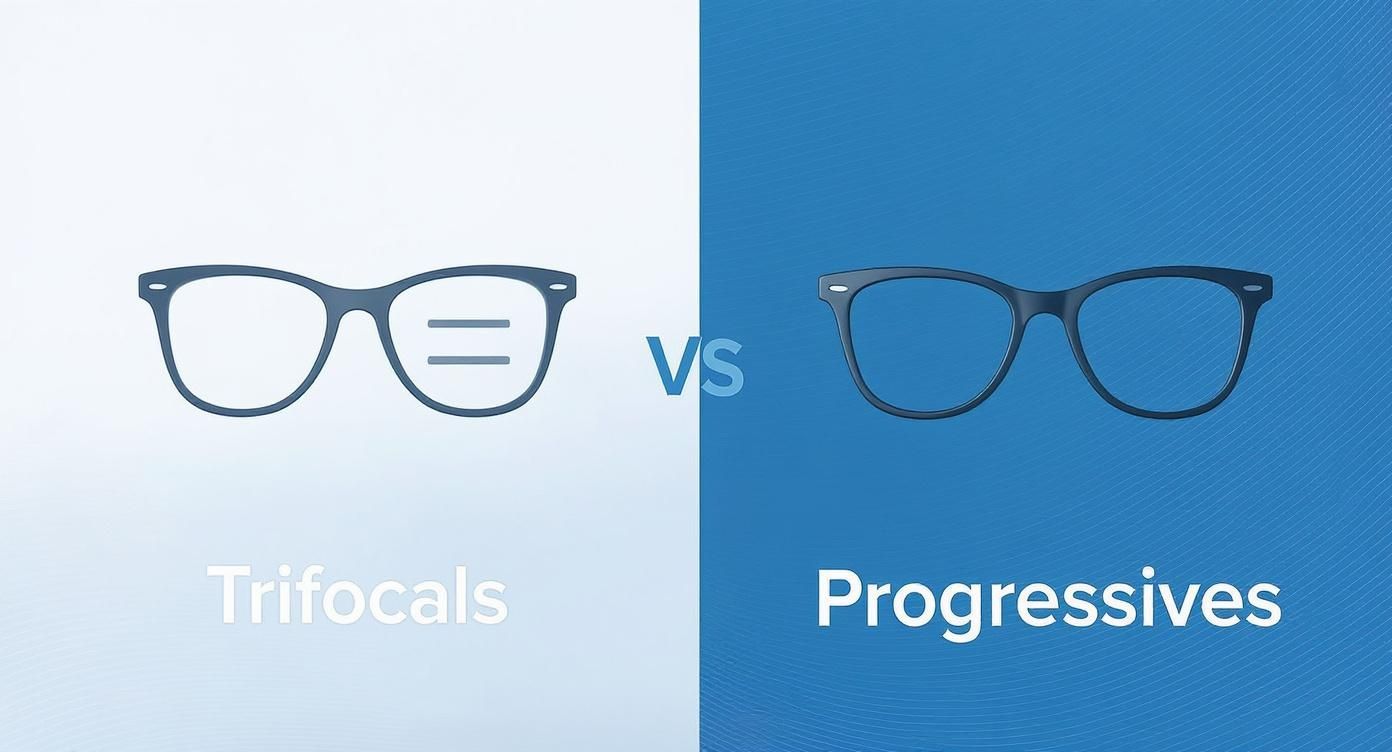
As you can see, both lens types solve the problem of needing multiple prescriptions, but their approach to aesthetics and how you experience the visual transitions is worlds apart. Your personal preference for style and function is what will ultimately lead you to the right choice.
Quick Comparison: Trifocal vs Progressive Lenses
To help guide your decision, here’s a summary of the key distinctions between trifocal and progressive lenses in a simple, side-by-side format.
| Feature | Trifocal Lenses | Progressive Lenses |
|---|---|---|
| Appearance | Obvious, visible lines separate three distinct viewing zones. | Completely seamless with no visible lines, offering a modern look. |
| Visual Transition | An abrupt "image jump" can occur when your eyes move between zones. | A smooth, gradual shift in focus as you look from far to near. |
| Adaptation Period | Generally easier for many to adapt to due to the clearly defined zones. | Can take longer to get used to because of peripheral distortion. |
| Intermediate Vision | Features a dedicated, wide zone that's great for computer work. | Has a narrower intermediate "corridor" that requires more head movement. |
| Best For | People who prefer distinct visual fields and a more budget-friendly option. | Those who prioritize aesthetics and a more natural-feeling visual experience. |
Ultimately, this table shows the core trade-off: trifocals offer wide, distinct fields of vision at the cost of visible lines, while progressives provide a cosmetically appealing, seamless look that may require more adaptation.
How Trifocal and Progressive Lenses Actually Work
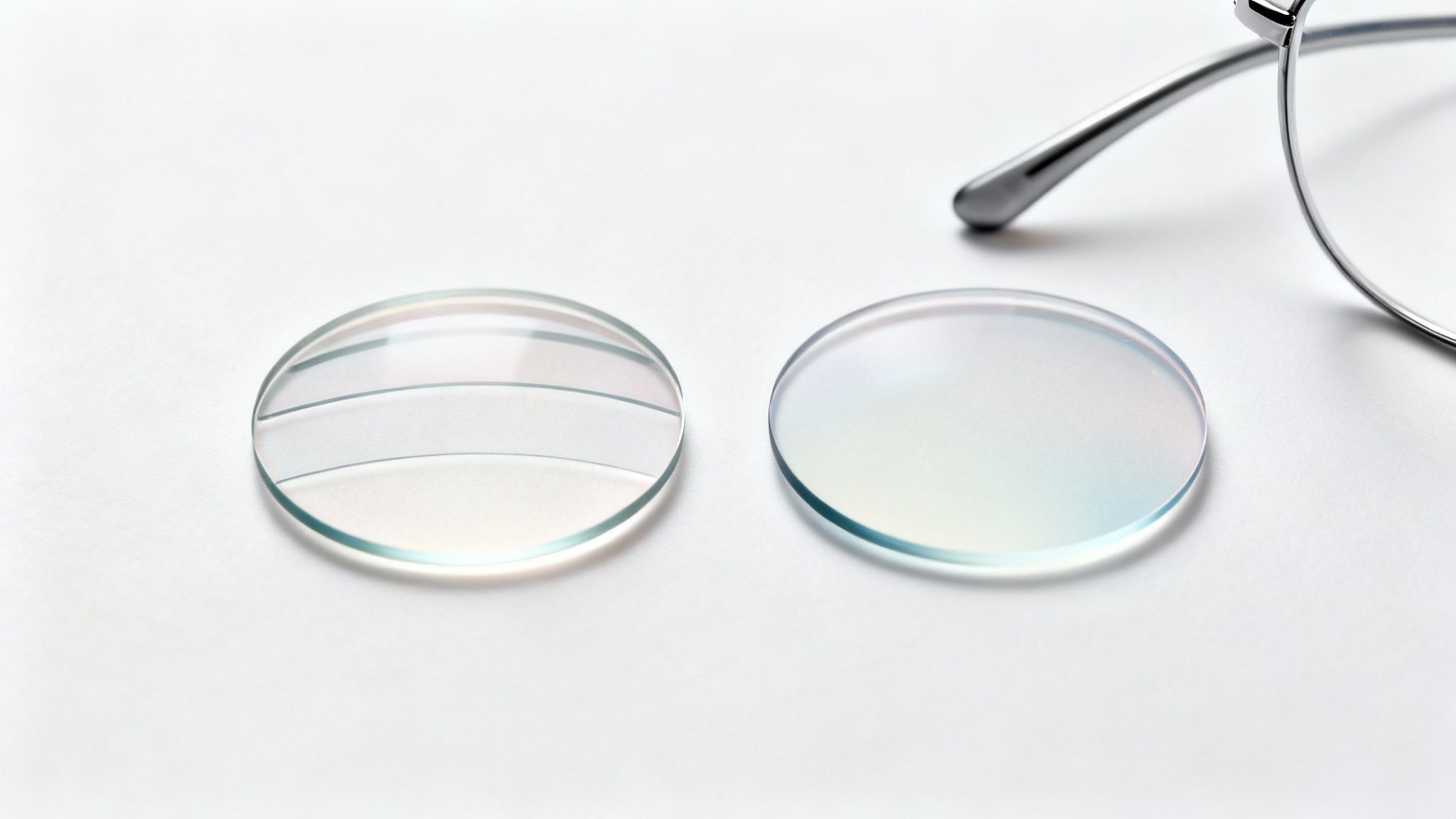
When we talk about trifocals versus progressives, it's best to start with how each lens is engineered. Imagine a staircase versus a ramp—both get you from one level to another, but the journey feels completely different. That's a great way to think about these two lenses, both of which are designed to solve presbyopia, the natural change in our eyes that makes close-up focus a challenge.
Both lens types correct for three primary distances: far away (like driving), intermediate (your computer screen), and near (reading a book). The real difference lies in how they package those powers into a single lens.
The Structured Design of Trifocal Lenses
Trifocal lenses are built with three distinct, visible segments. Think of them as having dedicated zones for specific tasks. It's a very direct and functional approach.
- Distance Vision: The largest section, at the top of the lens, is for seeing clearly at a distance—think of reading street signs while driving down Bloomingdale Road.
- Intermediate Vision: In the middle, there's a smaller, ribbon-shaped segment. This part is specifically for tasks at arm's length, like looking at your computer or the car's dashboard.
- Near Vision: The bottom segment has the strongest power for all your close-up work, from reading a menu to texting on your phone.
The catch is that these zones are separated by visible lines. To change focus, your eye physically has to jump over a line from one segment to the next. This can cause a phenomenon called “image jump,” where an object seems to abruptly shift as your gaze moves. Some wearers don't mind the clear-cut zones, but for others, that jump is a constant distraction.
The Seamless Transition of Progressive Lenses
Progressive lenses take a completely different route. Instead of sharp, visible lines, they feature a smooth and gradual power transition from the top of the lens down to the bottom.
This line-free design delivers a much more natural-feeling visual experience. As your gaze moves downward, the lens power increases seamlessly, letting you shift focus from a distant TV screen to your laptop, then down to a book without any abrupt changes. This also gives them the clean, modern look of regular single-vision glasses.
The key takeaway is that progressive lenses offer a seamless gradient of power, which eliminates the image jump found in trifocals. However, this advanced design introduces subtle distortions in the peripheral (side) areas of the lens.
These peripheral distortions can create a "swim" effect, and it’s the main reason progressives come with an adaptation period. Your brain has to learn to ignore the blur on the edges and aim your gaze through the clearest part of the lens—what we call the central corridor. We cover this in-depth in our guide on how progressive lenses offer seamless vision correction.
Ultimately, the choice comes down to a trade-off. Trifocals offer wide, dedicated fields of view with a predictable structure. Progressives, on the other hand, prioritize a seamless and cosmetically clean appearance, but that comes at the cost of narrower viewing corridors and some peripheral blur.
Aesthetics and Style for Your Eyewear
Let's be honest, your glasses are more than just a tool to see clearly—they're a fashion statement. They sit front and center on your face every day, so the type of lens you choose plays a huge role in your overall look and how confident you feel wearing them.
When it comes to trifocals versus progressives, the most obvious cosmetic difference is the lines. Trifocal lenses have two distinct, horizontal lines that carve the lens into its three viewing zones. While they get the job done, many people feel these lines give off a dated vibe.
The Modern, Seamless Look of Progressives
Progressive lenses, on the other hand, are designed to be completely seamless. There are no lines, period. They look just like a standard pair of single-vision glasses, giving you a clean, modern, and more youthful appearance.
This line-free look is a major reason why so many of our clients at iDoctor choose progressives, especially for their designer frames. When you've invested in a sophisticated pair of Tom Ford or Cartier frames, the last thing you want is a pair of visible lines distracting from the style.
The biggest cosmetic draw for progressives is simple: no lines. This not only enhances the style of your frames but also eliminates the distracting "image jump" you get with trifocals, making for a much smoother visual experience.
How Lenses Impact Your Frame Choices
The sleek design of progressive lenses also opens up your options for frames. Because trifocals need enough vertical space to fit all three segments, they can limit you to larger frames. Progressives are much more flexible, working well with a wider variety of shapes and sizes.
This means you can choose a frame that truly fits your personality without compromise. If you're looking for inspiration, our guide on the different types of spectacles frames is a great place to start.
It's no surprise that this blend of function and fashion has made progressives incredibly popular. The global market for progressive lenses was valued at around USD 6.54 billion in 2024 and is expected to nearly double by 2032. That kind of growth shows a clear preference for eyewear that looks as good as it performs.
At the end of the day, if a sleek, contemporary look is important to you, the line-free design of progressive lenses makes them the hands-down winner.
Getting Used to Your New Lenses
Getting the hang of new multifocal lenses is a bit like breaking in a new pair of shoes—it takes a little time for things to feel just right. Whether you choose trifocals or progressives, your brain has to learn a new way of seeing the world. Knowing what's coming can make all the difference.
For trifocal wearers, the learning curve is all about navigating those three distinct zones. The visible lines are your roadmap, which some people appreciate, but they also create an abrupt "image jump" when you shift your gaze. It can feel a bit jarring until your brain learns to anticipate it.
Progressives present a different kind of challenge. Without any lines, the transition is smooth, but the trade-off is some peripheral distortion at the edges of the lenses. Many people describe this as a "swim" effect, where your side vision can seem a little wavy or blurred at first.
It's All About Brain Training
No matter which lens you choose, consistency is king. Your brain is incredibly good at adapting, but it needs time and repetition to build new visual habits and learn to ignore the initial quirks of your new glasses.
The single best thing you can do is commit to wearing your new glasses full-time. Resist the temptation to switch back to your old pair—that just confuses your brain and drags out the adjustment period. Give it at least a solid week or two.
If you’re wearing progressives, here’s a pro tip: point your nose where you want to look. Instead of just flicking your eyes to the side, make a habit of turning your head. This keeps your line of sight within the clearest part of the lens, known as the "corridor," and dramatically cuts down on that swimmy feeling.
Your Day-by-Day Adjustment Guide
So, what should you really expect? Here’s a typical timeline for getting comfortable with either lens style:
- First Few Days: It's totally normal to feel a bit "off." You might experience some mild headaches or eye strain as your brain works overtime to process the new visual information.
- End of the First Week: Things should start to click. With trifocals, you'll find yourself glancing through the right segment without even thinking about it. With progressives, the swim effect will seem much less pronounced as you instinctively use the central corridor.
- After Two Weeks: Most people find their vision feels natural and comfortable by this point. If you’re still having trouble after two weeks, don't just suffer through it. Come see us. A quick frame adjustment at iDoctor is often all it takes to solve the problem.
Which Lens Fits Your Daily Life?
Choosing between trifocals and progressives comes down to a very personal question: how do you spend your day? The right lens isn't about which technology is "better," but which one seamlessly integrates into your routine, whether you're navigating Glendale Heights traffic, staring at a computer, or just enjoying a good book.
The real fork in the road is the intermediate zone. This is the vision you use for tasks at arm's length—think your computer screen, your car's dashboard, or even the food on your dinner plate. How you access that zone is what truly separates these two lens types.
Performance at the Computer
If you spend a significant chunk of your day in front of a monitor, your intermediate vision is non-negotiable. It's the key to avoiding digital eye strain, and your lens choice plays a huge role.
-
Trifocal Lenses: The big win for trifocals here is their wide, dedicated intermediate segment. This gives you a generous, stable field of view for your monitor, so you can see the whole screen with very little head movement. Of course, the trade-off is that you'll always have those visible lines.
-
Progressive Lenses: With progressives, the intermediate power is found in a narrower channel that flows between the distance and near zones. While the transition is beautifully seamless, it means you have to point your nose where you want to look. You might find yourself moving your head side-to-side more often to scan a large screen.
For people whose work is mostly stationary at a desk, that wide, clear intermediate zone in a trifocal can be a game-changer for comfort.
Driving and Being on the Move
When you're behind the wheel, you need clear vision at every distance, and you need it fast. Driving on busy roads like Army Trail Road or North Avenue demands quick glances from the road ahead to your dashboard and back again.
This is where progressive lenses often pull ahead. The line-free design offers a much more natural, intuitive experience. Your eyes can move smoothly from the road (distance) to your speedometer (intermediate) without the disorienting "image jump" that can happen with segmented lenses.
Trifocals are perfectly safe for driving, but those lines can take some getting used to. Some people find the abrupt power shifts distracting, especially when making quick checks of their mirrors or GPS.
The seamless transitions in progressive lenses make them a favorite for anyone with an active lifestyle. They provide more fluid, natural vision for moving around, socializing, or enjoying hobbies that require constant focus changes.
The Clear Trend in Eyewear
Over the last decade or so, the choice has become pretty clear for most people. We've seen a massive shift in preference, driven by both aesthetics and function. In fact, a recent survey of eyecare retailers found that 66% saw a jump in sales for custom progressive lenses, while about half reported a drop in bifocal and trifocal sales. You can discover more insights about these lens sales trends to see just how much things have changed.
This data lines up with what we see every day in our Glendale Heights boutique. More and more of our clients are drawn to the modern, no-line look that perfectly complements designer frames from brands like Gucci and Prada. For most, the combination of a clean appearance and natural visual flow makes progressives the obvious choice for a dynamic, modern life.
The Importance of an Expert Fitting
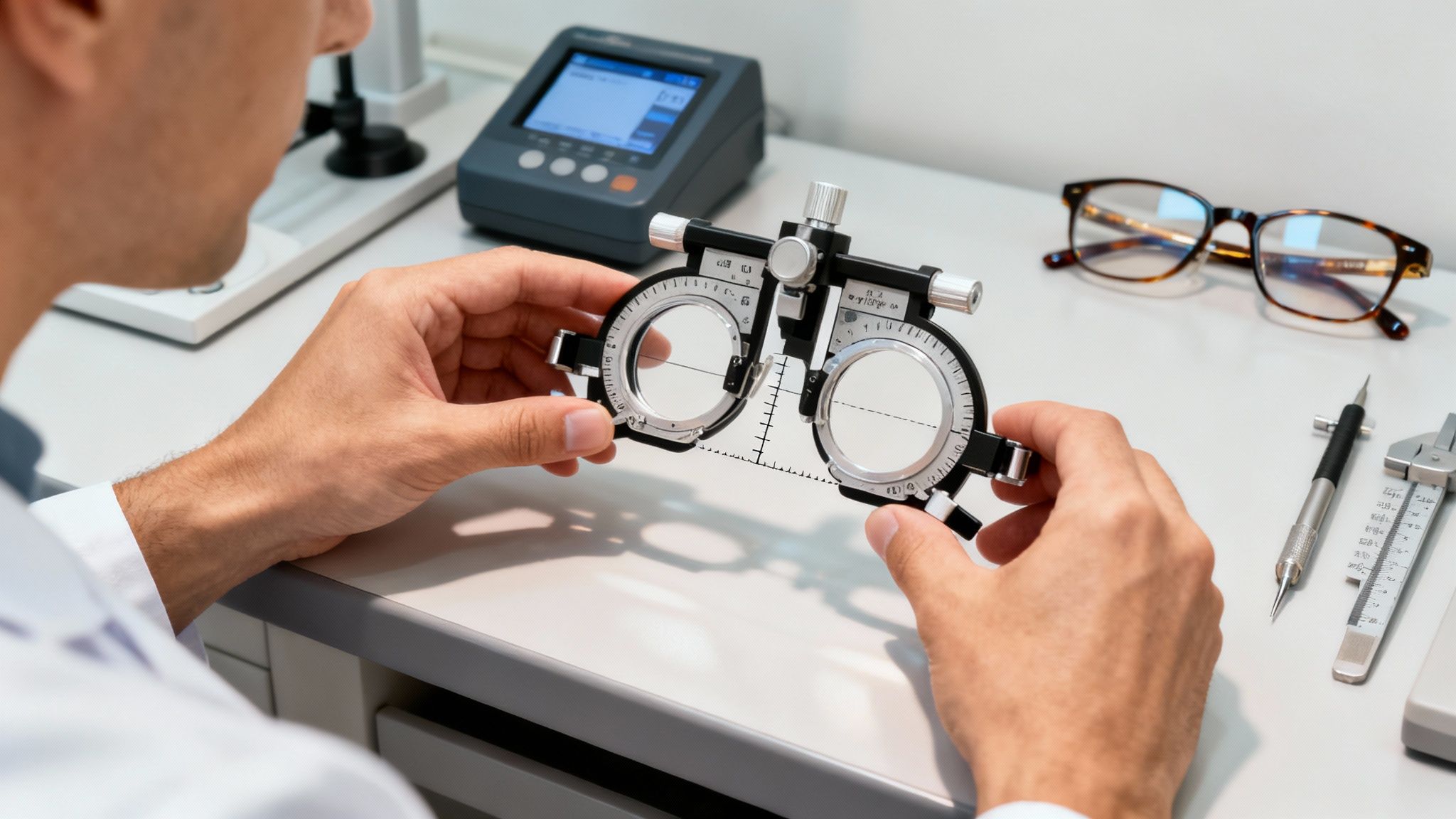
It doesn't matter if you land on trifocals or progressives—the magic is in the fitting. You can have the most advanced lens technology in the world, but if the measurements are off, you won't get the clear, comfortable vision you paid for.
This is especially true with multifocal lenses, where a tiny error has a massive impact. We're talking about a lens that's off by just a millimeter causing eye strain, headaches, and blurriness across your different viewing zones.
Precision Is Paramount
At iDoctor, we know that a great pair of glasses starts long before the lenses are cut. Our detailed eye exams in Glendale Heights are designed to capture every critical piece of data needed to make your lenses perfect for you.
We dial in on several key measurements:
- Pupillary Distance (PD): This is the exact distance between the centers of your pupils. Getting this right ensures the optical sweet spot of the lens is perfectly aligned with your eye, giving you the sharpest view.
- Segment Height: This measurement dictates where the viewing zones sit in your frames. For both trifocals and progressives, it has to be spot-on so you can shift your gaze between distances without a thought.
- Corridor Length: This is unique to progressives and controls how gradually the lens power shifts from top to bottom. We match this to your specific frame and how you use your eyes every day.
An expert fitting is the final, essential step in turning an advanced lens design into a tool for effortless, comfortable vision. Without precise measurements, even the most expensive lenses will underperform.
The Right Frame for the Right Lens
The frame you pick is more than just a style choice; it's a critical part of the lens's performance. For instance, some of today’s trendy frames with a short vertical height simply don't have enough room for a multifocal lens to work properly.
Our expert opticians in Glendale Heights will guide you through our curated collection of designer eyewear, including sought-after brands like Cartier and Oliver Peoples. We’ll help you find a style that not only looks incredible but also gives your lenses the real estate they need to function flawlessly.
We make sure your new glasses deliver on both style and substance. You can dive deeper into the benefits of custom eyewear measurements in our detailed article. Ultimately, our goal is to create a completely customized solution that feels like it was made just for you, from the moment your exam begins to the final fitting.
Frequently Asked Questions
Here are the answers to a few common questions we hear from our patients at our Glendale Heights boutique.
Are progressives better than trifocals for driving?
Many drivers in the Glendale Heights area prefer progressive lenses. Their line-free design allows for a smoother, more natural transition when your eyes move from the road ahead (distance) to your dashboard or GPS (intermediate). This eliminates the distracting "image jump" that can occur with lined trifocals.
Which lens is better for my designer frames?
For luxury frames from brands like Cartier, Gucci, or Tom Ford, progressive lenses are almost always the preferred choice. Their seamless, no-line appearance preserves the clean aesthetic of the frame design, giving you a modern and sophisticated look. Trifocal lines can detract from the style of high-end eyewear.
Does iDoctor accept vision insurance for these lenses?
Yes, absolutely. At iDoctor, we want premium vision to be accessible. We accept all major vision insurance plans to help cover the cost of your eye exam, frames, and your choice of trifocal or progressive lenses. Our team can help you understand and maximize your benefits.
Ready to find the perfect lenses for your lifestyle? At iDoctor, your independent optometry boutique in Glendale Heights, we pair comprehensive eye exams with a hand-picked selection of designer eyewear to create a solution that’s truly yours. From helping you see clearly at the Glendale Heights Arts Festival to ensuring you have the perfect eyewear for driving down North Avenue, we're here for all your vision needs. Schedule your appointment today and see what a difference an expert fitting makes.