It's a sinking feeling every glasses-wearer in Glendale Heights knows. You clean your lenses, hold them up to the light, and there it is—a scratch, right in your line of sight. It’s maddening, especially when you need clear vision for your commute on Army Trail Road or a walk through East Branch Forest Preserve.
Let’s get one thing straight: you can't truly repair a scratched lens at home. Once the lens material or its delicate coatings are damaged, that's permanent. However, some DIY tricks claim to hide or fill in the tiniest surface-level scuffs, but they're temporary at best and often cause more harm than good.
Why a "Simple" Scratch is a Big Deal
For anyone in Glendale Heights, clear vision is a must-have, whether you're navigating traffic on Bloomingdale Road or enjoying a day out at Camera Park. That scratch on your glasses isn't just a cosmetic issue; it actively messes with your vision and comfort.
Think of it this way: a pristine lens focuses light perfectly onto your retina. But when a scratch is present, it acts like a tiny prism, scattering and distorting that light before it ever reaches your eye. Your brain gets a fuzzy, distorted signal, and that's where the real problems begin.
How Scratches Affect Your Daily Life
That one little mark can set off a chain reaction of issues that follow you all day long. The most common complaints we hear from our Glendale Heights clients are:
- Glare and Visual "Noise": Scratches bend light in all the wrong ways. This creates annoying glare, halos around headlights at night, and blurry patches that float in your vision. It's especially bad when you're driving after dark or sitting under fluorescent office lights.
- Constant Eye Strain: Your eyes are amazing, and they'll work overtime trying to focus through the damaged part of the lens. This constant effort leads to tired, sore, and sometimes watery or dry eyes by the afternoon.
- Nagging Headaches: That relentless strain on your eye muscles is a classic trigger for tension headaches. If you've been getting headaches for no apparent reason, take a close look at your glasses. The culprit might be staring right back at you.
A deep scratch does more than just blur your vision. It can compromise the lens's structure and scrape away critical protective coatings, like your UV protection or anti-reflective layer. Suddenly, your eyes are less protected, and your expensive lenses are even more susceptible to damage.
The Importance of Getting an Expert Opinion
I know how tempting it is to look for a quick home remedy, but understanding the real damage is the first step. Here at iDoctor, a boutique optometry practice in Glendale Heights, we can take a proper look at your eyewear and assess the scratch.
We help our neighbors figure out if a minor scuff is manageable or if replacing the lens is the only safe and effective way to get your crystal-clear vision back. It all starts with protecting your lenses, and we're here to help you make the right call.
How to Assess Scratches on Your Lenses
Before you even think about trying a DIY scratch repair on your glasses, you need to play detective for a minute. Not all scratches are the same, and trying the wrong "fix" can turn a small scuff into a ruined lens, especially if you're dealing with premium frames from brands like Gucci or Cartier. A good, honest look is always the first step.
The best way to do this is to hold your glasses up to a bright light source—a sunny window or a desk lamp works perfectly. Tilt them back and forth, letting the light catch every part of the lens surface. This simple trick reveals the true extent of the damage, helping you see the difference between a faint surface mark and a deep, vision-distorting gouge.
Differentiating Minor Scuffs from Deep Gouges
A minor surface scuff usually just looks like a faint, hazy line. You might only notice it from a specific angle, and it probably doesn’t really get in the way of your vision. These types of scratches are often just in the lens's outer protective coating. Honestly, these are the only ones you might be able to temporarily hide with an at-home method.
A deep gouge, on the other hand, is a whole different beast. You can actually feel it when you gently run your fingernail across the lens. That's a serious scratch. It has cut through the protective coatings and dug into the lens material itself, which is what causes that annoying distortion and glare. No DIY trick is going to fix this, and trying one will almost certainly make things worse.
This decision tree shows how even a small scratch can lead to distorted light, which triggers eye strain and headaches.
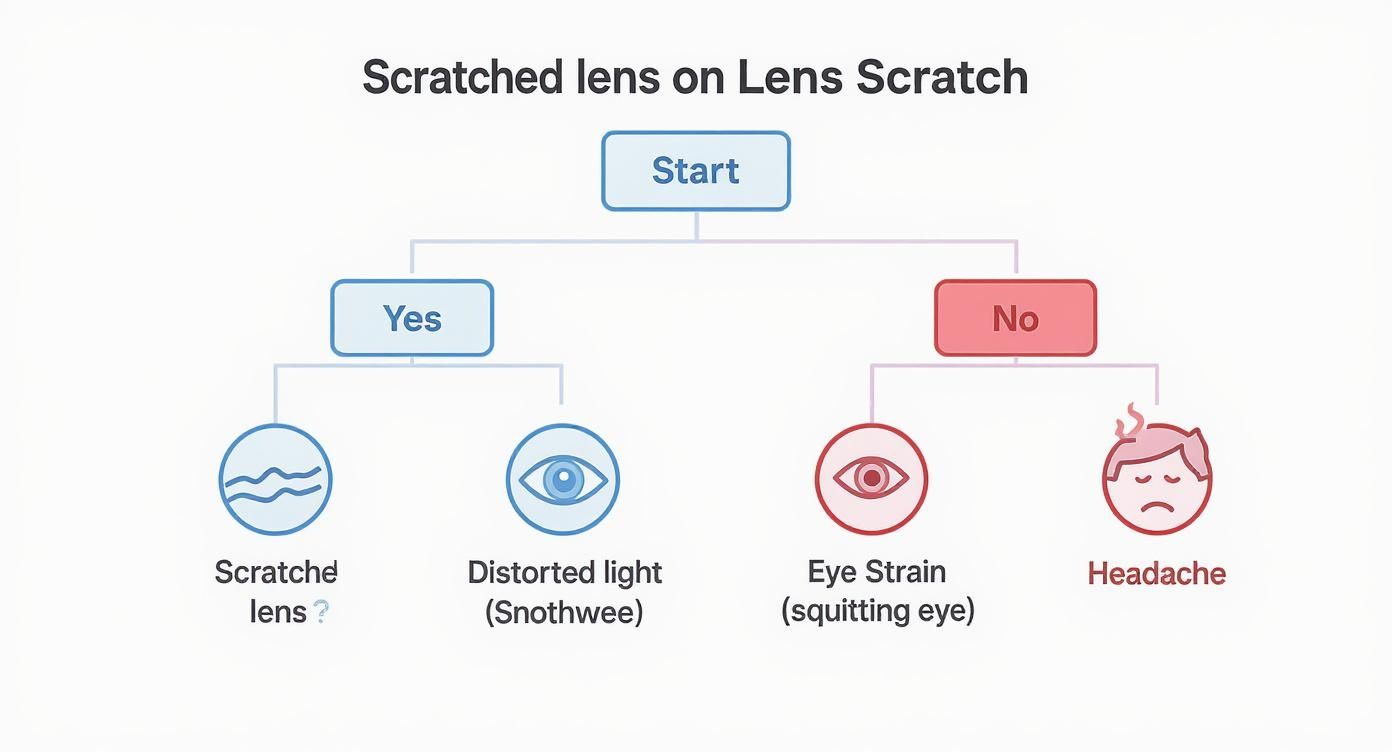
As you can see, the visual disruption from a scratch makes your eyes work overtime, which can lead straight to physical discomfort like headaches.
Identifying Your Lens Material and Coatings
Next up, you have to know what your lenses are made of. Different materials and coatings react very differently to the abrasive stuff found in many popular DIY "hacks."
- Plastic (CR-39): These are pretty common and lightweight, but they also tend to scratch more easily than other materials.
- Polycarbonate Lenses: Known for being tough and impact-resistant, but the material itself is relatively soft. Without a good protective coating, they can get scratched up. You can learn all about the pros and cons of polycarbonate eyeglass lenses in our detailed guide.
- High-Index Lenses: These are the go-to for strong prescriptions because they're thinner and lighter, but they absolutely rely on strong coatings for protection.
- Glass Lenses: You don't see them as often anymore, but they offer fantastic scratch resistance. The trade-off is that they're heavier and can shatter.
Pro Tip: Most modern glasses have special coatings. To check, hold your lenses up to the light again and look for a faint colored sheen, usually blue, green, or purple. That's a sign of an anti-reflective coating. These coatings are incredibly delicate and can be completely stripped off by harsh chemicals or abrasive pastes.
Knowing these details helps you make a smart call. If you're looking at a deep scratch, have coated lenses, or just feel unsure, the safest bet is to talk to a professional. Bringing your glasses to an expert eye doctor in Glendale Heights like us here at iDoctor guarantees you get the right assessment and avoid a costly mistake.
The Truth About DIY Scratch Repair Methods
A quick search for "how to fix scratched glasses" opens a Pandora's box of home remedies. You'll find everything from baking soda pastes and non-gel toothpaste to more questionable suggestions like car wax and furniture polish. But here's the million-dollar question: do any of them actually work? Let's take a hard, honest look.
The logic behind most of these "hacks" seems plausible at first glance. They either use a mild abrasive to grind down the surface around the scratch, or a waxy filler to temporarily cover it up. The goal is to make the lens surface feel smooth again, making the scuff less obvious. Unfortunately, the reality is far more complicated and fraught with risk.
Your eyeglass lenses aren't just simple pieces of plastic or glass. They're sophisticated pieces of optical engineering, almost always layered with delicate, microscopically thin coatings for anti-reflection, UV protection, and scratch resistance. These coatings are absolutely essential for clear, comfortable vision.
Why Most DIY Fixes End Up Causing More Harm
When you take an abrasive like toothpaste and start rubbing it on your lenses, you're not just working on the scratch. You're aggressively scrubbing away those critical coatings. This almost always results in a permanent, hazy cloud of thousands of new micro-scratches.
So, instead of fixing a single scratch, you've just created a much bigger, irreversible problem. The lens is now more prone to glare, offers less UV protection, and is set up to get scratched even more easily down the road.
Crucial Takeaway: DIY scratch repair methods don't actually remove scratches. At best, they're a temporary cosmetic trick that fills in a tiny scuff. More often, they cause permanent damage to your lens coatings, leaving you with worse vision than you started with.
There's a reason the market for high-quality plastic lenses was valued at around USD 1.535 billion globally in 2024. These lenses are precisely engineered with advanced coatings that a home remedy can obliterate in seconds. You can read more about the growth of the plastic eyeglass lens market and the technology involved.
DIY Repair Methods: A Risk-Benefit Analysis
Before you even think about trying a home remedy, it’s critical to weigh the potential reward against the very real risks. Most of these "fixes" are incredibly destructive to modern lenses with anti-reflective or other specialized coatings. Below is a quick breakdown of what you're actually getting into.
| DIY Method | Claimed Benefit | Potential Risk | Recommended For |
|---|---|---|---|
| Baking Soda Paste | Mildly abrasive paste buffs the surface to reduce scratch appearance. | Extremely likely to strip anti-reflective and UV coatings, creating a permanent cloudy haze. | Never recommended for coated prescription lenses. |
| Non-Gel Toothpaste | Grinds down the lens surface to "level" it with the scratch. | Removes all functional coatings in the treated area, leading to glare and future damage. | Never recommended for coated prescription lenses. |
| Car Wax / Furniture Polish | Fills in the scratch groove to make it temporarily invisible. | Leaves an oily, smudgy residue that impairs vision. The effect wears off very quickly. | Never recommended for any type of eyewear. |
As you can see, the theme here is that the risk far outweighs any potential benefit.
A Sober Look at Common Household "Remedies"
If you're still tempted to try a home fix for a very minor, superficial scuff on an old pair of uncoated glasses, it’s vital to understand the likely outcome.
Here’s a more detailed look at what to expect from the most common suggestions:
- Baking Soda Paste: This mild abrasive might—and that's a big might—slightly lessen the look of a tiny scratch on a basic plastic lens. But on a coated lens, it's practically guaranteed to destroy the anti-glare finish, leaving a permanent cloudy spot right in your line of sight.
- Non-Gel Toothpaste: Like baking soda, the gentle abrasives in toothpaste work by wearing down the lens material around the scratch. While this can make the scratch less deep, it also grinds away any protective coatings along with it.
- Car Wax or Furniture Polish: These products are designed to fill imperfections on hard surfaces, not provide optical clarity. They can temporarily hide a scratch, but the waxy filler wears off in hours, leaving behind a greasy film that smears and attracts dust, making your vision even worse. Sticking to proper cleaning is always the safer bet; check out our guide on how to clean your glasses lenses properly.
I get it—the appeal of a quick, cheap fix is strong. But before you reach for the toothpaste, ask yourself if a slight, temporary improvement is worth the high probability of ruining an expensive and essential pair of glasses for good.
Why Professional Care Is the Smartest Choice
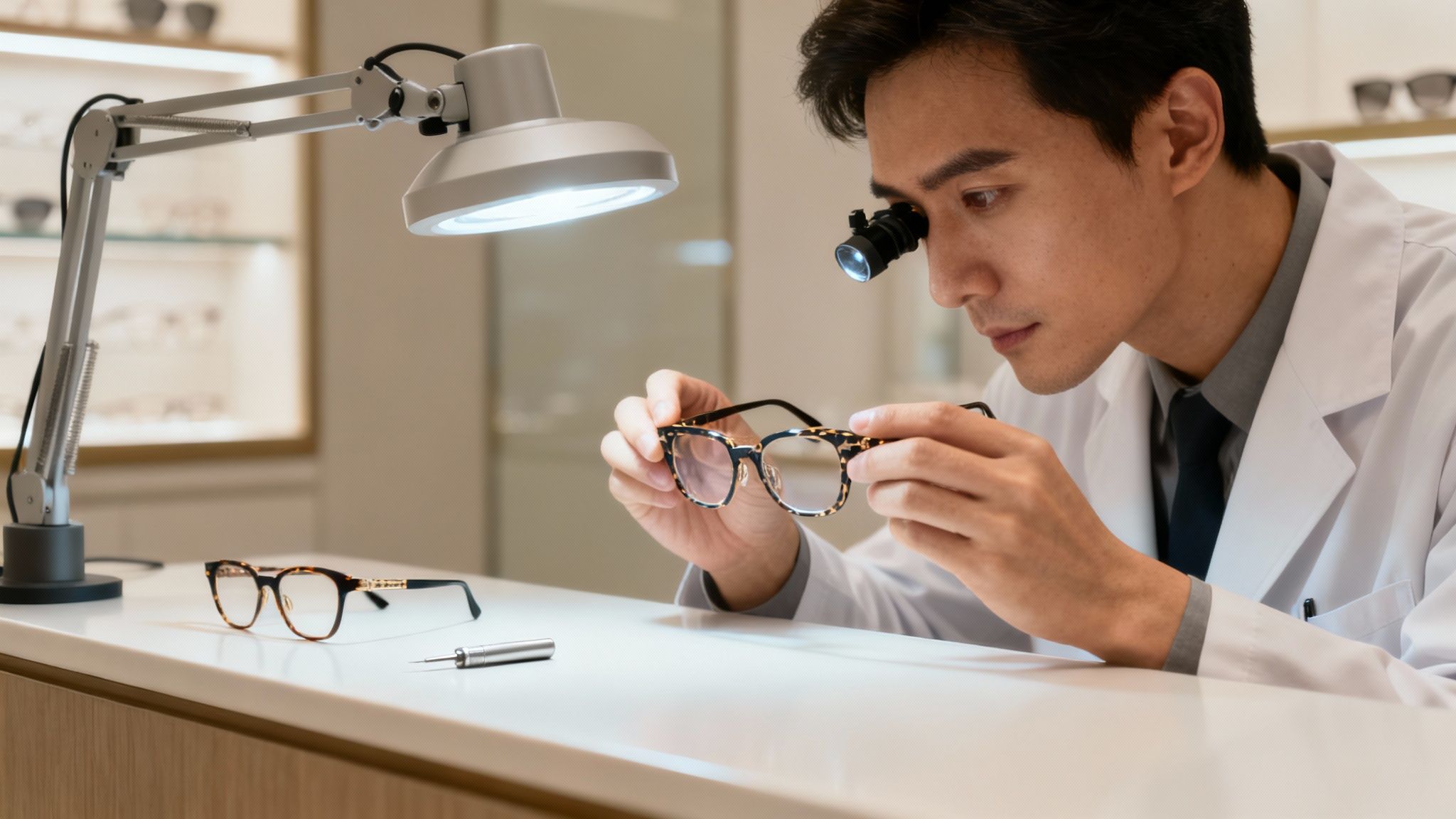
It can be tempting to try a quick DIY fix for a minor scuff on your glasses, but when you're dealing with a real scratch, calling in a professional is always the safest bet. This is especially true if you've invested in a premium pair of frames, like the Cartier, Gucci, or Tom Ford styles we carry at iDoctor. Trying to buff out a scratch on high-end eyewear can easily lead to permanent damage, turning a small problem into a very expensive one.
Here’s the hard truth: once a lens is scratched, that damage is done. You can't simply "remove" a scratch without also stripping away the incredibly thin, vital coatings applied to the lens surface. These layers—which provide anti-reflection, UV protection, and even scratch resistance—are essential for clear and comfortable vision. When you grind them away, you’re left with a hazy, distorted spot that’s often more distracting than the original scratch ever was.
The Limits of At-Home Fixes
Most at-home "remedies" you find online don't solve the underlying problem, which is the physical groove etched into your lens. They typically work in one of two ways: they either try to fill the scratch with a temporary substance or wear down the surrounding lens surface to match the depth of the scratch. Both approaches are flawed.
- Fillers are a temporary illusion. Products like wax or polish might make a scratch disappear for a few hours, but they leave a greasy residue that smudges constantly and attracts dust, making your vision worse.
- Abrasives cause permanent damage. Using things like toothpaste or baking soda is a sure-fire way to destroy your anti-reflective coating. You'll quickly find that glare from headlights and overhead lights becomes almost unbearable.
- You could alter your prescription. Aggressive polishing, even if done carefully, can subtly change the curvature of the lens. This can distort your prescription, leading to eye strain, headaches, and blurry vision.
When it comes to fixing scratched eyeglass lenses, the only truly effective solution is a professional lens replacement. This is the only way to guarantee perfect optical clarity, an accurate prescription, and fully intact protective coatings.
Professional Assessment and Real Solutions
Bringing your glasses to us means getting an expert evaluation. At iDoctor, our team can immediately assess the severity and location of the scratch to recommend the best path forward. We know how much you value both your vision and the investment you've made in your eyewear.
The demand for durable, long-lasting eyewear has never been higher. In fact, the global market for scratch-resistant coatings was valued at around $2.5 billion in 2025 and continues to grow. People understand that protecting their investment starts with quality. This is why professional lens replacement is so critical—it restores the advanced technology and protection you originally paid for.
We accept all major vision insurance plans and can help you figure out your benefits to see if a lens replacement is covered. Many plans include allowances for damaged lenses, which can make the process much more affordable than you might realize.
If a replacement is the right move, we'll ensure your new lenses are cut and fitted perfectly to your existing frames, whether they're a timeless pair of Ray-Bans or a bold Fendi statement piece. You can explore our collection of designer eyeglasses here and see the quality we're committed to. For everyone in our Glendale Heights community, from families near Glenbard West High School to the professionals working up and down North Avenue, clear vision is a necessity, not a luxury.
Of course, knowing how to fix a scratch is one thing, but avoiding it in the first place is the real win. The best way to protect your investment in good eyewear is to build a few simple, consistent habits. It's not complicated, and it will keep your vision sharp and your lenses looking new for a long, long time.
Let's be honest, the number one cause of scratches is wiping your lenses on your shirt. We've all been tempted. But your shirt hem, a paper towel, or a napkin are your lenses' worst enemies. Their fibers are surprisingly coarse and can act like sandpaper, dragging tiny bits of dust and grit across the surface and creating a network of fine scratches.
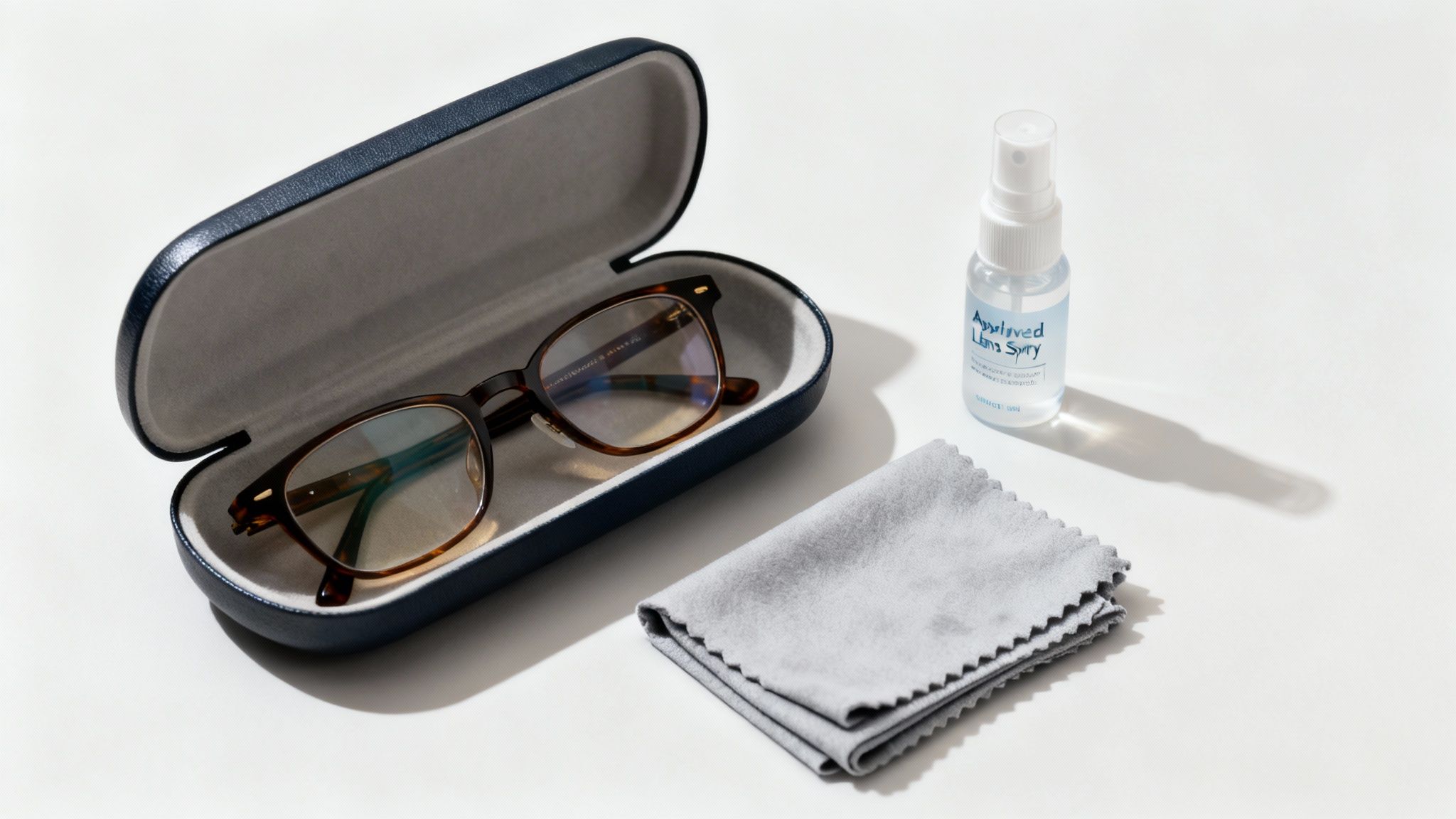
Doing It Right: Cleaning and Storing Your Glasses
Proper care is quick and easy. If you can make these steps part of your daily routine, you’ll sidestep the common mistakes that lead to damaged lenses.
- Rinse First, Always: Before you even think about wiping, hold your glasses under a gentle stream of lukewarm water. This simple step floats away any larger dust or grit that could get scraped across the lens.
- Get the Right Tools for the Job: A small drop of lotion-free dish soap on each lens, gently lathered with your fingertips, works wonders. Rinse all the soap off, then dry them completely with a clean microfiber cloth made specifically for lenses. Nothing else will do.
- Give Them a Safe Home: When your glasses aren't on your face, they should be in their case—preferably a hard-shell one. Just tossing them on a desk, in a purse, or on the car dashboard is asking for trouble.
Think of a hard case as a suit of armor for your glasses. It’s the ultimate defense against getting crushed, dropped, or scratched by your keys. It’s a small habit with a huge payoff.
Consider a Scratch-Resistant Coating from the Start
Smart prevention actually begins the day you buy your glasses. Opting for a high-quality, scratch-resistant coating is one of the best things you can do for the life of your eyewear. These modern coatings create a tough, protective layer that makes your lenses far more resilient to the everyday bumps and scuffs that are bound to happen.
There’s a reason the global market for these lenses is booming, with sales projected to top 200 million units in 2025. People are catching on to the value of protecting their investment. You can discover more about the trends in scratch-resistant lenses and see why they’re becoming the new standard. When you come in, we can also walk you through the science behind these next-generation lens coatings.
Your Local Eyewear Experts in Glendale Heights
When a scratch suddenly blurs your world, having a local professional you can count on makes all the difference. Here at iDoctor in Glendale Heights, we're not just selling glasses; we're your partners in keeping your vision crystal clear. Hopefully, this guide has given you a better understanding of how to assess a scratch, why you need to be so careful with DIY fixes, and when it’s time to call in the experts for a proper lens replacement.
We’d love for you to stop by our boutique on North Avenue for a professional lens assessment. Our team is always here to help you see perfectly, whether that means looking at repair options for your favorite frames or helping you find a fantastic new pair from our designer collection.
Your vision is far too precious to gamble on a temporary home remedy that could end up causing more harm than good. Let our experienced team provide a lasting, reliable solution that restores the clarity and protection your eyes deserve.
Whether you just need a quick, expert opinion on a scratch or it's time for one of our detailed eye exams in Glendale Heights, we've got you covered. We encourage you to learn more about our practice and see for yourself why so many of your neighbors in Glendale Heights, Bloomingdale, and Carol Stream trust us with their eye care.
Frequently Asked Questions in Glendale Heights
Can you just buff out the scratches on my Oliver Peoples glasses?
It seems like a simple solution, but buffing is a destructive process for high-end lenses. It grinds away the delicate coatings that provide anti-glare and UV protection. Worse, it can alter the lens curvature, distorting your prescription and causing headaches. For luxury eyewear like Oliver Peoples, Gucci, or Cartier, professional lens replacement is the only safe way to restore perfect vision and protect your investment.
Do you accept VSP for lens replacements in Glendale Heights?
Yes, we proudly accept all major vision insurance plans, including VSP, EyeMed, and more. Our team is fantastic at navigating the fine print and can help you figure out exactly what your benefits cover for lens replacements on your designer eyeglasses in Glendale Heights. We'll work to maximize your coverage and make the process as seamless as possible.
Are scratch-resistant coatings actually worth the extra money?
Without a doubt, yes. Think of a good scratch-resistant coating as a bodyguard for your lenses. It’s a tough, durable layer that provides a crucial defense against the everyday bumps, drops, and scrapes that are bound to happen. It’s one of the best ways to protect your eyewear investment, helping your lenses last longer while keeping your vision as clear as possible. It’s a small upfront cost that pays off big time in the long run.
When scratches get in the way of your sight, don't gamble on DIY fixes that could make things worse. Swing by iDoctor for a professional look. We can assess the damage and walk you through all your lens replacement options. We're dedicated to providing the absolute best eye care for our Glendale Heights community.
You can learn more about our services at https://idoctoril.com.