Ever been driving down Bloomingdale Road after a rainstorm and found yourself completely blinded by the glare coming off the wet pavement? That intense, almost painful light is exactly what polarized sunglasses are built to fight. For residents in and around Glendale Heights, understanding the meaning of polarized sunglasses is the first step toward safer, more comfortable vision.
In simple terms, polarized sunglasses have a special, invisible filter that specifically targets and blocks that harsh horizontal glare. It only lets in the useful vertical light, giving you a much clearer and more comfortable view. At iDoctor, your local optometry boutique, we help people find the perfect pair every day.
How Do Polarized Sunglasses Actually Work?
If you’ve ever had to squint from the blinding reflection bouncing off a car’s hood or the surface of a lake, you know what glare is. It’s more than just an annoyance; that harsh light causes serious eye strain and fatigue. Polarized sunglasses were engineered from the ground up to solve this exact problem, providing a level of visual comfort that regular tinted lenses just can't touch.
The best way to think about the chemical filter on a polarized lens is to picture a set of microscopic Venetian blinds. It's built with vertical patterns that act like a gatekeeper for light waves.
Sunlight normally scatters in all directions. But when it reflects off a flat surface like water or asphalt, it becomes concentrated horizontally. This is the "bad" light that causes blinding glare and visual discomfort.
The vertical filter in polarized lenses stops those intense horizontal light waves in their tracks. By neutralizing glare right at the source, your vision becomes instantly sharper and the world around you looks much clearer.
Seeing the Difference in the Real World
This filtering technology brings some immediate, noticeable benefits for anyone in Glendale Heights, whether you're behind the wheel, out for a walk, or enjoying a sunny day at Camera Park.
- Less Squinting, More Comfort: Your eyes can finally relax without constantly fighting harsh reflections, which helps cut down on eye strain and headaches.
- Sharper Vision and Better Color: With the "visual noise" of glare gone, colors look richer and more vibrant. You'll notice details you were missing before.
- A Must-Have for Safety: For drivers on busy roads like North Avenue or I-355, cutting glare is crucial. It helps you spot road hazards and other cars far more easily and quickly.
To give you a clearer picture, here's a simple breakdown of how polarized lenses stack up against standard sunglasses.
Polarized vs. Non-Polarized Lenses at a Glance
This table highlights the key differences between standard non-polarized sunglasses and advanced polarized lenses.
| Feature | Polarized Lenses | Non-Polarized Lenses |
|---|---|---|
| Glare Reduction | Excellent; blocks horizontal glare | Basic; reduces overall brightness |
| Visual Clarity | High; enhances contrast and detail | Standard; can wash out colors |
| Eye Comfort | Reduces eye strain and squinting | Offers some relief from brightness |
| Best For | Driving, fishing, water sports | General, casual wear |
| LCD Screens | Can make screens hard to see | No effect on screen visibility |
As you can see, while both types of lenses offer sun protection, polarized technology is specifically designed to tackle the problem of glare for a superior visual experience.
This technology can truly be a game-changer. For a deeper dive, feel free to explore the key differences between polarized and non-polarized sunglasses in our detailed guide. Here at iDoctor, we're all about giving you the knowledge to make the best possible choices for your vision.
The Science Behind Glare-Free Vision
To really get what polarized sunglasses do, we first have to talk about how light itself behaves. Sunlight travels in waves that vibrate in all directions—up and down, side to side, and everywhere in between. Normally, this scattered light is no problem for our eyes.
The trouble starts when that light hits a flat, reflective surface. Think about the blinding reflection off the water at Glendale Lakes Golf Club or the hood of a car on a sunny day along North Avenue. The light waves bounce off these surfaces and get organized, vibrating almost entirely in one direction: horizontally. This intense, concentrated horizontal light is what we see and feel as glare.
This is where the magic of polarization happens. Polarized lenses have a special chemical film applied to them. The molecules in this film are lined up vertically, creating a kind of microscopic filter.
How the Polarizing Filter Works
Think of this vertical pattern as a microscopic set of blinds or a gatekeeper for light. It physically blocks the intense, horizontal glare from getting through to your eye. At the same time, it allows the useful vertical light—the light we need to see clearly—to pass right through.
This selective filtering is the secret sauce. By cutting out all the visual "noise" from glare, the world looks sharper, colors appear richer, and your eyes don't have to work so hard.
This diagram is a great way to see it in action. The filter blocks the horizontal glare, letting you see with much more clarity and comfort.
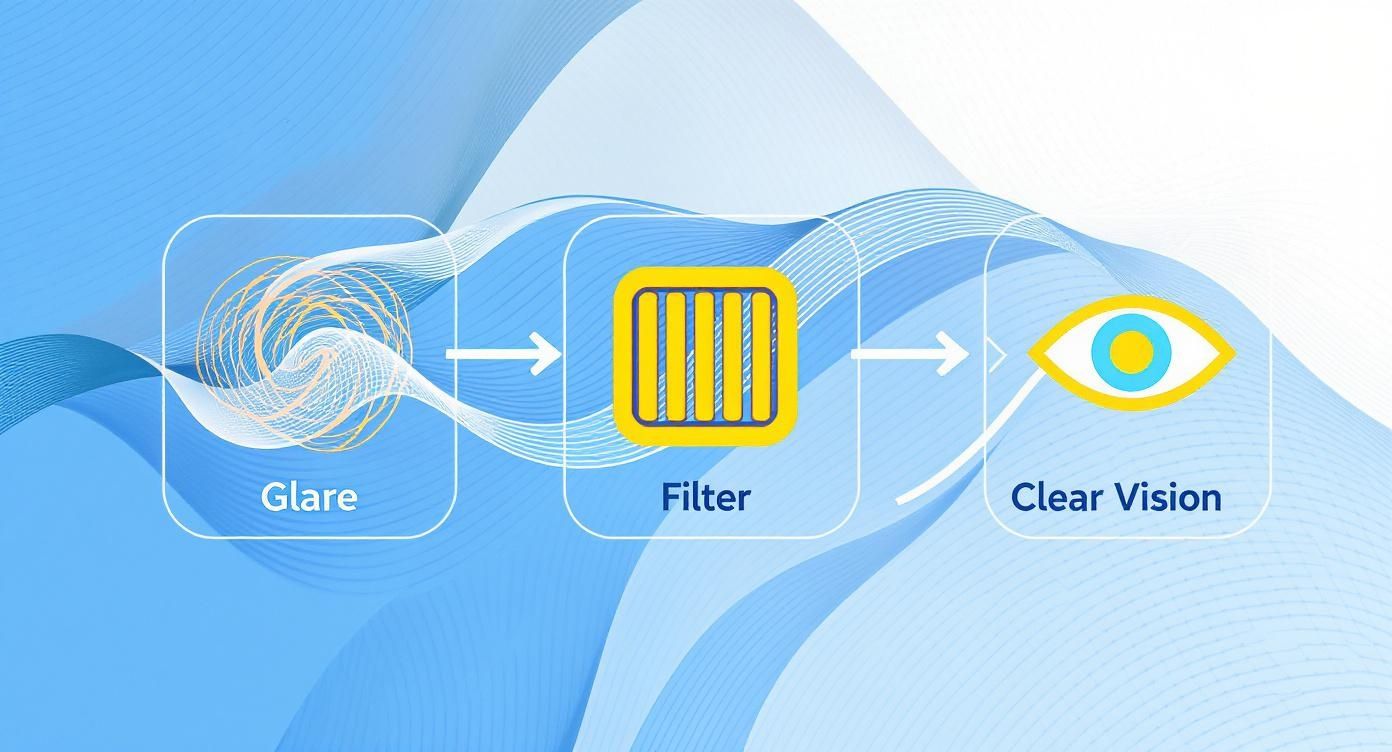
As you can see, the chaotic, blinding glare gets stopped by the filter, allowing only the good, clear light to reach your eye.
This process isn't just a minor improvement; it's incredibly effective. In fact, approximately 80% to 90% of glare on a sunny day is horizontally polarized light—exactly what these lenses are built to block. This is why polarized sunglasses are so much better at reducing eye strain and keeping you safe whether you're driving, fishing, or just enjoying a day out.
For a deeper dive into other glare-reducing options, you might want to read our guide on the benefits of anti-glare coatings on glasses. It's this smart, focused technology that delivers the kind of visual comfort that makes polarized lenses an essential for life in the Glendale Heights area.
Real-World Benefits of Wearing Polarized Lenses
The science behind polarized lenses is cool, but what really matters is how they make your day-to-day life better, especially around Glendale Heights. We're not just talking about basic sun protection here. These lenses offer a sharper, more comfortable, and safer way to view your surroundings.

From cutting down dangerous glare on the road to making colors pop, a good pair of polarized sunglasses is a practical upgrade for just about everyone.
Safer Driving and Reduced Eye Strain
One of the biggest wins for polarized lenses is safety behind the wheel. Think about driving on I-355 after a rainstorm with the sun low in the sky. That blinding glare bouncing off the wet road is more than just annoying—it's dangerous. Polarized lenses are specifically designed to kill that kind of horizontal glare, letting you see lane markings, other cars, and any obstacles with perfect clarity.
It’s no surprise they are among the best sunglasses for driving in Glendale Heights. Beyond just safety, cutting the glare means your eyes aren't constantly squinting and straining. At the end of a long day outside, you'll notice a real difference in eye fatigue and may even sidestep a tension headache.
Enhanced Clarity for Outdoor Activities
For anyone who loves spending time outdoors, polarized lenses are an absolute game-changer. You really see the difference in all sorts of situations:
- Richer, Deeper Colors: Head over to Camera Park, and you'll see how polarization cuts right through the hazy glare in the air. The greens of the trees and grass look more vivid, and the blue sky seems deeper.
- Seeing Into the Water: If you're an angler trying your luck at Mallard Lake, these lenses are practically cheating. They slice through the reflections on the water's surface, so you can actually spot fish and see what's going on beneath.
- Better Views on the Water: The same principle applies to any water activity. Good polarized lenses drastically reduce surface glare, which is why they can enhance your Kailua Kona whale watching experience by providing a much clearer view of the marine life and the horizon.
At the end of the day, polarized lenses give you a high-definition view of the world. By filtering out the visual noise of glare, they reveal details and color contrasts that standard sunglasses just can't touch, making every sunny day more comfortable and enjoyable.
When Polarized Lenses Aren't the Best Choice
Polarized lenses are fantastic for most daytime activities, but they aren't a perfect one-size-fits-all solution. Knowing when to skip them is just as important as knowing when to wear them. Honestly, there are a few specific situations where they can cause more problems than they solve.
The biggest issue comes down to how they interact with liquid-crystal displays (LCDs). Think about the screen on your smartphone, your car's digital dashboard, an ATM, or even the pump at the gas station. The same filtering magic that cuts glare can also block the light from these screens, making them look dim, distorted, or completely black.
Specific Scenarios to Watch Out For
Because of this screen-blocking effect, some people actively avoid polarized lenses for safety and convenience:
- Pilots: They absolutely need to see their digital instrument panels clearly and without interference. Polarized lenses are a no-go in the cockpit.
- Heavy Equipment Operators: Just like pilots, anyone operating machinery that relies on LCD screens for information needs an unfiltered view.
- Skiers and Snowboarders: This one can be surprising. While polarization cuts down on snow glare, it can also make it dangerously difficult to distinguish icy patches from powder, as ice reflects light differently.
The bottom line is simple: because a polarized filter works by blocking certain light waves, it can inadvertently block the light you need to see from digital displays.
This doesn't mean polarized lenses are flawed; it just means they're a specialized tool. You wouldn't use a hammer to turn a screw. In the same way, you wouldn't want polarization in a pair of specialty lenses for night driving, where the entire goal is to let in as much light as possible.
How to Check if Your Sunglasses Are Polarized
So, you've got a pair of sunglasses and want to know if they're actually polarized. It's a fair question. Luckily, you don't need any fancy equipment to find out. There are a couple of quick, reliable tricks you can try right now.
These tests work by exposing the unique way polarized lenses manage light, giving you a clear yes or no answer.
Test 1: The LCD Screen Method
This is by far the easiest and most common way to check your lenses. All you need is your phone, a computer monitor, or even a tablet.
- Turn on your screen. A white or bright background works best for this.
- Look through one lens. Hold your sunglasses up and peer at the screen.
- Rotate them 90 degrees. Now, slowly tilt your head or rotate the sunglasses.
If the lenses are polarized, the screen will get very dark or even go completely black. That's the polarizing filter doing its job, blocking the light waves coming from the LCD screen.
Test 2: The Two-Pair Test
Don't have a screen handy? If you have another pair of sunglasses that you know for sure are polarized, you can use them as a reference.
Simply hold one pair in front of the other, so you’re looking through both sets of lenses at the same time. Then, rotate one pair 90 degrees. If both are polarized, the overlapping area will turn black as they work together to block all light from passing through.
Find Your Perfect Polarized Pair in Glendale Heights
Knowing what polarized lenses do is one thing, but finding the right pair for your lifestyle is the real goal. It's clear people are catching on to the benefits—the global market for polarized sunglasses recently hit a value of about USD 5.71 billion, with North America leading the charge.
This isn’t just a trend; it's a shift toward investing in better, more comfortable vision. Here at iDoctor in Glendale Heights, our team is ready to help you navigate the options without the guesswork. We make finding great eyewear simple.
Your Style, Your Vision
We’ll help you match the perfect frames to your face and lifestyle from our curated collection of luxury brands like Cartier, Gucci, and Tom Ford, alongside accessible favorites like Ray-Ban and Kate Spade. All of them can be fitted with advanced polarized lenses.
Our team focuses on personalized service, making sure your new sunglasses are a perfect fit for everything you do, from driving around town to spending a day out on the water. For those who love the latest tech, options like smart audio polarized sunglasses are even becoming popular.
Your vision needs are unique. That's why we focus on custom solutions, from frame fit to lens technology, to ensure your eyewear enhances your life.
Great vision starts with knowing where your eye health stands. Before you pick out a new pair, it’s always smart to make sure your prescription is current. For more advice on picking frames and lenses, check out our guide on how to choose the perfect sunglasses.
We can add a polarization filter to most prescription lenses, so you never have to choose between clear vision and glare protection. When you’re ready, you can schedule one of our detailed eye exams in Glendale Heights and explore our collection of designer eyeglasses in Glendale Heights. We proudly accept all major vision insurance plans to help make premium eye care accessible for our community.
Your Polarized Sunglasses Questions Answered
Here at iDoctor, we get a lot of great questions from our Glendale Heights neighbors about polarized sunglasses. To help clear things up, here are answers to some of the most common ones we hear.
Can I get my prescription glasses polarized in Glendale Heights?
Yes, you absolutely can! Think of it as adding a powerful feature to the lenses you already need. As your local eye doctor in Glendale Heights, we can apply a polarization filter to most prescription lenses. It's the perfect all-in-one solution for anyone who needs vision correction but also wants to cut down on that blinding glare. Swing by our boutique, and we can walk you through the options for your specific prescription.
Are expensive polarized sunglasses really better?
That's a great question. While a higher price tag on brands like Cartier or Gucci often points to premium frame materials and design, the fundamental technology that blocks glare is generally the same. However, you're not just paying for the name. Higher-end lenses often have better quality polarizing films and more advanced coatings, which can mean sharper clarity and better durability. We can show you fantastic options across different price points, from Ray-Ban to Tom Ford, to help you find that sweet spot between performance and value.
Do polarized lenses also block UV rays?
This is a crucial point: polarization and UV protection are two separate things. Polarization is all about cutting reflected glare, while a UV coating shields your eyes from the sun's harmful ultraviolet rays. For your health and safety, you should never have to choose between them. That’s why every single pair of polarized sunglasses at iDoctor—from Kate Spade to Michael Kors—also comes with 100% UVA and UVB protection. You get the best of both worlds.
Do you accept vision insurance for polarized sunglasses?
Yes, we do. At iDoctor, we are proud to accept all major vision insurance plans. We believe that everyone in the Glendale Heights community deserves access to high-quality eye care and eyewear. Our team can help you understand and maximize your benefits for everything from eye exams to prescription polarized sunglasses.
Ready to see the world with less glare and more clarity? The expert team at iDoctor is here to help you find the perfect polarized sunglasses for your needs. We invite our neighbors from Glendale Heights and the surrounding Chicagoland suburbs to experience the difference premium eye care makes.
Visit us in Glendale Heights or book an appointment online today!