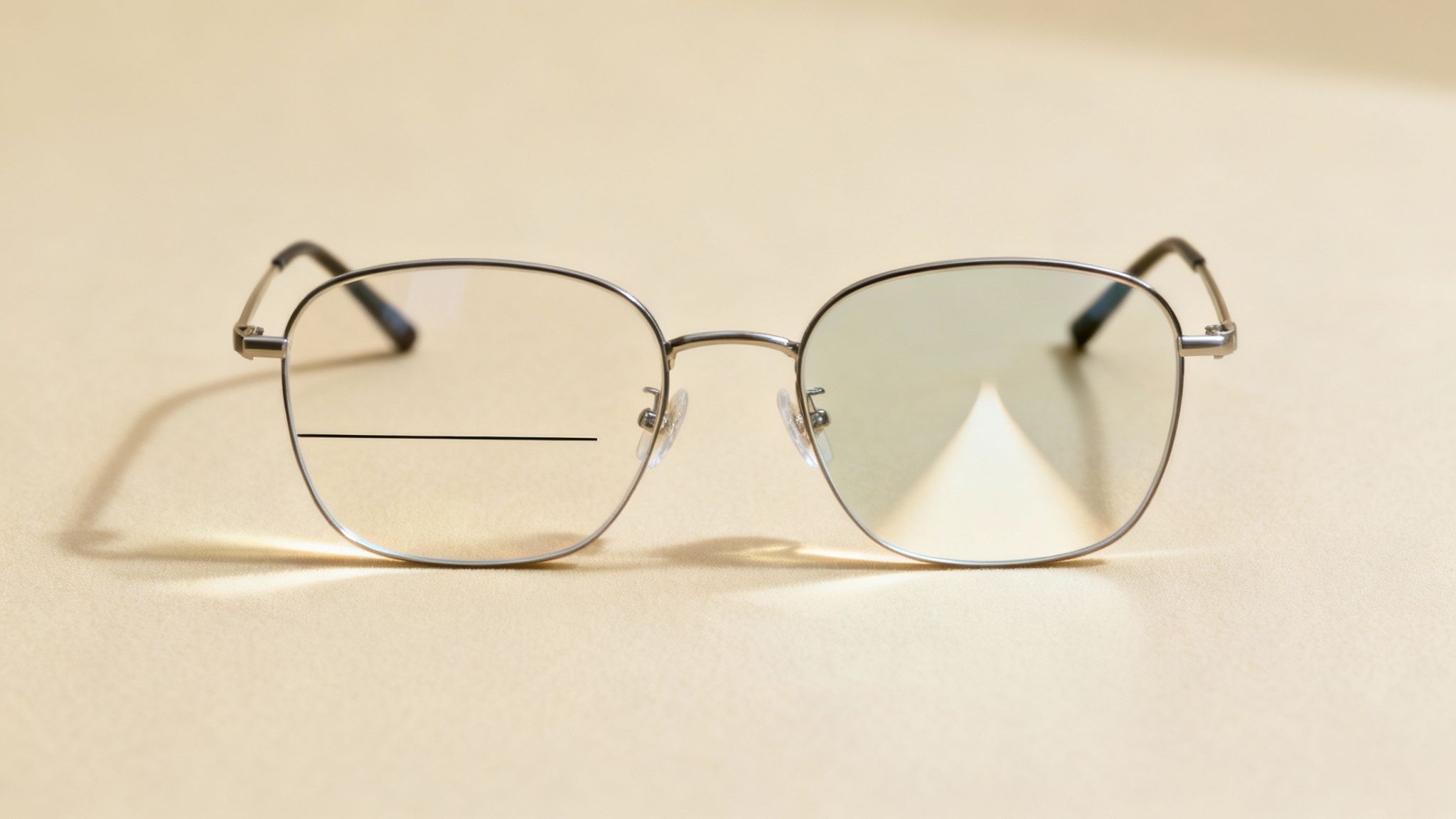
If you need glasses that help you see both up close and far away, you’ll likely end up choosing between bifocal and progressive lenses. Many of our patients in Glendale Heights ask about the difference. The most obvious one is the look: bifocals have a visible line separating the two prescriptions, while progressives have a seamless, no-line appearance.
But the differences go much deeper than just cosmetics. Bifocals give you two large, distinct viewing zones, which some people find easier to get used to. Progressives, on the other hand, provide a smooth, gradual shift between multiple distances—including that all-important intermediate range for computer screens. This guide will help you understand which option is the perfect fit for your lifestyle.
Your Quick Guide to Bifocal and Progressive Lenses
Picking the right multifocal lens is a big deal. It affects your comfort and how clearly you see the world all day, every day. For our patients here in Glendale Heights and the neighboring communities, the first step is really understanding the fundamental differences between bifocal vs. progressive lenses. The best choice for you will come down to your lifestyle, what you need to see clearly, and of course, your personal style.
Key Distinctions
Bifocal lenses are the tried-and-true classic. They are designed with two separate prescription powers in one lens. The top part is for distance vision, and a small, clearly defined segment at the bottom is for reading or other close-up work. This straightforward design gives you an exceptionally wide and stable field of view for both zones.
Progressive lenses are the more modern take on multifocal technology. They have no lines at all, which means you get a smooth, gradual transition from your distance vision at the top, through an intermediate zone in the middle, down to your near vision at the bottom. This creates a more natural viewing experience and looks just like a standard pair of single-vision glasses. You can learn more by exploring our guide on the different kinds of eyeglass lenses available.
The most significant functional difference is that progressive lenses include an intermediate, or "corridor," viewing zone. This makes them ideal for tasks like computer work or seeing your car’s dashboard clearly—something bifocals don't account for.
To give you a quick starting point, here’s a table that boils down the main differences between the two.
Bifocal vs Progressive Lenses at a Glance
This table offers a snapshot of the core differences to help you see which option might be a better fit right off the bat.
| Feature | Bifocal Lenses | Progressive Lenses |
|---|---|---|
| Appearance | Visible line separates two vision zones | No visible lines for a seamless look |
| Vision Zones | Two distinct zones (distance and near) | Three main zones (distance, intermediate, near) |
| Field of View | Wide, clear viewing areas for each zone | Narrower "corridor" for intermediate/near |
| Adaptation | Generally easier; some find the "image jump" jarring | Can take longer; requires learning to find the "sweet spot" |
| Best For | Static tasks like reading or desk work | Dynamic lifestyles requiring fluid vision changes |
| Cost | Typically more budget-friendly | Generally more expensive due to advanced technology |
Of course, a chart can only tell you so much. The right lens for you really depends on the unique demands of your eyes and your life.
The Enduring Clarity of Bifocal Lenses
Bifocal lenses are one of the most classic and trusted solutions for anyone dealing with presbyopia—that completely normal, age-related change that makes it harder to focus on things up close. The design is brilliantly simple: one lens, two different prescription strengths, and a visible line dividing them. The main, larger portion of the lens corrects your distance vision, while the smaller segment at the bottom is dedicated to reading or other close-up work.

This clear-cut separation is the bifocal's biggest strength. It gives you an exceptionally wide and stable field of view for both distance and near tasks. For many people trying multifocal lenses for the first time, this straightforward design is much easier to get used to than the gradual blend of a progressive lens. You look up for distance, you look down to read—no ambiguity.
Of course, this design comes with a well-known quirk called the "image jump." It’s that abrupt shift in focus you feel when your gaze crosses the line between the two zones. While most people adapt to it fairly quickly, it can definitely be disorienting at first.
Understanding the Visual Experience
That "image jump" is exactly why bifocals really shine during more stationary activities. Picture yourself settling in with a good book, working on a detailed craft, or paying bills at your desk. In these moments, your eyes stay within the reading segment for long stretches, and you get to enjoy that wide, unwavering clarity.
On the flip side, they can feel a bit clunky in dynamic situations where you’re constantly shifting your focus. Simple things like walking down a flight of stairs or navigating a busy grocery aisle might require you to consciously dip your head to look through the top part of the lens to avoid the disorienting jump. If you're just starting to notice these focus issues, you can explore our guide on how to tell if you need bifocals.
Key Takeaway: The major plus for bifocals is their simplicity and incredibly wide viewing zones. The trade-off is the lack of any intermediate vision (for computer distance) and the noticeable "image jump" between the two fields of view.
The reliability and no-fuss functionality of bifocals have kept them popular for decades. This enduring appeal is backed by solid numbers. In 2023, the global market for bifocal lenses was valued at around USD 2.5 billion and is expected to grow to approximately USD 4.2 billion by 2032. This growth is largely driven by the aging global population and the increasing diagnosis of presbyopia. You can dive deeper into the numbers with this in-depth market analysis.
Who Is the Ideal Candidate for Bifocals?
So, are bifocals the right choice for you? It really comes down to your daily routine and what you value most in your vision. This type of lens tends to be a fantastic fit for people who:
- Prioritize Wide Fields of View: If you need the largest, clearest area possible for either distance or reading, without any distortion, bifocals are hard to beat.
- Engage in Stationary Tasks: Anyone who spends hours reading, crafting, or doing focused desk work often loves the stable, dedicated reading segment.
- Are Sensitive to Peripheral Distortion: Unlike progressives, bifocals have no "soft focus" areas on the sides. You get crisp, edge-to-edge clarity in both zones.
- Prefer a Simpler Adaptation Period: For many, adjusting to two distinct zones feels more intuitive and happens much faster than learning to find the "sweet spot" in a progressive lens.
Ultimately, choosing between bifocal vs. progressive lenses is a personal decision. For our patients in Glendale Heights, a thorough consultation here at iDoctor is the best way to match your unique visual needs with the right lens technology, making sure your new glasses are a perfect fit for your life.
The Modern Appeal of Progressive Lenses
Progressive lenses are a huge step forward in eyewear, giving you a completely seamless, no-line look that’s identical to a standard single-vision lens. Instead of that distinct, tell-tale line you see in bifocals, progressives have a gradual "corridor" of power. This channel transitions smoothly through all your different vision zones.
Your eyes can move naturally from looking at something far away at the top, through your intermediate vision in the middle, and all the way down to near vision at the bottom for reading.
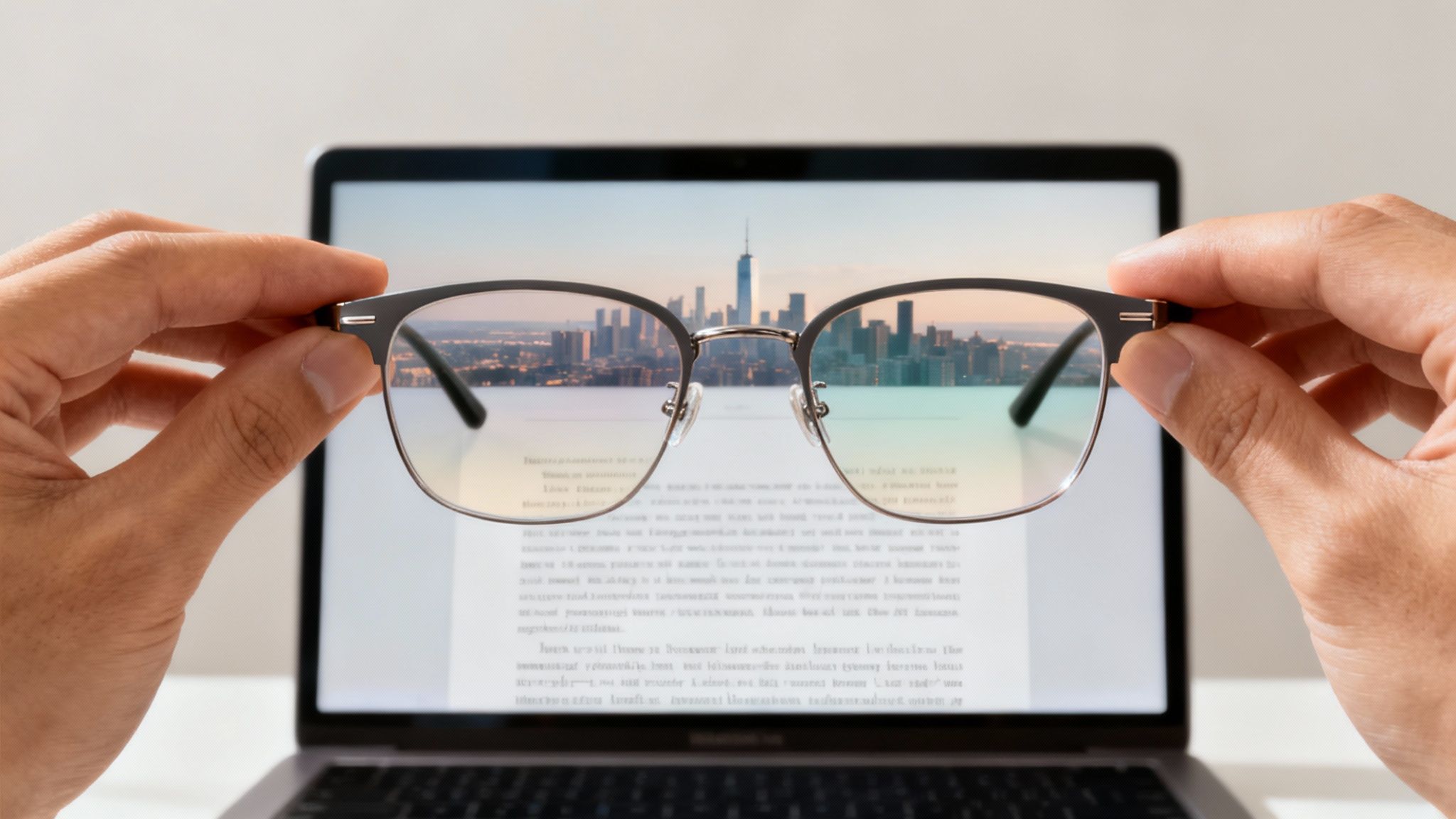
This fluid design is a perfect fit for a dynamic, modern lifestyle. Just imagine you’re driving down North Avenue, you glance at your dashboard, and then you look down to read a quick text. A progressive lens lets you do all of that without any jarring visual breaks or the "image jump" common with bifocals.
It's this advanced design that has made progressive multifocal lenses such a fast-growing part of the eyewear market. Back in 2024, the global market for progressive lenses was already valued at about USD 6.54 billion. It's expected to climb to nearly USD 11.93 billion by 2032, which really shows how much people prefer their seamless function.
Understanding the Visual Experience
The real magic of a progressive lens is its ability to give you clear vision at pretty much any distance. That intermediate zone, which is totally missing from bifocals, is essential for all those tasks between arm's length and the horizon—things like working on a computer, seeing your car's infotainment screen, or reading prices on a store shelf.
Of course, this sophisticated technology does come with a bit of a learning curve. When you first get them, you might notice some peripheral distortion or "soft focus" areas on the sides of the lenses. Don't worry, this is a totally normal result of the complex lens design that has to fit multiple powers onto one surface.
The greatest strength of progressive lenses is their ability to mimic natural vision. By eliminating lines and providing a full range of focus, they offer both functional versatility and a more youthful, modern aesthetic.
The good news is that lens technology has come a long way. Here at iDoctor, we use advanced digital "freeform" lenses that are custom-milled for your exact prescription and the specific frame you choose. This process drastically cuts down on that peripheral distortion, giving you a much wider and more natural field of view than you'd get with older, conventional progressive designs.
Who Is the Ideal Candidate for Progressives?
The choice between bifocals and progressives really boils down to your lifestyle. Progressive lenses are a fantastic match for anyone who leads an active life and needs clear, fluid vision for a whole range of tasks throughout the day.
You might be a great candidate for progressives if you:
- Want a No-Line, Modern Look: Let's be honest, the cosmetic appeal is a huge plus. Progressives look just like single-vision lenses, which many people prefer.
- Need Clear Intermediate Vision: If you spend a lot of time on a computer or tablet, or just need to see things clearly at arm's length, that intermediate zone is non-negotiable.
- Live a Dynamic Lifestyle: For anyone who is constantly shifting focus—like parents, busy professionals, or anyone on the go—the smooth transitions are a game-changer.
- Are Willing to Adapt: While there's an adjustment period that can take a few days to a couple of weeks, the long-term benefit of more natural vision is worth it for most people.
This combination of looks and function makes progressive lenses a top choice for those looking for designer eyeglasses in Glendale Heights. To get a better sense of how they work with different styles, you can check out our detailed guide that explains progressive lenses and designer frame compatibility.
Putting Lenses to the Test: Real-World Scenarios
Theory is one thing, but how these lenses actually perform in your day-to-day life is what really matters. Whether you're working, running errands around Glendale Heights, or just relaxing, your lens choice will shape your entire visual experience.
Let's walk through a few common situations to see how each lens stacks up.
At the Local Cafe or Working From Home
Picture yourself at a spot like T-Time Cafe, laptop open and a coffee at your side. This is where progressive lenses truly shine. You can look at your screen through the intermediate zone, glance down at your phone in the near zone, and then look up to say hello to the barista through the distance portion. It’s all one fluid, natural movement.
Now, imagine that same scenario with bifocal lenses. While your distance and near vision are perfectly crisp, your laptop screen falls into a frustrating visual gap. You'll probably find yourself leaning way in to use the reading segment or craning your neck back to peer through the bottom of the distance lens. Neither is comfortable for more than a few minutes.
Key Differentiator: For dynamic tasks that demand clear vision at all ranges—like computer work mixed with social interaction—progressive lenses deliver a far more natural and comfortable experience.
Navigating the Grocery Store
Think about your next trip to Valli Produce or Jewel-Osco over on Bloomingdale Road. You're scanning the top shelves (distance), reading the aisle signs (intermediate), and checking your shopping list on your phone (near).
Here, the comparison gets a little more interesting:
- Bifocals: That wide, stable reading area is fantastic for your list. But looking at the middle shelves can be disorienting because of the "image jump," and you might find yourself pointing your chin down to see the floor clearly while you walk.
- Progressives: The smooth transitions are almost purpose-built for this. You can shift your focus from a high shelf to a price tag to your cart without a thought. The only trade-off is the slight peripheral blur, which just means you'll learn to turn your head more instead of just your eyes for side glances.
Driving on Local Roads
Clear vision while driving is non-negotiable. Whether you’re on Army Trail Road or merging onto I-355, you need to see everything at once: the road ahead, your mirrors, your dashboard, and distant traffic signs.
With progressive lenses, it all feels intuitive. You can see the road, check your GPS, and spot a sign in the distance with simple, natural eye movements. It just works. Adding the right coating can elevate the experience even further; we cover the benefits of anti-reflective lens coatings in another guide.
With bifocals, you get a great view of the road through the top of the lens. The problem comes when you need to look at your dashboard. You have to make a very deliberate head tilt to bring the reading segment into play. That constant up-and-down head motion can get old fast, especially on a long drive.
The market certainly reflects this preference for modern life. The global progressive lenses market was valued at around $29.9 billion in 2021 and is growing fast. By comparison, the bifocal market, sitting at $8.5 billion in 2023, is seeing much slower growth. These prescription lens market insights show a clear trend.
Enjoying an Afternoon at the Park
Let's say you're at Camera Park watching your kids play soccer (distance), then you check a text on your phone (near), all while chatting with a friend standing nearby (intermediate).
Someone wearing progressive lenses handles this scene without even thinking about it; their vision just flows from one task to the next. The bifocal wearer, on the other hand, is doing more work—constantly adjusting their head to switch between the two distinct zones and completely missing that effortless intermediate vision for conversation.
Ultimately, the best lens is the one that fits your life. The only way to know for sure is to have a conversation with an expert eye doctor in Glendale Heights who can match the right optical technology to your real-world needs.
Tips for Adapting to Your New Lenses
Getting a new pair of multifocal glasses is a great feeling, but remember that your brain and eyes need a moment to get on the same page. A brief adaptation period is completely normal, whether you've picked bifocals or progressives.
This adjustment is all about your brain learning to process visual information in a new way, through different parts of the lens. With a little patience and a few simple tricks, you can make this transition feel smooth and natural.
Getting Used to Bifocal Lenses
With bifocals, the biggest hurdle is usually the "image jump"—that abrupt shift you experience when your gaze crosses the visible line. The trick is to train your brain to automatically use the right part of the lens for the right job.
Here are a few practical tips to help you get the hang of it:
- Point Your Nose: This is the golden rule. Get into the habit of pointing your nose directly at whatever you want to see clearly. Reading a book? Point your nose down at the page. This simple action forces your eyes into the correct segment and cuts down on that disorienting feeling.
- Watch Your Step: When you're walking, especially around stairs or curbs, make a conscious effort to tilt your head down. This ensures you're looking through the top part of the lens (for distance), preventing the ground from appearing blurry or weirdly close.
- Practice Makes Perfect: Set aside a few minutes each day to deliberately switch your focus. Look at something far away, like the TV, then look down at something close, like your phone. This little exercise helps your brain master the distinct shift between the two vision zones much faster.
Finding Your Rhythm with Progressive Lenses
Adapting to progressives is less about a "jump" and more about finding the "sweet spot" for every distance. Since there are no lines, it’s a subtler process of teaching your eyes how to navigate the invisible corridor of power.
Your brain is incredibly adaptable. Most people adjust to their new progressive lenses within a few days to two weeks of consistent, all-day wear. The more you wear them, the more intuitive and natural your new vision will feel.
To help your brain find its new rhythm, try these techniques:
- Lead with Your Nose (Again!): Just like with bifocals, this is key. To read, drop your chin so your eyes look through the bottom of the lenses. For computer work, keep your head level and lower your eyes slightly to find that intermediate sweet spot in the middle of the lens.
- Turn Your Head, Not Just Your Eyes: Progressive lenses have some softer focus in your peripheral vision. To see something clearly to your side, get into the habit of turning your whole head to face it. This keeps your line of sight in the clearest part of the lens.
- Be Patient and Consistent: This is the most important part. Wear your new glasses as much as you possibly can, especially for the first two weeks. Constantly switching back to your old pair will only confuse your brain and make the adjustment period longer.
For a deeper dive, check out our guide on adjusting to progressive lenses, which offers even more detailed advice.
And remember, at iDoctor, our support doesn't stop once you walk out the door of our Glendale Heights boutique. We're always here for follow-up adjustments to ensure your new glasses fit perfectly and your vision is comfortable.
Finding Your Perfect Vision Solution in Glendale Heights
When it comes to choosing between bifocal and progressive lenses, there's no single "best" answer—only what's best for you. Your vision, daily habits, and even personal style all play a huge role. Here at iDoctor, our entire focus is on guiding you to that perfect match, so your new glasses genuinely improve your day-to-day life.
It all begins with one of our detailed eye exams in Glendale Heights. We set aside a full 30 minutes for you, using advanced imaging to map out a precise picture of your vision. This detailed look is what allows us to go beyond a generic prescription and make a recommendation that’s truly built around your eyes.
A Consultation Focused on You
After the exam, our opticians sit down with you to talk about your life. What does a typical day look like? Are you in front of a computer for hours? A passionate reader? Maybe you need clear, uninterrupted vision for driving from Glen Ellyn to Carol Stream. These details are crucial in figuring out which lens technology will actually work for you.
This is where the bifocal vs. progressive debate becomes real. We'll connect the dots between how each lens works and what you need to do, making the choice feel clear and straightforward instead of overwhelming.
At iDoctor, we believe the best lens choice is an informed one. We don’t just sell glasses; we provide a complete vision solution that blends clinical precision with a deep understanding of your lifestyle.
Once we’ve settled on the right lens, the fun begins—finding the perfect frame. Whether you love the classic look of Cartier glasses near me or the sharp, modern lines of Tom Ford, our collection has you covered. We carry a wide selection of designer frames from Gucci and Prada, as well as trusted names like Ray-Ban and Coach, so there's a perfect fit for every taste and budget.
The infographic below breaks down the key difference in getting used to each lens type.
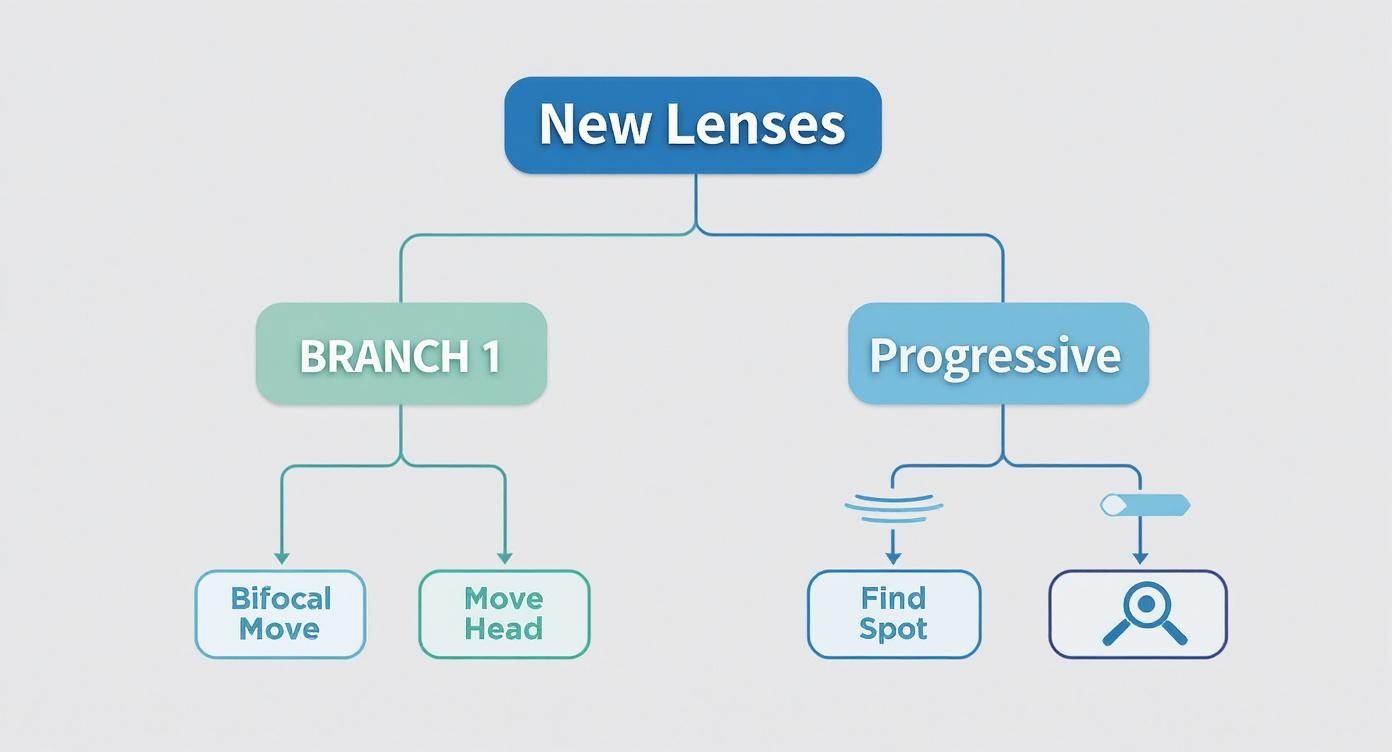
It’s a simple visual reminder: with bifocals, you’ll learn to move your head to switch between zones, while progressives are all about finding that "sweet spot" in the lens.
Experience the Best Optometrist in Glendale Heights
Our goal is to help you find glasses that you not only see perfectly with but also love to wear. Our team makes sure your chosen frames are expertly fitted to your new lenses, balancing both performance and style. We invite you to see what a truly personal approach to eye care feels like, right here in Glendale Heights. Your path to clear, comfortable vision starts at iDoctor.
FAQ: Your Lens Questions Answered
When you're trying to decide between bifocals and progressives, a lot of questions come up. We hear them all the time from our patients right here in Glendale Heights, so let's tackle some of the most common ones.
Can I use my vision insurance for these lenses at iDoctor?
Absolutely. We accept all major vision insurance plans here at iDoctor in Glendale Heights. Bifocal and progressive lenses are almost always a covered benefit, but the exact amount your plan pays can differ. Our team is great at navigating insurance and will help you get the most out of your benefits to make sure you get the best vision for your budget.
Which type of lens is better for driving on Army Trail Road?
That's a fantastic, real-world question. For daily commutes on roads like Army Trail Road or Bloomingdale Road, many of our patients find progressive lenses to be a clear winner. The smooth shift from looking at the road, to glancing at your dashboard, and then to your GPS is completely seamless—no disorienting image jumps. That said, the best way to decide is to chat with us about your driving habits during your detailed eye exams in Glendale Heights.
Will designer frames from Tom Ford or Prada work with both lens types?
Yes, and you've got great taste! Nearly all of our designer frames, including stunning pieces from Tom Ford, Prada, and Cartier, can be fitted with either bifocal or progressive lenses. Progressive lenses need a little more vertical space in the frame to fit all three vision zones. Our opticians are experts at ensuring the designer frames you love are a perfect functional match for the lenses you need, so your new glasses look amazing and work flawlessly.
Seriously, how long will it take to get used to progressive lenses?
It really does vary from person to person, but most people feel completely comfortable in their new progressives within a few days to about two weeks. The secret? Wear them consistently. It's tempting to retreat to your old glasses, but that just confuses your brain and makes the adjustment take longer. We’ll give you simple tips, and we’re always here for a follow-up to make any small tweaks you might need.
Ready to see the world more clearly? At iDoctor, we bring together expert eye care and a fantastic selection of designer eyewear for our community in Glendale Heights. Schedule your appointment and let us help you find your perfect fit.