Getting progressive lenses to work perfectly is part art, part science. The real magic isn't just in the prescription itself, but in a combination of precision measurements, smart frame selection, and a deep understanding of your daily life. This blend of technical skill and personal insight is what makes the difference between a frustrating pair of glasses and a seamless visual experience. At iDoctor in Glendale Heights, we specialize in creating that perfect blend for our clients.
Why a Perfect Fit Is the Secret to Loving Progressive Lenses
If you're in Glendale Heights and considering progressive lenses, you've come to the right place. Anyone who has struggled with multifocals knows the classic complaints: distorted peripheral vision, a "swimmy" feeling, or a viewing corridor that feels impossibly narrow. The honest truth? A precise, customized fit is the single most important factor in avoiding all that.

Unlike old-school bifocals with their jarring line, progressive lenses provide a smooth, gradual shift from distance to near vision. But for that sophisticated technology to work as intended, the accuracy has to be dead-on. Here at iDoctor, our warm, professional team uses a meticulous process to make sure your new progressives feel completely natural from day one.
The Foundation of Clear Vision
Success with progressives is built long before the lenses are even cut. It all starts with a conversation about you—what you do all day, your posture, and the unique geometry of your face and eyes.
A great fit is a harmony of several key elements:
- A Detailed Lifestyle Consultation: We'll talk about everything. How much time do you spend on the computer? Do you read in a recliner? What are your hobbies? This tells us where you need the clearest vision.
- Precise Ocular Measurements: We use advanced digital tools to get exact data for things like pupillary distance (PD) and segment height. It’s a game-changer for clarity.
- Thoughtful Frame Selection: Let's be honest, not every frame is cut out for a progressive lens. We’ll guide you to styles that look great and have the right dimensions for optimal performance.
- Expert Adjustments: Once your glasses are ready, the final fitting is where we fine-tune the frame so the optical center of the lens aligns perfectly with your pupil.
This thorough, step-by-step approach is why our patients walk out seeing the world with incredible clarity and comfort.
Your Local Glendale Heights Experts
At iDoctor, we know that a perfect fit starts with a perfect prescription, which is why our detailed eye exams in Glendale Heights are the essential first step. We want to make sure you see beautifully whether you’re enjoying a walk through Camera Park or just driving down Bloomingdale Road.
A perfect progressive lens fit doesn't just improve vision; it's a huge factor in improving the overall patient experience in your practice. When patients love their glasses, they trust their provider.
Think of us as your local experts, committed to solving the progressive lens puzzle for you. Our mission is to take what can be a daunting process and turn it into an experience that brings you comfort, clarity, and confidence in your new eyewear.
Starting with a Lifestyle-Focused Consultation
A successful progressive lens fitting doesn't start with a ruler or a fancy digital measurement tool. It starts with a conversation. Here at iDoctor, we’ve found that the single most critical step is getting to know your daily life first. This chat is more than just polite small talk; it's the diagnostic work that lets us truly customize your vision.
We aren’t just fitting you for lenses; we’re designing a visual experience that needs to blend seamlessly into everything you do.
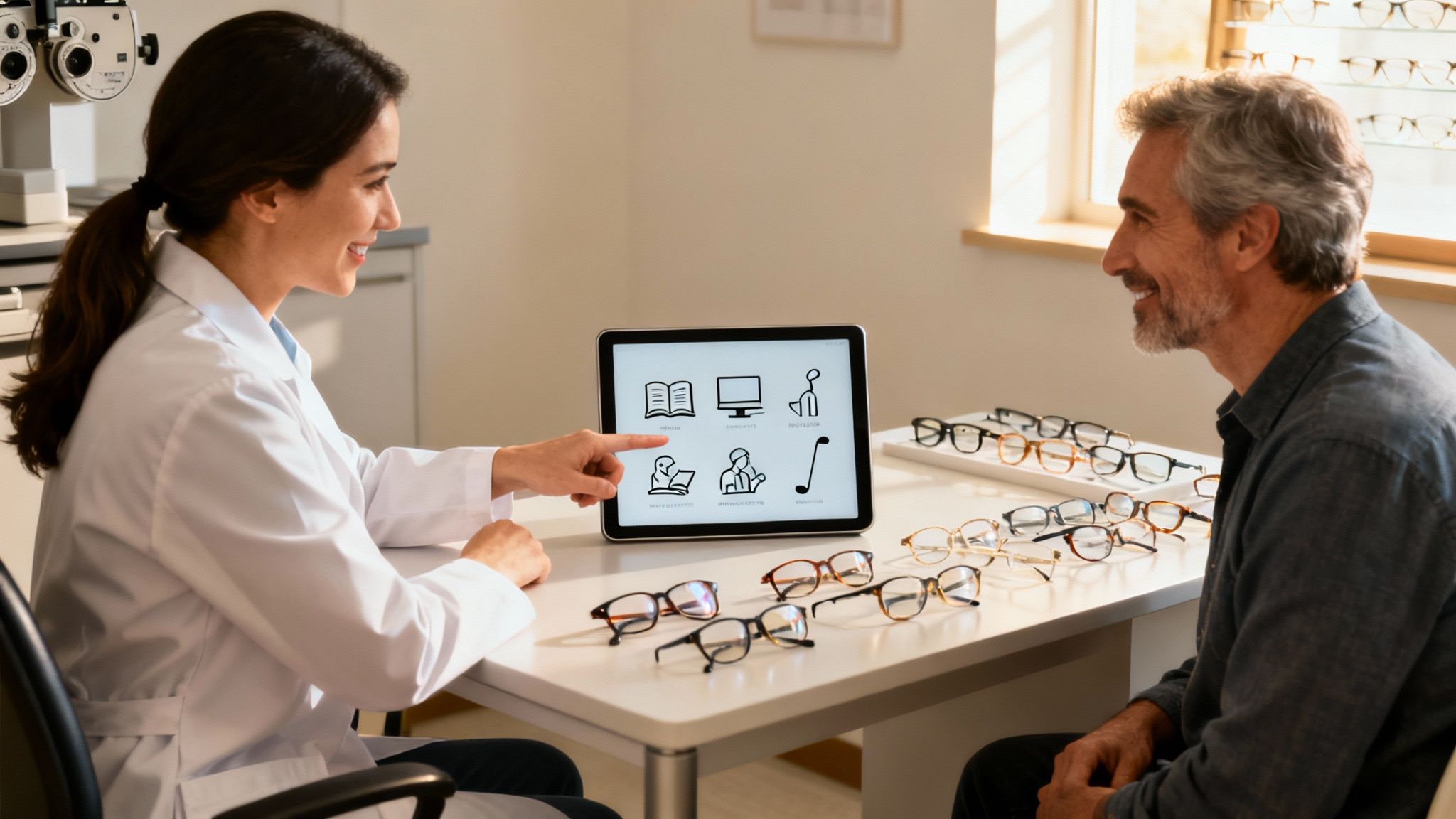
Think about it this way: the visual demands of a teacher at Glenside Middle School are incredibly dynamic. One moment they're reading a textbook, the next they're looking up at a student in the back row, and then they shift focus to a laptop. This happens over and over, all day long.
That’s a completely different world from a retiree who spends their mornings golfing at Glendale Lakes Golf Club and afternoons with a good book. Their visual priorities and even their head posture are entirely different, which means they need a different lens design and fitting strategy.
Discovering Your Visual Demands
To really understand your world, our optometrists ask specific, practical questions. These aren't just from a checklist; they're designed to uncover the small details of how you use your eyes all day.
We'll dig into things like:
- Your Work: Are you at a desk with multiple computer monitors? Or are you a contractor who needs to see blueprints up close before scanning a whole job site?
- Your Hobbies: Do you spend hours reading? Are you a musician who needs to see sheet music? Maybe you love driving the scenic routes along North Avenue on the weekends.
- Your Screen Time: How many hours a day are you on a smartphone, tablet, or computer? How far do you typically hold your devices?
- Your Driving Habits: Do you drive a lot at night? Do you rely on a GPS mounted on your dashboard?
Your answers help us match you with the right progressive lens. Some designs have much wider reading areas, while others prioritize a broader intermediate zone for heavy computer use. Without this lifestyle deep-dive, we'd just be guessing. Knowing what to ask is everything, which is why we created a guide covering the 5 essential questions to ask your optometrist during an eye exam in Glendale Heights.
Setting Clear Expectations for Success
A huge part of this initial talk is about setting expectations. Progressive lenses are fantastic, but they're not magic. There’s always a short adaptation period, and we’re upfront about what you can expect as your brain gets used to a new way of seeing.
We’ll break down key concepts in plain English. For instance, we'll explain the visual 'corridor'—the central channel in the lens with the clearest vision—and teach you the "point your nose" rule. We'll also talk about the soft focus you'll notice in your peripheral vision, which is a normal characteristic of all progressive lens designs.
By getting all of this out in the open from the start, we eliminate surprises. It empowers you with the knowledge to adapt quickly and confidently, building the kind of trust that defines the iDoctor experience.
Ultimately, this lifestyle consultation is the foundation for a perfect fit. It ensures your new glasses are far more than just the right prescription; they're a personalized tool built to enhance every part of your life. It's this dedication that makes us a leading eye doctor in Glendale Heights for complex vision needs.
Choosing the Right Frame and Lens Technology
Once we've dialed in on your unique visual needs, it's time for the fun part: picking the hardware. This is where the science of optics meets your personal style, and getting this combination right is absolutely critical for a great experience with progressive lenses. The frame you choose is far more than a fashion accessory—it's the very foundation that holds the complex optics of your new lenses.
At iDoctor in Glendale Heights, our team is here to guide you through a handpicked collection that includes everything from stunning Cartier and Gucci frames to the timeless appeal of Ray-Ban. We'll work with you to find a frame that not only looks fantastic but has the proper dimensions to make your progressive lenses perform flawlessly.
Why Your Frame Choice Is So Important
Not all frames are built the same, especially when we're talking about progressives. The shape and size of the frame directly dictate how well the lens can do its job. A frame that's too short or sits awkwardly on your face can seriously disrupt the different viewing zones, making adaptation a real challenge.
Here are the key characteristics we meticulously evaluate:
- Vertical Height: The frame needs enough vertical real estate to house the entire lens design—from your distance vision at the top, through the intermediate corridor, all the way down to the reading area. A frame that’s too shallow will simply chop off the bottom of the lens, rendering the reading portion useless.
- Pantoscopic Tilt: This is just the angle that the bottom of the frame tilts in toward your cheeks. A little tilt is good; it helps align the lens optics with your eye as you look down to read. We fine-tune this to make sure you’re looking through each zone at the perfect angle.
- Vertex Distance: This measures how far the back of the lens sits from the front of your eye. Keeping this distance just right is crucial for your prescription to feel accurate and clear.
Nailing these details is what makes the sophisticated technology in your lenses work as it should. For a deeper dive into how different styles can affect your vision, take a look at our guide on the different types of spectacles frames.
Unpacking Progressive Lens Technology
Just like frames, progressive lenses themselves have evolved dramatically. Gone are the days of one-size-fits-all designs. Today's lens technology offers a range of options for different lifestyles and budgets. The market for these lenses is booming, valued at USD 6.13 billion in 2024 and projected to hit USD 10.5 billion by 2035. This growth is driven by incredible innovations like freeform technology, which custom-crafts the lens for your eyes. You can find more details on the growing progressive lens market on wiseguyreports.com.
So, what are your main options? Let's break down the world of progressive lenses to help you understand the technology you'll be wearing every day.
Progressive Lens Design Comparison
| Lens Type | Key Feature | Best For | Example Scenario |
|---|---|---|---|
| Standard | Traditional, pre-molded design with a narrower field of view. | Budget-conscious wearers with simpler prescriptions. | Someone who needs their first pair of progressives for general use and isn't on a computer all day. |
| Customized | Digitally surfaced on the back of the lens for a wider, clearer view. | Most wearers, as it offers a significant visual upgrade. | An office worker who needs to switch between their computer screen, paperwork, and looking across the room. |
| Personalized | Tailored to your prescription, frame, and wearing habits. | Wearers with high prescriptions, astigmatism, or specific visual demands. | An architect who needs crisp vision at their drafting table, on their monitor, and looking at a job site. |
While a standard lens gets the job done, most people find the visual comfort and wider fields of view in a customized or personalized lens to be a worthwhile investment. The adaptation is often much quicker and the "swim and sway" effect is dramatically reduced.
For patients with higher prescriptions, astigmatism, or very specific visual demands from their work or hobbies, customized freeform lenses often provide a night-and-day difference. The reduction in peripheral distortion alone is a game-changer for many.
Essential Add-Ons for Modern Life
Finally, let's talk about the finishing touches. Lens coatings and treatments are what protect your investment and elevate your visual comfort. Life around the Chicagoland area means dealing with all sorts of light—from the bright sun over Lake Michigan to hours spent under harsh office fluorescence.
- Anti-Reflective (AR) Coating: Honestly, this is a non-negotiable for any progressive lens. It cuts down on distracting glare from headlights, computer screens, and overhead lights. The result? Sharper vision, less eye strain, and lenses that look practically invisible.
- Blue Light Filtering: If you're on a digital device for hours a day, a blue light filter is a smart move. It can help ease digital eye strain and is thought to help regulate sleep patterns, especially if you enjoy screen time in the evening.
- Photochromic Lenses (Transitions): These are the ultimate convenience. The lenses automatically darken when you step outside into UV light, giving you a seamless two-in-one solution for both eyeglasses and sunglasses. They're perfect for anyone who is constantly moving between indoors and out.
By carefully pairing the right frame, the best lens technology, and the most practical coatings, we can build a pair of glasses that is perfectly tuned to your life in Glendale Heights and beyond. This is how we ensure you not only see your best but also feel incredible in your new eyewear.
The Art and Science of Precision Measurements
Once we’ve landed on the perfect frame and lens technology, we get down to the most critical part of the entire process: taking the measurements. This is where the magic really happens. Think of it like a bespoke suit—the finest material in the world won't matter if the tailoring is off by even a millimeter. Precision is everything.
At iDoctor, we rely on advanced digital tools during our detailed eye exams in Glendale Heights to capture a whole host of data points. This isn't your grandpa's ruler-and-a-sharpie method; it’s a sophisticated process that allows us to understand exactly how you wear your glasses and see the world.
Going Beyond Standard Pupillary Distance
One of the first measurements everyone thinks of is the pupillary distance (PD)—the space between your pupils. But for progressives, a single PD number just doesn't cut it. We need a monocular PD, which means measuring from the bridge of your nose to the center of each pupil individually.
Why the extra step? Because almost no one's face is perfectly symmetrical. Your right eye might be a bit closer to your nose than your left, or vice-versa. A monocular PD ensures the optical center of each lens is perfectly aligned with each eye. For progressive lenses, this is absolutely non-negotiable for comfortable, clear vision. If you want a deeper dive, we have a great article on how to measure your pupillary distance for the perfect eyewear fit in Glendale Heights.
This diagram helps visualize how the physical frame, lens, and coatings are the foundational choices we build upon with these precise measurements.
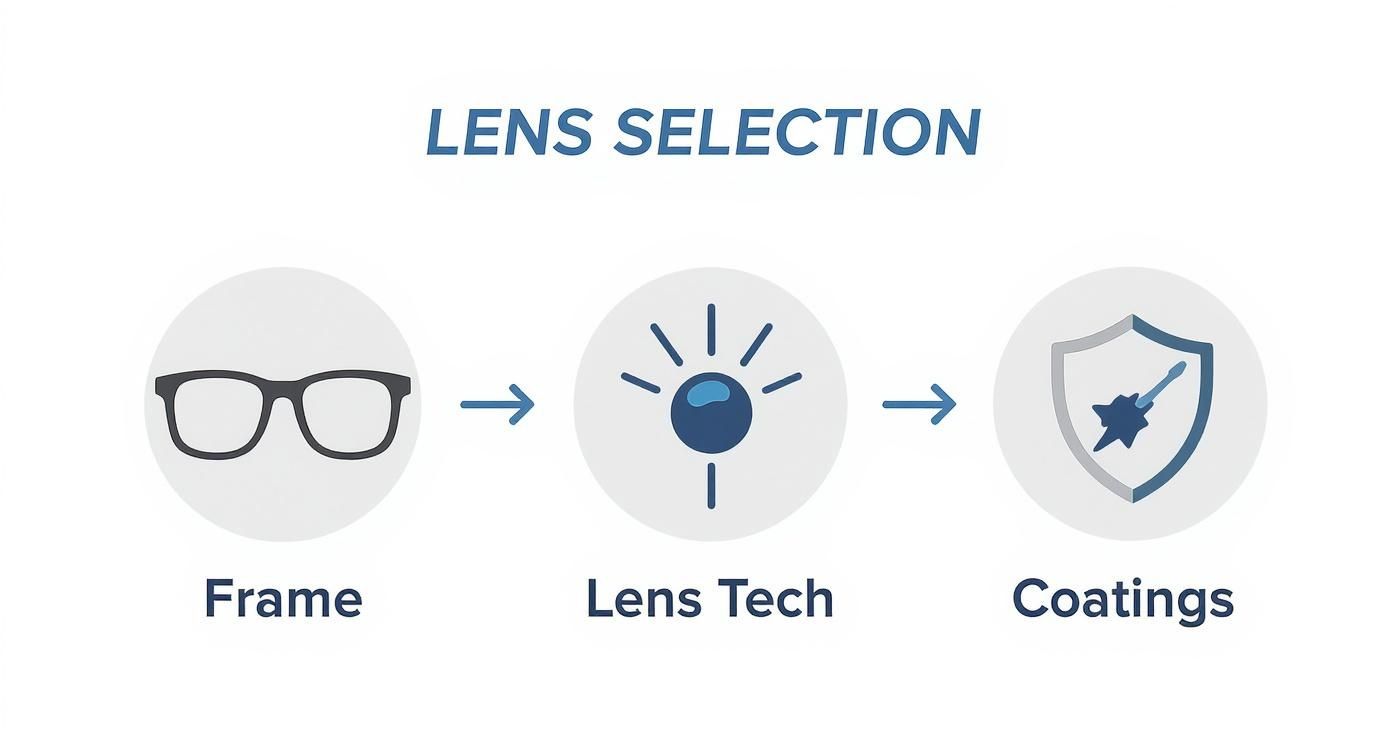
Think of these components as the high-quality canvas. Our job is to paint the masterpiece on it with exact measurements.
The Importance of Fitting Height
Next up is the fitting height. This is a vertical measurement, running from the very bottom of the lens in your chosen frame straight up to the center of your pupil. This single number dictates where all the different zones of your progressive lens will sit.
Get it wrong, and the whole experience can be thrown off. Too high, and you'll find yourself constantly tucking your chin to find the reading zone. Too low, and you'll be looking through the near-vision portion when you're trying to see into the distance—a disorienting and potentially dangerous situation. We always take this measurement while you're wearing the actual frame you've picked, standing in a natural posture, so the reading zone lands in the most intuitive spot.
A proper fitting height is the difference between a conscious, awkward head nod and a simple, effortless downward glance to read. It's the secret to making progressives feel like second nature.
Fine-Tuning with As-Worn Measurements
To get the absolute best performance out of modern digital lenses, we take a few final "as-worn" measurements. These account for the unique way a specific frame sits on your individual face, refining the optics for incredible clarity.
These include:
- Pantoscopic Tilt: This is simply the angle of the frame front as it sits against your face. Most frames have a slight downward tilt, which helps with the reading area, and we measure this precisely to optimize the lens design.
- Vertex Distance: This measures how far the back of the lens sits from your eye. It's a small distance, but it can have a big impact on how your prescription feels, so we nail it down.
- Frame Wrap Angle: This is the curve of the frame as it follows your face. Sportier, more wrapped styles require special calculations to prevent peripheral distortion.
By meticulously capturing all these data points, we're crafting a lens not just for your prescription, but for your face in your frame. This scientific, personalized approach is what elevates a good pair of glasses to an exceptional one. It’s this dedication to detail that makes us the best optometrist in Glendale Heights.
The Final Fitting: Bringing Your Vision to Life
This is the moment we've been working towards—when all the careful measurements and planning become a reality. The day you pick up your new glasses isn't just a quick handover; it's a dedicated dispensing appointment. Here, we'll verify every detail and make those final, critical adjustments that separate a good pair of glasses from a great one.
Our commitment at iDoctor is to ensure you walk out of our Glendale Heights boutique not just seeing clearly, but feeling confident and empowered to use your new progressives from day one.
First things first, we do a meticulous check. Using a digital lensometer, we confirm the prescription in your lenses matches what we ordered, down to the last decimal. Then, we place the glasses on you and verify that all our fitting marks—the monocular PD and fitting height—are perfectly aligned with your pupils. This guarantees the lens's visual "corridor" is exactly where it needs to be for you to see effortlessly.
Fine-Tuning the Fit and Feel
Once we've confirmed the optics, our focus shifts to the physical fit of the frame. This is where an optician's hands-on expertise really shines. Even the most stunning Tom Ford or Oliver Peoples frame needs to be personally tailored to the unique contours of your face.
We concentrate on a few key areas to dial in the comfort:
- Temple Tips: We'll carefully shape the temple arms so they wrap snugly behind your ears. The goal is a secure fit that prevents slipping, but without any uncomfortable pressure points.
- Nose Pads: For metal frames, we adjust the nose pads to distribute the weight evenly and position the frame at the perfect height and distance from your eyes.
- Pantoscopic Tilt: We'll do one last check of the frame's angle on your face, ensuring it has that slight, almost imperceptible, inward tilt that makes the reading zone work its magic.
These subtle, hands-on adjustments are what truly make the glasses feel like they were made just for you.
Your Guide to Mastering Progressives
Now, it's over to you. We'll personally walk you through the "how-to" of using your new lenses. Getting the hang of progressives is all about building a few new habits that will quickly become second nature. The technology behind progressive lens fitting has come a long way in the last decade, with innovations like freeform lens surfacing—which is standard in our practice—leading to wider fields of view and much faster adaptation times. If you're curious, you can learn more about these advancements in progressive lens technology.
Here are the simple techniques we share with every new progressive wearer:
- Point with Your Nose: This is the golden rule. Instead of just darting your eyes to the side, get into the habit of turning your head and pointing your nose directly at what you want to see. This keeps your vision locked into the clearest part of the lens.
- Discover Your Zones: We'll have you practice finding the three main viewing areas. Look straight ahead for distance (like looking across the room), drop your gaze slightly for intermediate tasks (like your computer), and look further down for close-up reading.
- Handle Stairs and Curbs with Confidence: When looking down at your feet, you’ll be looking through the reading portion of the lens, which can make things seem a bit off. The trick is to simply tuck your chin down, which allows you to look through the top, distance part of the lens.
Mastering these simple movements is the secret to a quick, successful adaptation. It’s a bit of muscle memory, but most people find it becomes automatic within just a few days of consistent wear.
By the time you walk out onto Army Trail Road, our goal is for you to feel genuinely excited and prepared. This final step is all about building your confidence, so you can start enjoying your new, clear world right away.
Troubleshooting Common Adaptation Challenges
Even with the most precise measurements and a perfect fit, your brain still needs a little time to get used to progressive lenses. It's completely normal to feel a bit "off" for the first few days—this is a temporary phase while your brain and eyes learn this new way of seeing. My goal is to get you through that brief adjustment period and on your way to clear, comfortable vision.
Think of this section as your field guide for those first couple of weeks. We’ll walk through the most common bumps in the road, why they happen, and what you can do about them. And remember, our team here in Glendale Heights is always ready to help with a quick frame adjustment if you need it.
"The Sides of My Vision Seem Blurry"
One of the first things nearly everyone notices is a bit of softness or blur along the edges of their vision. This isn't a defect; it's just part of how a progressive lens is designed. The power has to change gradually from top to bottom, and that creates some distortion on the periphery.
The trick is learning a new habit: point your nose, not just your eyes.
When you want to look at something to your left or right, turn your head slightly instead of just darting your eyes to the side. This keeps your gaze centered in the clearest part of the lens, known as the "corridor." It might feel a little strange at first, but after a few days, it’ll become second nature.
"I Feel a Little Off-Balance or Dizzy"
That "swimmy" or disorienting feeling, especially when you're walking around or turn your head quickly, is another common experience. This sensation is almost always tied to the fit of the frame on your face, particularly an angle called pantoscopic tilt.
If you're still feeling off-kilter after a day or two, it’s a strong sign that a small frame adjustment will fix it. Pop into our Glendale Heights boutique, and we can tweak the tilt or adjust how the frame sits on your nose. You'd be surprised how much of a difference a tiny change can make.
A small adjustment, sometimes just a few degrees, can make a world of difference in how your brain processes the new visual information. It’s often the quickest fix for feelings of dizziness.
We've put together a more in-depth resource on what to expect, and you can learn more about adjusting to progressive lenses in our detailed guide.
"Finding the Reading Area Is Tricky"
Finding that "sweet spot" for reading without tilting your head back at an awkward angle can be a real challenge at first. This usually comes down to either the fitting height measurement or simply getting used to a new posture for near tasks.
Before you get frustrated, try these simple techniques:
- Lower your eyes, not your head. Keep your head in a comfortable, neutral position and just let your gaze drop down into the bottom of the lens.
- Bring your reading material down. Instead of craning your neck, try holding your phone, tablet, or book a little lower than you used to.
- Practice, practice, practice. Sit on the couch and practice looking up at the TV, then down to your phone, and back up again. This helps build the muscle memory needed to find the right spot instantly.
If you’ve tried these tips and it still feels like a struggle, we'll need to take another look. As the best optometrist in Glendale Heights, we're committed to making sure your lenses work seamlessly for you.
Here's a quick cheat sheet for some of the most common issues new progressive wearers face and what you can do about them.
Common Progressive Lens Problems and Solutions
| Symptom | Potential Cause | What to Do |
|---|---|---|
| Blurry Side Vision | Inherent peripheral distortion in all progressive lenses. | Turn your head to look at objects ("point your nose"). Avoid glancing with just your eyes. |
| "Swimmy" Sensation | Incorrect pantoscopic tilt, vertex distance, or frame wrap. | Visit your optician for a frame adjustment. A small tweak often solves this immediately. |
| Reading Area is Too Low | Incorrect fitting height measurement or patient posture. | Try dropping your eyes instead of your head. If that fails, the fitting height may need to be re-measured. |
| Headaches or Eye Strain | Brain is adapting; incorrect PD or prescription. | Give it a few days. If it persists, schedule a follow-up to verify all measurements and the prescription. |
| Clear Vision is Too Narrow | Lens design may not match visual needs (e.g., standard vs. "short corridor" lens). | Discuss your daily activities with your optician. A different lens design may be more suitable. |
Most of these initial hurdles are easily cleared with a bit of practice and sometimes a quick, minor adjustment from a skilled optician. Don't hesitate to reach out if things don't feel right after a week.
FAQs about Progressive Lenses in Glendale Heights
If you're considering progressive lenses for the first time, you probably have a few questions. That's completely normal. Here in our Glendale Heights boutique, we’ve heard just about all of them, so we've put together some answers to the most common ones we hear from our patients.
How long does it take to get used to progressive lenses?
This is hands-down the most frequent question we get. For most people, the adjustment period is surprisingly short—anywhere from a few days to about two weeks. The real secret is consistent wear. Don't switch back and forth with your old glasses. At iDoctor, our precise fitting process dramatically cuts down on adaptation time, helping you see clearly whether you're driving on Army Trail Road or reading at home.
Can I use my vision insurance on designer frames at iDoctor?
Absolutely! We believe that great vision and great style go hand-in-hand. iDoctor accepts all major vision insurance plans, and you can apply your benefits toward any frame in our collection, including luxury brands like Cartier, Gucci, and Tom Ford. Our team is fantastic at helping you find designer eyeglasses in Glendale Heights and get the most out of your plan, ensuring you get the perfect pair without compromise.
What's the difference between your fitting and buying online?
The difference is everything. An online retailer can't replicate the in-person expertise and precision measurements required for progressive lenses. We take exact data, like your monocular pupillary distance and specific fitting heights, while you're wearing your chosen frame. A tiny error of just a millimeter can make the lenses ineffective. Our Glendale Heights optometrists ensure your lenses are perfectly mapped to your eyes and posture for the sharpest, most comfortable vision possible.
Do I really need a full eye exam for a progressive lens fitting?
Yes, starting with a comprehensive eye exam is crucial. A perfect fit relies on an up-to-date and highly accurate prescription. Our detailed eye exams in Glendale Heights use high-resolution imaging to ensure your prescription is flawless before we even begin the fitting process. This foundational step guarantees the best possible outcome for your new progressive lenses.