That sinking feeling you get when you see a fresh scratch on your glasses? We’ve all been there. It’s a common frustration for folks right here in Glendale Heights. Your first instinct might be to google a quick fix, but as eye care professionals, we want to be blunt: most permanent scratches simply cannot be removed at home without making things much, much worse. This guide is about what actually works for minor issues versus what’s just a dangerous myth.
Your Realistic Guide to Fixing Scratched Glasses
A scratch right in your line of sight can ruin your whole day, whether you're driving down North Avenue or just trying to read an email. It’s so tempting to look for a fast solution online, but many of those popular DIY "hacks" can permanently wreck the very coatings that protect your eyes and keep your vision sharp.
Before you even think about reaching for toothpaste or baking soda, you have to understand what you're working with. Modern lenses aren't just simple pieces of plastic anymore. They’re sophisticated optical tools with multiple, high-tech layers.
Most quality lenses today come with:
- Anti-reflective coatings that cut down on glare from headlights and screens.
- Scratch-resistant coatings for a first line of defense against everyday wear.
- UV protection to shield your eyes from harmful sun exposure.
- Blue light filters which can help reduce eye strain from all that screen time.
When you grab an abrasive paste to try and "buff out" that scratch, you’re not really fixing anything. You're actually grinding away these vital layers. The result? You could end up with a hazy, distorted lens that glares more than ever and is even more prone to future damage.
Key Takeaway: Trying to polish a scratch out of a coated lens almost always creates a bigger, more distracting problem than the original scratch. You risk completely ruining your anti-glare or UV coatings, and that's damage you can't undo.
First, Figure Out What Kind of Scratch You Have
It's important to remember that not all scratches are the same. A tiny surface scuff you got from accidentally setting your glasses lens-down is a world away from a deep gouge from dropping them on the pavement near Camera Park. A superficial mark might just be on the very top coating, but a deep scratch cuts right into the lens material itself, changing its structure for good.
This difference is everything. It's the single most important factor in deciding what to do next. While you might be able to temporarily hide a very minor scuff, a genuine scratch can't be safely repaired at home. That's why taking a moment to assess the damage is your first, and most crucial, step.
To help you out, here’s a quick way to gauge what you’re dealing with and what your safest options are.
Quick Guide: Scratch Severity and Recommended Actions
| Scratch Severity | Appearance | DIY Potential | Professional Help Recommended? |
|---|---|---|---|
| Minor Scuff | A very faint mark, often only visible when you tilt the lens in the light. Doesn't distort vision. | Very low. Some lens cleaning waxes might temporarily fill it, but results vary and are not permanent. | Maybe. An optician can confirm if it's just the coating and offer solutions. |
| Noticeable Scratch | A visible line that you can feel slightly with your fingernail. It might be distracting in your peripheral vision. | Not recommended. Abrasives will strip coatings and create a large, smudged area. | Yes. A professional needs to assess if the lens can be salvaged or needs replacement. |
| Deep Gouge | A deep line you can easily feel with a fingernail. It clearly obstructs and distorts your vision. | Absolutely not. Any attempt will permanently ruin the lens and its optical integrity. | Definitely. The lens is compromised and will need to be replaced. |
Ultimately, a professional assessment is always the safest bet. It's better to know for sure than to risk your vision on a guess.
When It's Time to Call in a Professional
Here at iDoctor, our first priority is helping our Glendale Heights neighbors protect their vision and the investment they've made in their eyewear. We get how frustrating damaged glasses are, whether they're your trusty Ray-Bans or a new pair of beautiful Cartier frames.
Bringing your glasses to an expert is the only way to get a truly reliable diagnosis. We can tell you exactly how deep the scratch is and walk you through the best options, which usually means replacing the lens. We can even help you find a great new pair from our collection of designer eyeglasses in Glendale Heights. Before you risk your eyesight on a risky home remedy, let us guide you toward the right solution for clear, comfortable vision.
How to Properly Assess Scratched Lenses
Before you even think about grabbing a "miracle" scratch remover, let's take a step back. The single most important thing you can do is properly assess the damage. I’ve seen too many people rush into a so-called fix, only to make the problem a hundred times worse. A few moments of careful examination can tell you if you're dealing with a minor cosmetic issue or something that needs a professional’s touch.
First things first, you need good light. Find a bright spot near a window or grab a lamp. Give your glasses a proper cleaning with a lens-safe spray and a clean microfiber cloth. You’d be surprised how often a stubborn smudge or fleck of debris can look exactly like a scratch.
Once they're clean, hold them up and tilt them back and forth. You're looking for how the light plays across the surface. This little trick will make any imperfections pop, revealing what you're really up against.
Differentiating Surface Scuffs from Deep Scratches
Not all scratches are the same—not by a long shot. Knowing the difference is everything. Is it a faint, wispy line you can only see from a certain angle? Or is it a noticeable groove that’s impossible to ignore?
- Surface-Level Scuff: This usually looks like a very light haze or a shallow mark. It’s typically just in the top layer, like the anti-reflective or scratch-resistant coating. Annoying? Yes. Vision-impairing? Usually not.
- Deep Scratch: This is the real problem. A deep scratch has dug through the protective coatings and into the lens material itself. It's the kind of damage that creates blurriness, distorts light, and becomes a constant distraction.
To help you figure out what you're dealing with, this decision tree can point you in the right direction.
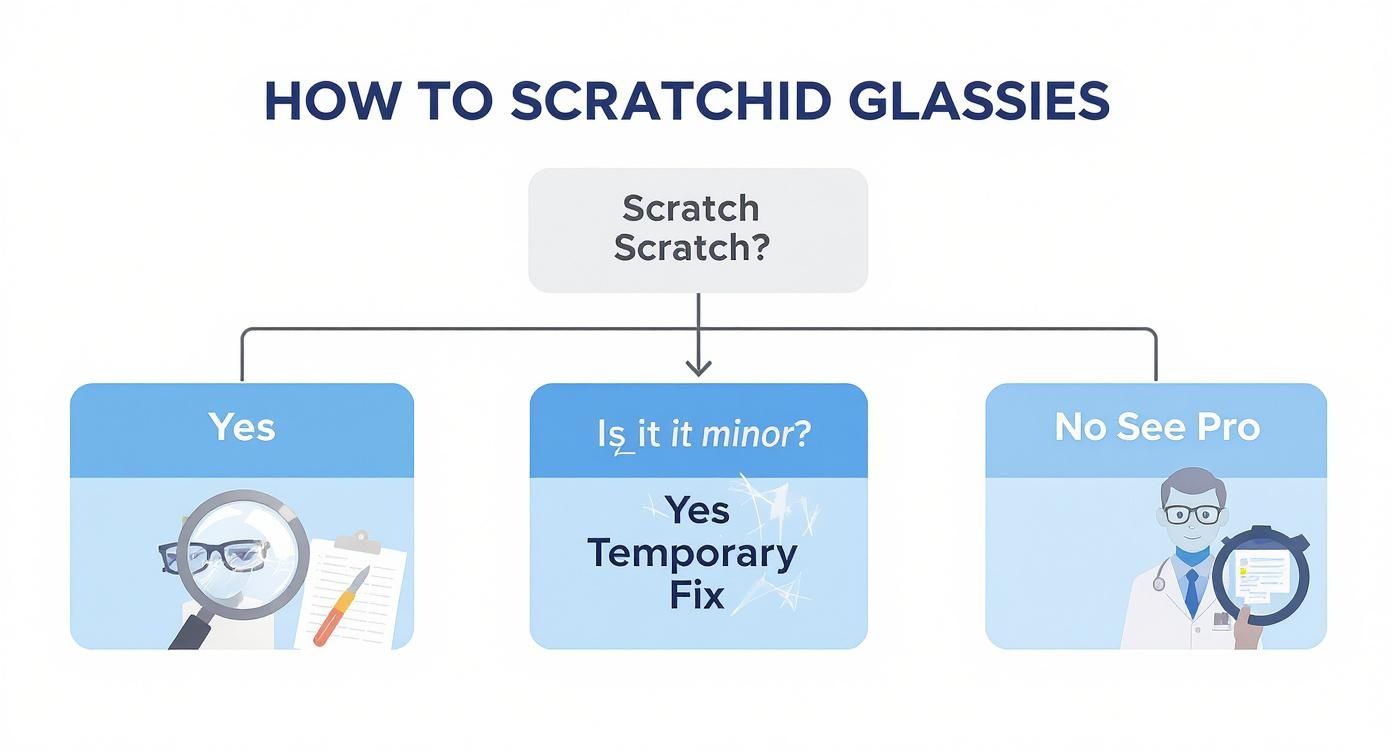
As you can see, the depth is the deciding factor. It's what separates a quick, temporary fix from a necessary trip to your optician.
Performing the Fingernail Test
One of the oldest tricks in the book is still one of the best for gauging scratch depth: the fingernail test. It’s a simple, tactile way to feel what your eyes can’t always see.
Gently, and I mean very gently, run your fingernail across the scratch. Don't apply pressure—you're not trying to dig in. If your nail glides right over the mark without catching, you're likely dealing with a minor scuff on the coating.
But if you feel your nail catch in the groove, even for a split second, that's your answer. The scratch is deep. It means the damage has breached the surface coatings and is now in the lens itself.
Key Takeaway: If a scratch is deep enough to catch your fingernail, it has compromised the lens. No at-home remedy is going to fix that. Trying to buff it out will only destroy the surrounding coatings, leaving you with a huge, hazy patch that's far worse than the original scratch.
Considering the Lens Material
The type of lenses you have matters, too. For instance, polycarbonate lenses are incredibly tough against impacts, but they’re a softer material that can be more prone to scratching than, say, high-index plastic. If you're curious about how different materials stack up, you can learn more about the pros and cons of polycarbonate eyeglass lenses in our detailed guide.
Knowing your lens material helps set realistic expectations for both their durability and your repair options.
Ultimately, taking the time to do a thorough assessment saves you a world of frustration. When you know exactly what you're dealing with from the start, you can avoid those risky DIY experiments that promise the world but only deliver permanent damage.
Safe At-Home Methods for Minor Surface Scuffs
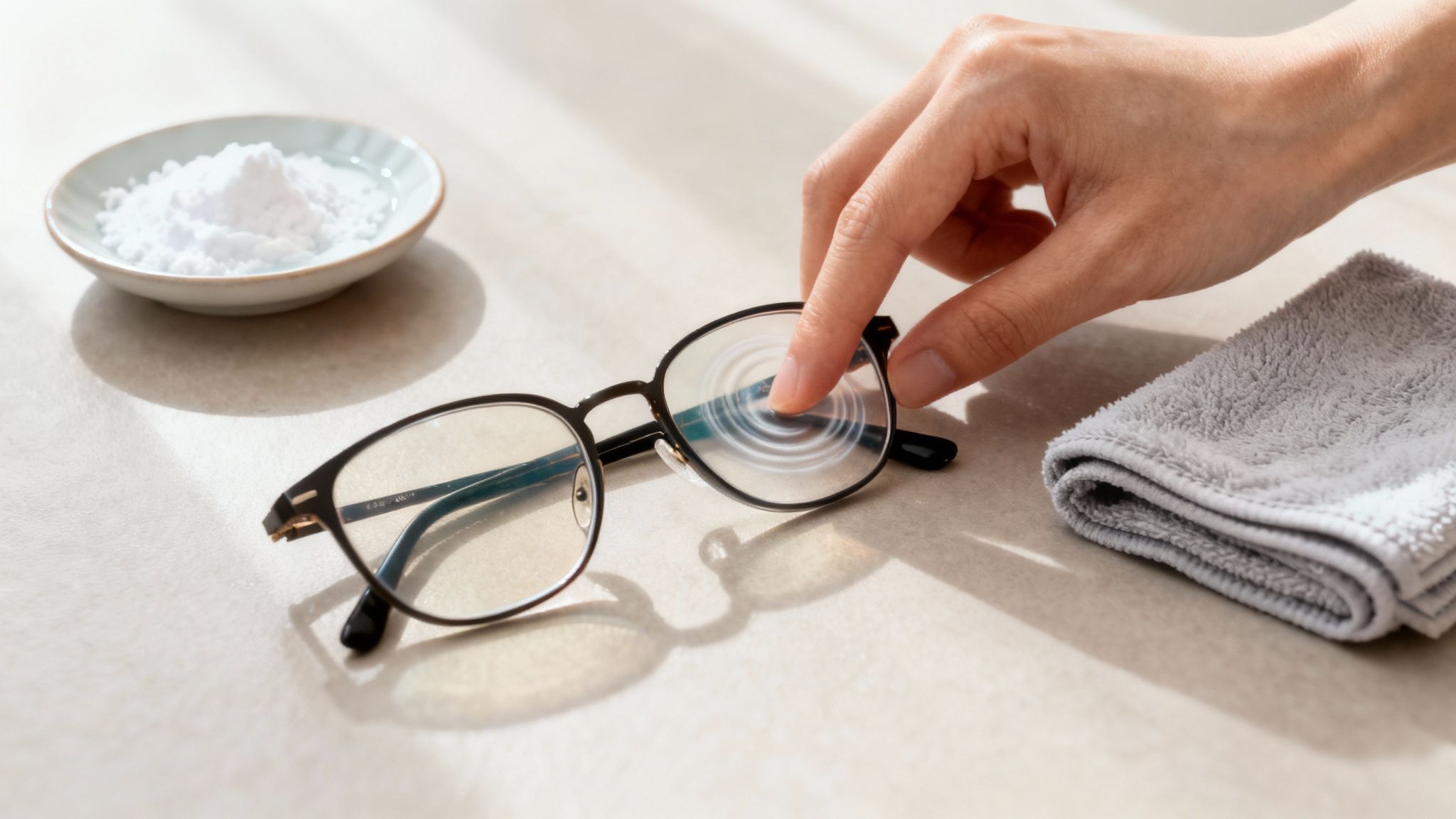
Let’s get one thing straight right away: no home remedy will truly remove a scratch from a lens. It’s just not possible. What these methods attempt is to subtly polish or fill in a microscopic scuff on the outermost coating, making it less noticeable for a short time. Think of it as a temporary cosmetic touch-up, not a genuine repair, and it only works for the most insignificant marks.
Before you even think about trying a fix, your lenses must be perfectly clean. A single speck of dust can turn your gentle effort into a disaster, acting like sandpaper and making the problem worse. We have a complete guide on the right way to do this, so check out the proper technique for how to clean your glasses lenses properly. Sometimes, a thorough cleaning reveals that what you thought was a scuff was just a stubborn smudge.
These techniques are a last resort. Proceed with extreme caution and only on the tiny surface scuffs you identified earlier.
The Baking Soda Paste Method
If you’re sure you're dealing with a very light surface mark, a simple paste of baking soda and water is one of the mildest things you can try. Baking soda is a soft, fine abrasive that can sometimes smooth out the microscopic edges of a scuff on the lens coating.
Here’s the safest way to go about it:
- Make the paste. Mix about two parts baking soda to one part water. You're aiming for a thick paste, something with the consistency of toothpaste that won’t run all over the lens.
- Apply a tiny amount. Use a clean, lint-free microfiber cloth—never your shirt or a paper towel—to dab a small bit of paste directly onto the scuff.
- Use gentle, circular motions. With the absolute lightest pressure, rub the paste over the mark in a soft circular motion for no more than 10-15 seconds. Let the paste do the work, not your elbow grease.
- Rinse it all off. Hold the lens under cool, running water until every trace of the paste is gone.
- Dry and inspect. Carefully pat the lens dry with a fresh microfiber cloth and check your work under a bright light.
If the scuff looks a little better, stop. Don't get greedy. Trying again and again can wear down the anti-reflective coating and create a permanent hazy spot that’s far worse than the original scuff.
Understanding the Risks and Limitations
Even the most careful DIY methods come with big risks, especially for high-end eyewear. Modern lenses, like the ones we fit for our Cartier and Tom Ford frames, aren’t just simple pieces of plastic. They have advanced, multi-layered coatings that are precisely engineered to cut glare, block UV rays, and resist smudging.
The global market for these specialized lens coatings was valued at around $2.5 billion in 2025, and that number is expected to keep climbing. This huge investment shows how important these coatings are for visual quality and durability, improving user satisfaction and cutting down on replacement costs.
When you use any abrasive—even something as mild as baking soda—you are fundamentally changing that microscopic surface. Rubbing too hard can strip these coatings away, causing permanent smudges, more glare, and making your lens even more prone to future damage.
A Quick Word on Polishing Principles
The basic idea of using a fine abrasive to smooth a surface isn't new. It’s the same core principle behind learning how to remove car scratches with DIY tips, where you use finer and finer grits to smooth out a clear coat.
But an eyeglass lens is a precision optical instrument, not a car door. Its specific curvature and coatings are vital for your vision. Any change, no matter how tiny, can mess with its optical integrity. That's why what works on other surfaces is so dangerous for your glasses.
These methods are not real repairs. They are a temporary cosmetic trick. For any scratch you can feel with a fingernail or that gets in your line of sight, the only real solution is professional help and, most likely, a lens replacement. Trying to fix it yourself will almost certainly turn a small annoyance into a costly mistake.
Why Most DIY Scratch Removal Hacks Just Make Things Worse
If you've ever searched online for how to fix scratched glasses, you’ve probably seen a ton of "quick-fix" hacks. They promise a cheap, easy solution using things you already have at home, like toothpaste or baking soda. It sounds tempting, I get it. But as an eye care professional, I can tell you these are the fastest ways to permanently ruin a good pair of glasses.
The truth is, your glasses aren't just simple pieces of plastic or glass anymore. They're sophisticated optical tools. Those lenses, whether in a pair of Gucci frames or your trusty daily wear, have multiple, ultra-thin coatings that are critical for clear vision and protecting your eyes. These layers reduce glare, block UV light, and resist scratches—and they are incredibly delicate.
When you take an abrasive like toothpaste and start rubbing, you aren't polishing out a scratch. You're literally sanding off those essential coatings, creating a bigger, blurrier mess than you started with.
The Problem with Abrasives
Most of the household products recommended in these online "hacks" are, by their very nature, destructive to your lenses. They work by removing material, which is the exact opposite of what you want to do to a precision lens.
Let's break down why some of the most popular hacks are so terrible for your glasses:
- Toothpaste: Most toothpastes contain harsh abrasives like hydrated silica. These are meant to scrub tough plaque off your teeth, not gently polish a lens coating. Using it will scour away your anti-reflective layer, leaving you with a permanent, hazy smudge right in your line of sight.
- Baking Soda: People think of it as a gentle cleaner, but it’s still an abrasive. Rubbing a baking soda paste on your lenses will slowly but surely wear down those delicate coatings, especially on premium lenses.
- Car Wax or Furniture Polish: These are designed to fill in scratches on hard, non-optical surfaces like paint or wood. On your glasses, they just smear a greasy film that distorts light, creates a rainbow effect, and makes it impossible to see clearly.
- Glass Etching Cream: This is by far the most dangerous one. These creams contain hydrofluoric acid, a chemical that literally dissolves glass and plastic. It will permanently destroy your lenses and their coatings the moment it touches them.
Here's the bottom line: you can't "buff out" a scratch without removing the material around it. When you do that on a lens with specialized coatings and a precise prescription curve, you destroy its optical integrity. You ruin what makes the lens work.
You're Destroying More Than Just the Surface
The damage from these so-called fixes goes way beyond just a blurry spot. You're actually stripping away the very technology you paid for.
When that anti-reflective coating is gone, you'll suddenly notice a lot more glare from headlights at night and reflections from your computer screen, which can lead to serious eye strain and headaches. If you want to understand why this coating is so important, take a look at our guide to the best anti-reflective coating for glasses.
This isn't minor damage, either—it's permanent. There's a reason the market for high-tech, scratch-resistant glass was valued at around USD 6.12 billion in 2022 and is expected to more than double by 2030. A massive amount of R&D goes into these coatings. Once you've scrubbed them off, there’s no putting them back on.
Ultimately, trying a DIY scratch removal hack is a gamble you are almost guaranteed to lose. You risk turning a small, annoying scratch into a huge, vision-impairing problem that requires a costly lens replacement. Don't reach for the toothpaste. The smartest move is always to protect your investment—and your vision—by seeking professional advice.
When It’s Time to Call in a Professional for Scratched Glasses
It’s always tempting to look for a quick DIY fix for scratched glasses, but here's the honest truth from an expert: once a prescription lens is scratched, its optical quality is permanently damaged. There really is no home remedy that can fix the scratch without also risking the precise curvature of your lens or stripping away its essential coatings.
That's why bringing your glasses to an eye care professional is always the smartest—and safest—move.

Trying to buff out a scratch isn't like polishing your car. You’re working with a highly precise medical device. Any attempt to grind down the surface will permanently change how light travels through the lens, which can lead to even worse eye strain and visual distortion than the original scratch caused. Bringing them to your local eye doctor in Glendale Heights is the best first step you can take.
What to Expect During a Professional Consultation
When you stop by our boutique, we do more than just give the scratch a quick look. We conduct a detailed evaluation because we know your vision is far too important for guesswork.
Here’s a look at our process:
- Damage Assessment: First, we use specialized tools and proper lighting to see exactly how deep and where the scratch is. This helps us know if it's just on a surface coating or if it has dug into the lens material itself.
- Vision Impact Analysis: We'll chat with you about how the scratch is actually affecting you. Is it creating glare during your evening drive on Army Trail Road? Is it a constant distraction at your computer? Understanding this helps us gauge the urgency.
- Exploring Your Options: With all the information, we’ll give you clear and honest advice. In nearly every case involving a noticeable scratch, the only real solution is to replace the lenses.
Our main goal isn't just to sell you new lenses. It’s to restore your vision to be as clear and comfortable as it should be, safely. We'll walk you through why a replacement is the right call, ensuring you see how it protects both your eyesight and your investment in quality glasses.
Replacing your lenses is often more affordable than you might guess, especially since we accept all major vision insurance plans. Our team is great at helping you navigate your benefits to get the most out of your coverage and keep your out-of-pocket costs down.
The Real Value of a Professional Lens Replacement
Choosing to have your lenses replaced by a trusted optometrist gives you a peace of mind that no DIY fix ever will. We guarantee your new lenses are a perfect match for your prescription, crafted with precision, and fitted expertly into your frames. This ensures the optical centers are aligned perfectly for your eyes, preventing the headaches and strain that often come from glasses that aren't quite right.
The eyewear industry is huge—it's projected to bring in over $151 billion globally in 2025. Much of that growth comes from people choosing premium lenses with advanced coatings for their durability and clarity. Protecting that investment with professional care just makes sense.
And if your frames are looking a bit worn out, this might be the perfect time for an upgrade. We can help you browse our hand-picked collection of designer eyeglasses in Glendale Heights, with beautiful options from Prada, Saint Laurent, and Oliver Peoples. It can be tough to know when it's time for a change, which is why we created a helpful guide on https://idoctoril.com/blog/how-often-should-you-get-new-glasses/.
Preventing Scratches to Protect Your Eyewear
The old saying holds true: an ounce of prevention is worth a pound of cure. When it comes to your glasses, the easiest way to deal with a scratch is to make sure it never happens in the first place. A few simple, daily habits are all it takes to protect your investment and keep your vision crystal-clear.
So many scratches come from one common mistake—cleaning lenses with the wrong thing. Grabbing the corner of your shirt, a napkin, or a paper towel might feel like a quick fix, but those materials have rough fibers. They can trap tiny dust particles and grind them right into your lens coatings, creating a web of micro-abrasions over time.
Build Better Eyewear Habits
Consistency is everything. By making a few small actions part of your routine, you can dramatically extend the life of your lenses, whether you're rocking a pair of high-fashion Tom Fords or your trusty everyday Ray-Bans.
- Always Use Microfiber: The only cloth that should ever touch your lenses is a clean microfiber one. It's specifically designed to trap and lift away dirt and oil without abrading the surface.
- Stick to Approved Cleaners: For best results, pair that cloth with a cleaning spray made for eyeglass lenses. It will dissolve smudges and grime safely without damaging any special coatings.
- Store Them Properly: This one is huge. Whenever your glasses aren't on your face, they belong in a hard-shell case. Tossing them into a purse, pocket, or backpack is a recipe for disaster.
Think of a protective case as armor for your glasses. It creates a solid barrier against keys, phones, and anything else that could cause a deep, vision-blocking scratch. If you adopt only one new habit, make it this one.
Avoiding Environmental Damage
Beyond just how you handle them, protecting your glasses means being aware of your surroundings. Lenses can be surprisingly vulnerable to environmental factors you might not even think about. For a deeper look at how modern lens technology helps, check out our article on why next-generation lens coatings matter for scratch resistance and clarity.
One of the absolute worst places you can leave your glasses is on your car’s dashboard on a sunny day. That focused, intense heat can literally warp the frames and cook the delicate coatings on your lenses, causing them to craze, peel, and become far more prone to scratching.
A simple but effective trick? Always place your glasses lenses-up when you set them down. This avoids direct contact with gritty tables or countertops. The core idea is to always have a protective layer, a principle that applies to other tech as well; you can read about the benefits of using a screen protector for general device care, which operates on the same logic.
By making these small adjustments, our friends and neighbors here in Glendale Heights can keep their eyewear looking and performing like new for years.
FAQ: Your Questions About Scratched Lenses in Glendale Heights
We get a lot of great questions about eyewear care at our Glendale Heights boutique. Here are a few common ones we hear from our patients.
Can my optometrist just buff out the scratch?
Unfortunately, no. Your eyeglass lenses are precisely crafted medical devices with a specific curvature to correct your vision. Any attempt to "buff" or polish a scratch would alter that curvature, ruining your prescription and stripping away the protective lens coatings. The only safe and effective solution for a noticeable scratch is to replace the lens.
Where can I get designer eyeglasses near me in Glendale Heights?
You're in the right place! At iDoctor, we offer a curated collection of luxury and designer eyewear from top brands like Cartier, Gucci, Tom Ford, Oliver Peoples, and more. We also carry a wide range of affordable brands like Ray-Ban and Coach. We can help you find the perfect frame and ensure your new, scratch-free lenses are fitted with expert precision.
Does vision insurance cover scratched lenses?
In many cases, yes! Most vision insurance plans, including VSP and EyeMed, offer benefits or warranties that can significantly lower the cost of replacing damaged lenses. At iDoctor, we accept all major vision plans and can help you understand your specific coverage to ensure you get the best value when it's time for a replacement.
Your vision is too important to put up with a compromised lens. If you’re tired of looking through scratches, let the experts at iDoctor help you see clearly again. Serving Glendale Heights and the surrounding Chicagoland suburbs, we're here to provide the best care for your eyes. Schedule one of our detailed eye exams in Glendale Heights today, and we'll explore your best options together.