Trying to figure out your insurance for an eye exam in Glendale Heights can feel like a puzzle, but it's usually more straightforward than it seems. The great news is that most vision plans cover a big chunk of your annual check-up and eyewear, making it much easier to keep your eyes healthy and your glasses up-to-date without breaking the bank. At iDoctor, our goal is to help our neighbors here in Glendale Heights understand and use their benefits with confidence.
Your Guide to Navigating Eye Exam Insurance
If you're in Glendale Heights, maybe driving down North Avenue or heading to the Glendale Lakes Golf Club, you've probably wondered how your insurance works for eye care. We get these questions all the time at iDoctor, so we put together this guide to clear things up. We'll walk through the difference between vision and medical insurance and how they both play a role in keeping your eyes healthy.
Knowing your coverage ahead of time can save you a lot of money and stress. This guide is your roadmap—it lays out everything you need to feel confident about using your benefits at our local boutique, from the exam room to picking out your next pair of glasses.
Why Your Insurance Matters
Think of your eye exam insurance as a key part of your overall wellness plan. It’s not just for when things get blurry; it’s a proactive tool that helps you protect your sight for the long haul. If you want a good primer on the basics, understanding what health insurance is and how it works provides a great foundation for everything else.
Using your insurance for regular eye exams is a smart move for a few reasons:
- Early Detection: Many serious eye diseases, like glaucoma and macular degeneration, don't have early symptoms. An annual exam is the best way to catch them before they can cause permanent vision loss.
- Overall Health Insights: Your eyes are a window to your health. We can spot early signs of conditions like diabetes and high blood pressure just by looking at the blood vessels in your retina.
- Financial Savings: Exams and eyewear can be expensive. Your benefits dramatically lower what you pay out-of-pocket for everything from check-ups to new contacts.
At iDoctor, our goal is simple: we want every Glendale Heights resident to enjoy clear vision and great health. That's why we make it a point to accept all major vision insurance plans. You can check out a full list of the insurance plans we accept right on our website to see if yours is included. We want your visit to be smooth and simple, from the moment you book your appointment to the fun part—finding that perfect pair of Cartier or Ray-Ban frames.
It’s one of the biggest points of confusion we see every day: what’s the difference between a vision plan and regular health insurance? I always tell my patients in Glendale Heights to think of it like this: vision insurance is for wellness, while medical insurance is for illness. That simple idea usually clears things up.
Your vision plan—think VSP or EyeMed—is built for routine, preventive care. Its whole purpose is to help you see clearly and keep your eyes healthy. This covers your annual comprehensive eye exam, where we check your prescription and screen for any early signs of trouble. It also gives you an allowance or discount for glasses and contact lenses.
On the other hand, your medical insurance, like Blue Cross Blue Shield or Medicare, kicks in when we need to diagnose, monitor, or treat a medical eye condition. This is for health problems, not just getting you a new prescription.
When to Use Each Type of Insurance
Let's walk through a common scenario. Say you come in for your yearly check-up because things just aren't as sharp as they used to be. We'll perform a comprehensive exam, update your prescription, and you’ll head out to pick some new frames. That entire visit is a perfect fit for your vision plan.
But what if, during that same exam, I notice something that looks like early glaucoma? Or maybe you mention that you’ve been seeing strange flashes of light. Suddenly, the visit shifts from a simple "wellness" check to a medical evaluation. Any specialized testing, follow-up appointments, or treatments for that condition would then be billed to your medical insurance.
This is a great way to visualize how your eye care is split between routine vision and specific medical needs.
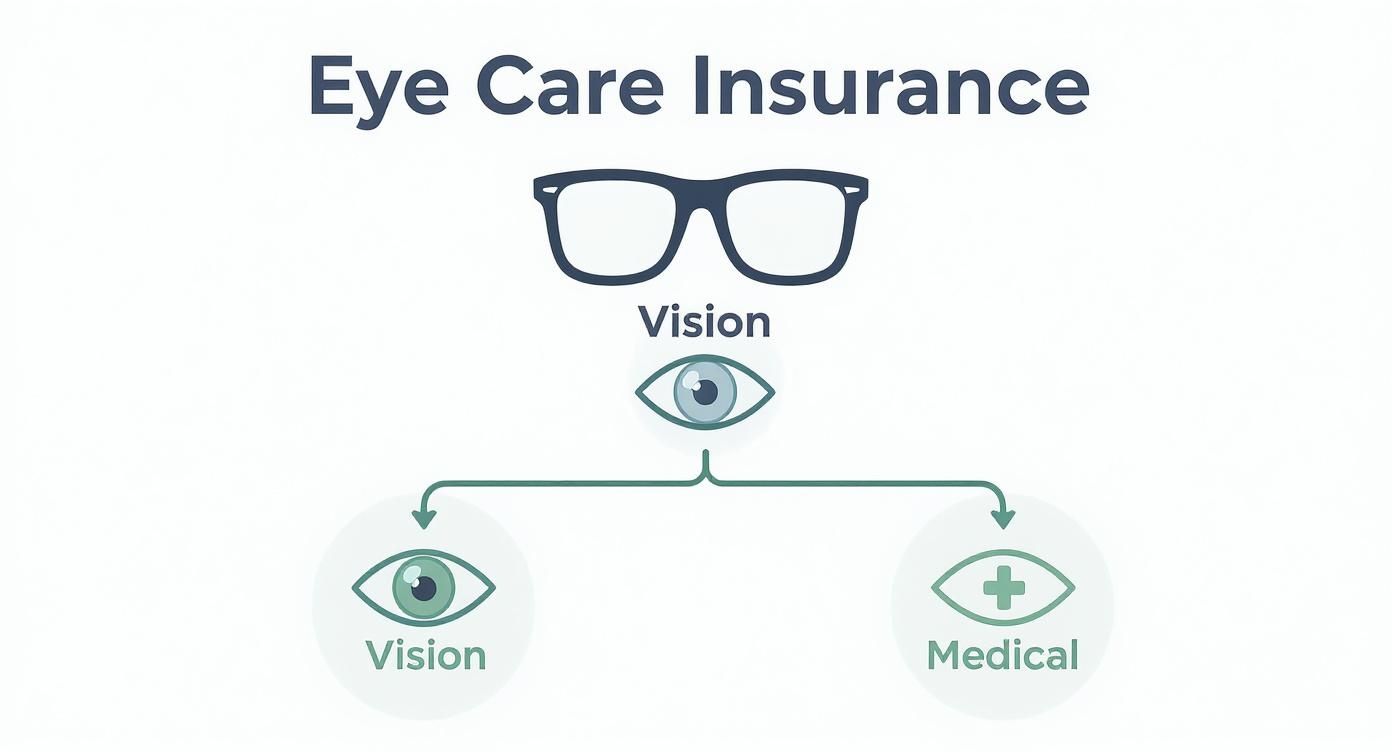
The key thing to remember is that your coverage really depends on the reason for your visit and the diagnosis. It’s not about which doctor you see, but what we're looking for and what we find.
The Impact of Having Vision Coverage
Does having a dedicated vision plan actually make a difference? Absolutely. The numbers don't lie. A 2025 study found that among adults who have managed vision care, a whopping 73% had an eye exam in the past year. That figure drops dramatically to just 46% for adults who don't have vision insurance. It’s clear that having coverage makes people far more likely to get the preventive care they need.
Don’t worry about figuring this all out on your own. At iDoctor, our team sorts this out for you. We’ll look at your needs for the visit and determine the right insurance to bill, making sure you get the most out of your benefits and keep your out-of-pocket costs as low as possible.
To make this even clearer, here's a simple breakdown of what typically falls under each type of plan.
Vision Insurance vs Medical Insurance Coverage for Eye Exams
This table gives you a quick side-by-side look at what you can generally expect your vision and medical plans to cover when it comes to eye care.
| Service / Condition | Typically Covered by Vision Insurance? | Typically Covered by Medical Insurance? |
|---|---|---|
| Annual Comprehensive Eye Exam | Yes | No (unless a medical reason arises) |
| Prescription for Eyeglasses or Contacts | Yes | No |
| Allowance for Eyeglass Frames & Lenses | Yes | No |
| Treatment for Glaucoma or Cataracts | No | Yes |
| Eye Infections or Injuries (e.g., Pink Eye) | No | Yes |
| Management of Diabetic Retinopathy | No | Yes |
| Sudden Vision Changes or Flashes of Light | No | Yes |
Hopefully, this gives you a much better picture of how things work! Knowing the difference helps you come to your appointment prepared.
Whether it's a routine visit or something more urgent, we’re ready to help. If you have a specific health-related concern, you can learn more about our dedicated medical eye exams in Glendale Heights, where we use advanced diagnostic tools to protect your long-term eye health.
How Your Vision Plan Covers Eye Care and Eyewear
Once you realize your vision plan is all about wellness, the benefits start to make a lot more sense. Think of it as a tool for proactive eye care. Most major plans give you annual coverage for the essentials, which makes staying on top of your eye health and keeping your prescription up-to-date much more affordable.
At the heart of every plan is the comprehensive eye exam. Your insurance usually covers the lion's share of this visit, leaving you with a small, predictable co-pay. This is just a fixed fee you pay at our office, sometimes as low as $10 or $20, depending on your specific plan. That benefit alone removes a major barrier to getting your eyes checked every year.
This push for preventive care is catching on globally. In fact, the vision insurance market is projected to hit an incredible $137.4 billion by 2033, with routine exams leading the charge. It shows a real shift in how we value early detection for maintaining healthy eyes. You can read the full research about vision insurance market growth to see just how big this trend is becoming.
Allowances for Frames and Lenses
After your exam, your vision plan really shines when it's time for new glasses. This benefit usually comes as an allowance—a set dollar amount your insurance will put towards your new frames and lenses.
Here’s a simple breakdown of how this works:
- Frame Allowance: Your plan might give you a $150 allowance for frames. Here at iDoctor, you can put that credit toward any pair we carry, whether it's a classic from Ray-Ban and Kate Spade or a luxury design from Gucci and Tom Ford. If the frames you love cost more than $150, you just pay the difference. It's that easy.
- Lens Coverage: Standard single-vision lenses are typically covered with just a small co-pay. If you need something more advanced like bifocals or no-line progressive lenses, your insurance still helps out by covering a large portion of the cost.
Coverage for Contact Lenses
More of a contact lens person? No problem. Your plan usually lets you use your allowance for contacts instead of glasses. This means you can apply that benefit toward a fresh supply of your preferred lenses. It's important to remember this is typically an either/or choice—you can use your annual allowance for glasses or contacts, but usually not for both in the same year.
The goal is to make high-quality eye care and eyewear accessible. By understanding these key terms—co-pay, allowance, and coverage—you can confidently use your benefits to their fullest potential.
Knowing how to work these benefits is a game-changer, especially when you’ve found the perfect pair of designer frames. To help you get the most out of your plan, we put together a guide with more specific tips on how to maximize your vision insurance benefits for designer eyewear in Glendale Heights.
Understanding Exclusions and Out-of-Pocket Costs
While your vision insurance is a fantastic tool, it’s smart to know what isn't typically covered to avoid any surprises at checkout. Think of your plan as covering the foundational, essential parts of your eye care. The specialized services and high-end upgrades often have some out-of-pocket costs.
Knowing about these common exclusions ahead of time helps you budget accordingly and make the best choices for your eyes and your wallet.
One of the most common separate charges is for a contact lens fitting and evaluation. This is a distinct service from your routine comprehensive eye exam. While the main exam nails down your prescription, the fitting is all about making sure the contacts fit the unique curve of your eye safely and comfortably. It requires extra measurements and trial lenses, which is why it’s billed as a separate item.
Common Lens Enhancements
Lens upgrades are another area where you'll likely see some extra costs. Your plan usually covers the cost of basic, single-vision lenses, but the cool, high-tech features that make your glasses even better often come with an additional fee.
Here are a few popular add-ons that typically involve an out-of-pocket expense:
- Anti-Reflective (AR) Coatings: A must-have for many, these coatings cut down on annoying glare from computer screens and headlights.
- Photochromic Lenses (Transitions): These are the lenses that automatically darken when you go outside. Super convenient, but considered an optional upgrade.
- High-Index Materials: If you have a strong prescription, these materials make your lenses much thinner and lighter. They look better but cost more than standard plastic.
- Blue Light Filters: With all the time we spend on screens, these filters are designed to reduce digital eye strain.
Navigating Frame Allowances
Your vision plan will almost always include a frame allowance—a specific dollar amount you can put towards a new pair of frames. This is a huge help, especially if you've got your heart set on a designer pair from Fendi or Tom Ford.
It’s pretty straightforward. For example, if your plan gives you a $175 allowance and you fall in love with a pair of Gucci frames priced at $400, you just cover the $225 difference.
Pro Tip: A great way to handle these out-of-pocket costs is by using a Flexible Spending Account (FSA) or Health Savings Account (HSA). These accounts let you use pre-tax money for medical and vision expenses, saving you a nice chunk of change on everything from your contact lens fitting to that perfect pair of Cartier glasses.
Knowing what to expect makes the whole process smooth and stress-free. If you’re curious about what an exam might cost without any insurance at all, check out our guide on how much an eye exam costs without insurance.
Here at iDoctor, we believe in total transparency. Our team will always walk you through your benefits and explain any potential costs before we move forward, so you're always in control.
How to Use Your Insurance at Our Glendale Heights Office
We believe using your insurance for an eye exam should be simple and stress-free. So, we've fine-tuned our process here at iDoctor to make sure our Glendale Heights patients can easily access their benefits without the typical runaround.

It all starts before you even step through our doors. We’ve designed everything to give you clarity and confidence right from the beginning.
Your Simple Path to Coverage
Navigating insurance doesn't have to be a headache. We’ve broken it down into a few straightforward steps so you can focus on what's important: your vision and finding the perfect pair of glasses.
- Gather Your Information: First things first, grab your insurance member ID card. It has all the details we need to look into your specific plan.
- Verify Your Benefits with Us: Next, just give our Glendale Heights office a call or use our online portal. Our team knows exactly what to ask and will contact your provider for you to confirm what’s covered for exams, frames, and lenses.
- Schedule Your Appointment: Once we have a clear picture of your benefits, it's time to book your detailed eye exam in Glendale Heights. Our 30-minute appointments give us plenty of time to cover everything without you feeling rushed.
We handle the insurance calls and jargon so you don’t have to. Our goal is to give you a clear, upfront summary of your benefits, including any co-pays or allowances you should expect.
During and After Your Visit
When you arrive, we’ll walk you through your benefits and how they apply to everything we offer. We can show you exactly how your allowance works with our curated eyewear collection, whether you're eyeing a classic pair of Ray-Bans or treating yourself to luxury frames from Cartier or Prada.
After your exam, we'll help you find eyewear that fits your vision needs, personal style, and insurance allowance perfectly. Once you've made your choice, we handle all the billing. We submit the claims directly to your insurance provider, which means less paperwork for you and a seamless experience from start to finish.
Making eye care more accessible is a global effort. A 2025 World Health Organization report noted that while things are improving, millions still can't get the glasses they need. Their goal is to boost coverage by 40% by 2030—a mission we fully support here in Glendale Heights by making insurance as easy as possible. You can discover more insights about global eye care access and see why this work matters so much.
Why Regular Eye Exams Are a Smart Health Investment
Think of your eye exam insurance as more than just a way to get a discount on new glasses. It's really a powerful tool for protecting your long-term health. Here at iDoctor in Glendale Heights, we see your annual visit as a critical piece of your overall wellness plan, not just a quick vision screening.
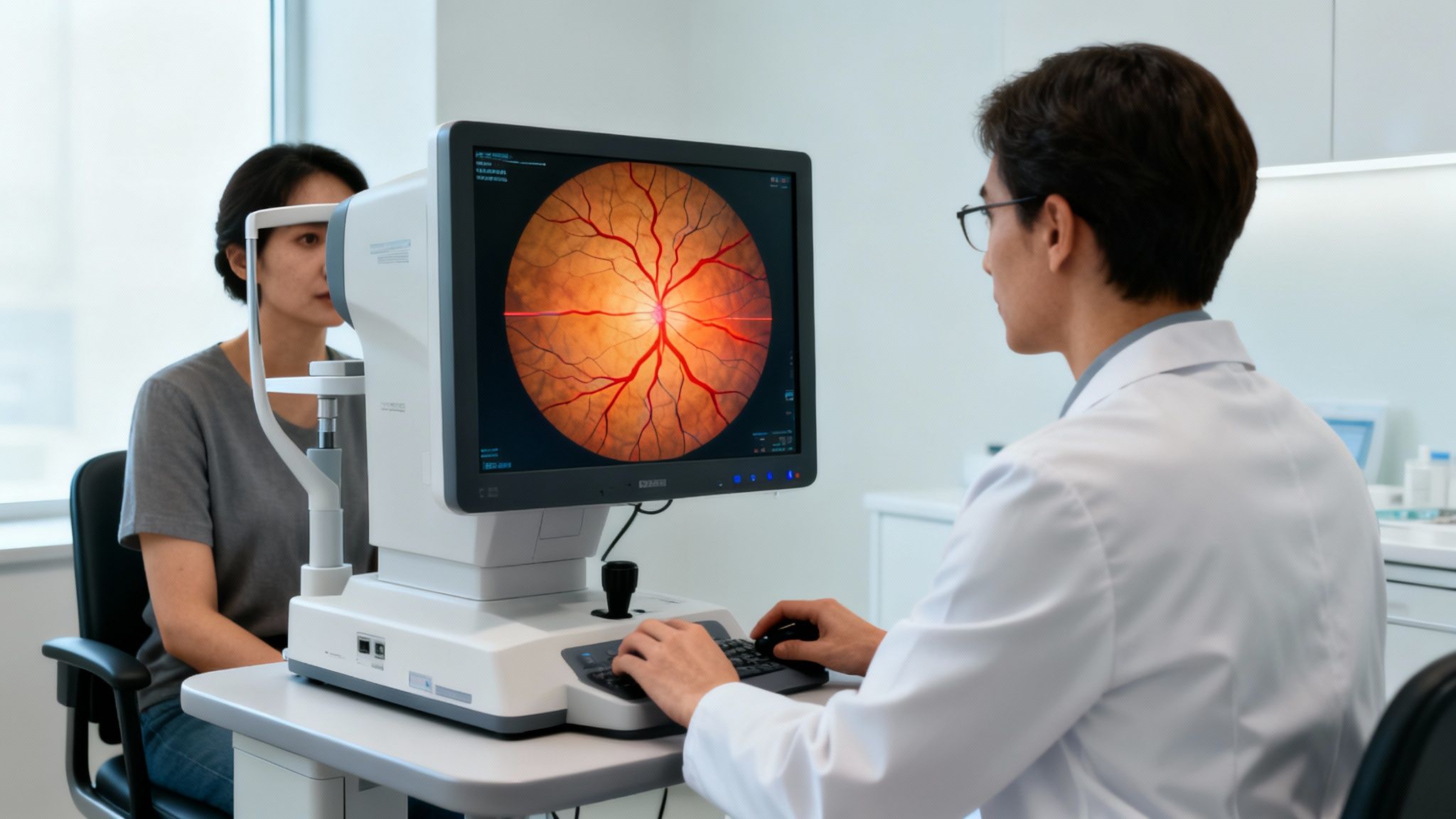
Our detailed eye exams in Glendale Heights aren't your average "which is better, 1 or 2?" test. We use high-resolution retinal imaging to get a deep, detailed look inside your eye. This technology allows us to see far beyond just your prescription, giving us a clear view of your optic nerve and the delicate blood vessels in the back of your eye.
A Window to Your Overall Health
It's a fascinating fact: your eyes are the only place on your body where a doctor can see your blood vessels in their natural state without having to make a single incision. This gives us an incredible, direct view into what’s happening with your systemic health.
That's why using your eye exam insurance for a yearly check-up is such a smart, proactive move. We can often spot the earliest warning signs of serious health conditions, sometimes before you even have symptoms.
- Diabetes: We can identify tiny changes in the retinal blood vessels, often the first clue of diabetic retinopathy.
- High Blood Pressure: Hypertension can cause visible damage, like kinks or even small bleeds in the vessels, which we can see during an exam.
- Glaucoma: Known as the "silent thief of sight," this disease shows no symptoms until vision loss is permanent. We can catch it early.
- Macular Degeneration: Spotting this common cause of vision loss in its initial stages is crucial for slowing it down.
Catching these problems early during a routine eye exam can help you avoid complex and expensive medical treatments later on. It truly is one of the simplest and most effective preventive health steps you can take.
For local families, especially those with kids in Queen Bee School District 16, these exams are also vital for academic success. So much of what a child learns is visual. Keeping their prescription current gives them every possible advantage in the classroom. Investing in annual exams is an investment in both their health and their education.
Your Eye Exam Insurance Questions Answered
We get it—insurance can be confusing. To help clear things up, we've put together answers to the most common questions we hear from patients right here in our Glendale Heights office.
Which Insurance Plans Do You Accept in Glendale Heights?
At iDoctor, we are proud to be in-network with all major vision insurance plans, including VSP, EyeMed, Davis Vision, and Spectera. For medical eye care, we also accept most major health insurance plans. The best part? Our team will happily verify your specific coverage before your appointment to ensure you get the most out of your benefits, making us a convenient choice for an eye doctor in Glendale Heights.
Can I Use Insurance to Buy Designer Eyeglasses Like Cartier?
Absolutely! Using your benefits is one of the best ways to get luxury eyewear. Most vision plans include a frame allowance, which is a set dollar amount that goes toward new frames. You can apply that allowance to any pair in our boutique, including top brands like Cartier, Gucci, and Tom Ford. If the frames you love cost more than your allowance, you simply pay the difference. It's a fantastic way to make those designer eyeglasses in Glendale Heights much more affordable.
Is a Contact Lens Fitting Covered by My Insurance?
A contact lens fitting is a separate service from your comprehensive eye exam. The exam determines your prescription, while the fitting ensures the lenses sit properly on your eyes for clear and comfortable vision. Because it's a specialized service, coverage can vary. Most plans offer an allowance for contact lenses in Glendale Heights or will cover a portion of the fitting fee. We'll always check your specific benefits beforehand so there are no surprises.
Ready to put your benefits to good use with exceptional eye care and eyewear? As the best optometrist in Glendale Heights, the team at iDoctor is here to make the whole process a breeze. Schedule your appointment today by visiting us at https://idoctoril.com.