Let’s cut right to the chase: Does wearing glasses actually improve your eyesight over time? Many of our clients in Glendale Heights ask this very question, and the answer is important for understanding your vision health.
The simple answer is no. While your glasses are an incredible tool for giving you sharp, clear vision the moment you put them on, they don't permanently change the physical shape or structure of your eyes. Think of them as a focusing aid, not a cure.
So, What Do Glasses Actually Do?
For anyone in Glendale Heights, from daily commuters on Glen Ellyn Road to students at Glenbard West High School, this is a really common question. The answer lies in understanding why you need glasses in the first place.
Most vision problems are caused by what we call refractive errors. In simple terms, this just means your eye isn't bending light correctly to focus it on your retina—the light-sensitive tissue at the back of your eye. Your prescription lenses are custom-made to bend that light for you, ensuring it lands exactly where it should. The result? A crisp, clear picture of the world.
But here's the key: when you take your glasses off, your eyes go right back to their natural state. That feeling some people get—that their vision is now worse without glasses—is really just your brain noticing the dramatic difference between sharp focus and its old, blurry normal.
It's a common myth that wearing glasses makes your eyes "weaker" or dependent. The truth is, your eyes aren't changing. Your brain has just gotten used to the luxury of seeing clearly and doesn't want to go back to straining all the time!
To get a quick overview, here's a simple breakdown of what your glasses are and are not doing for you.
How Glasses Affect Your Vision
| What Glasses Do | What Glasses Don't Do |
|---|---|
| Correct refractive errors like nearsightedness, farsightedness, and astigmatism. | Permanently change the physical shape of your eye. |
| Provide immediate, clear vision when worn. | "Cure" the underlying cause of your vision problem. |
| Reduce eye strain, headaches, and fatigue from struggling to see. | Make your eyes weaker or more dependent on them. |
| Bend light to focus it properly on your retina. | Stop your prescription from changing over time. |
The first step toward getting that perfect focus is knowing what your eyes need. A thorough, professional evaluation is the only way to get a truly accurate prescription. To see what that involves, take a look at our guide on what to expect during detailed eye exams in Glendale Heights. This appointment is the foundation for getting the right lenses to help you see the world in stunning high definition.
How Glasses Work to Sharpen Your Vision
Think of your eye as a sophisticated camera. To capture a crisp, clear picture of the world, light has to focus perfectly on the retina—the light-sensitive "film" at the very back of your eye. When that happens, your vision is sharp and in high definition.
For many of us, though, a refractive error gets in the way. It’s a simple term for when the unique shape of your eye bends light incorrectly. The result? A blurry image, whether you're trying to make out a street sign down the road or read a text message up close.
The Science of Bending Light
This is where eyeglasses come into play. The lenses in your glasses act as a custom-calibrated tool, designed to fix your eye’s specific focusing problem. They are expertly shaped to bend, or refract, the light just enough to ensure it lands squarely on your retina.
- For Nearsightedness (Myopia): Your eye focuses light in front of the retina instead of on it. Concave lenses are used to diverge the light rays, pushing the focal point back to where it belongs.
- For Farsightedness (Hyperopia): In this case, your eye focuses light behind the retina. A convex lens helps by converging the light rays sooner, pulling the focal point forward.
- For Astigmatism: An irregularly shaped cornea scatters light, creating multiple focal points and causing blurriness at all distances. A special cylindrical lens is needed to gather that scattered light into a single, sharp point on the retina.
This visual helps break down how glasses act as an immediate aid for clear sight, rather than a permanent fix for the eye itself.
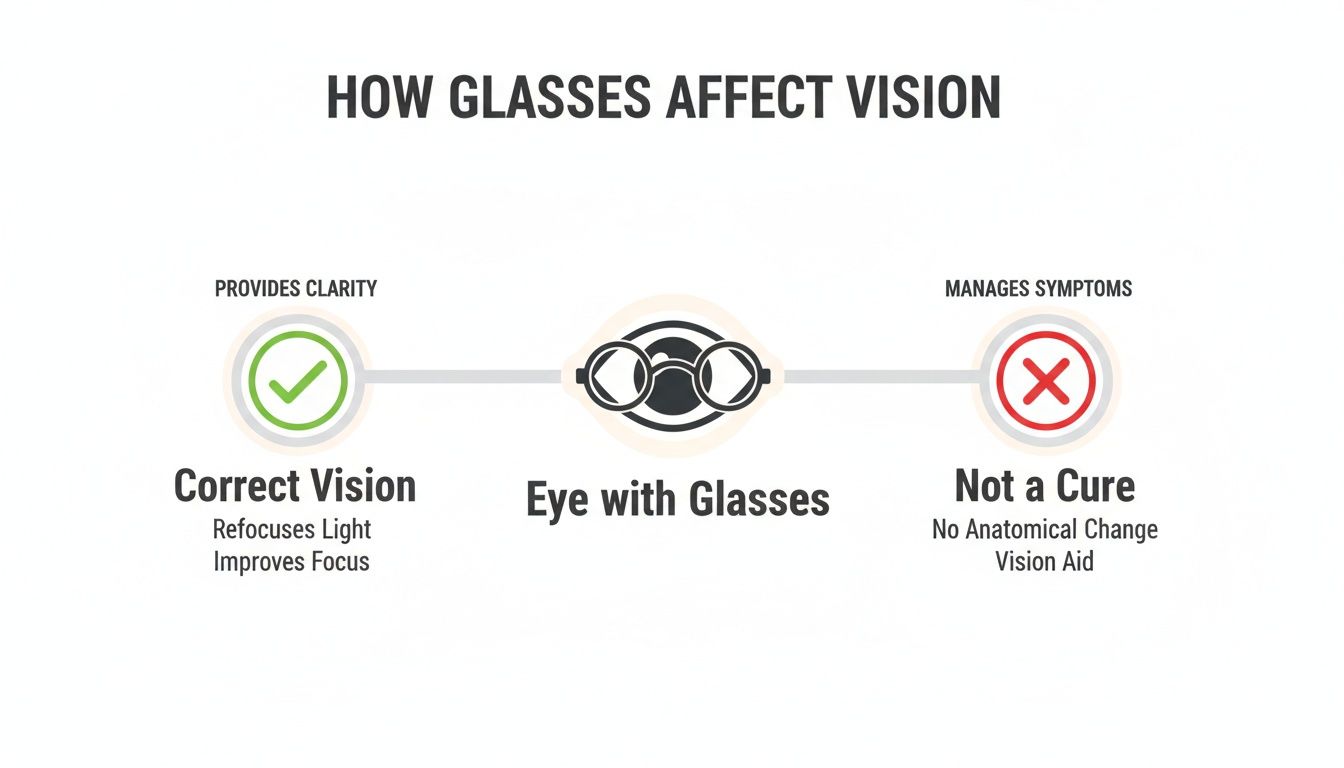
As you can see, glasses are a brilliant tool that corrects your vision while you wear them, but they don't alter the physical structure of your eye.
Why Your Unique Prescription Matters
Since no two pairs of eyes are identical, a one-size-fits-all approach just doesn’t work for vision. The prescription you get from your eye doctor is a highly specific formula that accounts for exactly how your eyes bend light.
Wearing glasses doesn't physically change your eyes; it simply provides the exact correction needed to compensate for their natural shape. The relief you feel is your eye muscles finally relaxing because they no longer have to strain to focus.
Getting these measurements right is the key to clear, comfortable vision. With so many advanced lens designs out there, understanding the different types of eyeglass lenses can make all the difference in finding the perfect fit for your lifestyle. Your glasses essentially partner with your eyes, taking on the heavy lifting of light-bending so you can simply enjoy the view.
Let's Clear Up Some Common Myths About Eyeglasses
It’s time to tackle some of the biggest fears people have about wearing glasses. If you’ve ever found yourself wondering if glasses will make your vision worse or if you'll be stuck with them forever, you're not alone. These are common questions, fueled by a lot of misinformation out there.
The good news? These worries are completely understandable, but they're rooted in myths, not medical science. Wearing properly prescribed glasses is actually one of the best things you can do for your eyes.
Myth 1: Wearing Glasses Makes Your Eyes Weaker
This is probably the most widespread myth we hear. Let's be clear: eyeglasses do not weaken your eyes. Think of them as a tool, not a treatment that changes your eye's structure. They’re like a perfectly tuned lens for a camera, helping to bend light so it lands just right on your retina.
This process lets your eye muscles finally relax instead of constantly straining to focus. When you take your glasses off, your vision simply returns to its natural, uncorrected state. It hasn't gotten worse; your brain just got a taste of what clear, high-definition vision feels like and now really notices the difference.
That feeling of "depending" on your glasses? It's not a sign of weakness. It's just your brain and eyes appreciating a world without constant blur and strain.
These myths aren't just local gossip; they're a global issue. For example, a 2023 study revealed that while people know glasses help, a surprising 32.4% believe long-term wear is harmful. An even more stunning 75.2% fear becoming permanently dependent on them. This just goes to show how vital it is to get your information from a trusted eye care professional.
Myth 2: Your Eyes Will Become Dependent on Them
This one goes hand-in-hand with the first myth. The sense that you "need" your glasses more and more isn't your eyes deteriorating—it's your brain adapting to a new, better normal. Before you had glasses, your brain was working overtime trying to make sense of fuzzy images.
Once it experiences sharp, effortless vision, it doesn't want to go back. It's like listening to your favorite song on a high-end sound system for the first time. If you go back to listening on tiny, cheap earbuds, the sound will seem much worse than you remembered, even though the earbuds are the same. Your standards have simply been raised.
Now, wearing the wrong prescription is a different story—that can definitely lead to headaches and eye fatigue. If you're feeling any discomfort, it’s a clear signal that you need a professional eye exam. Getting the right prescription from an eye doctor in Glendale Heights is key to making sure your glasses are helping, not hurting.
When Glasses Can Actively Improve a Child's Vision
For most adults, glasses are an incredible tool for correcting vision, not curing it. But with kids, it's a completely different story. A child's visual system is still a work in progress, and in some situations, wearing glasses isn't just about seeing clearly today—it's a form of therapy that can create genuine, long-term improvements.

This is particularly true for conditions that interfere with how a child's eyes and brain learn to communicate. Getting ahead of these issues is crucial for healthy development, which is why regular pediatric eye exams are so important for families in Glendale Heights and our local school districts.
Forging Strong Brain-Eye Connections
One of the best examples of this is amblyopia, which most people know as "lazy eye." This happens when one eye can't see as clearly as the other, and the brain starts to favor the stronger eye, effectively ignoring the signals from the weaker one. If you don't intervene, the brain might never learn how to properly see out of that eye.
This is where glasses become a star player. By providing a sharp, focused image, the correct prescription forces the brain to pay attention to the visual information coming from the weaker eye. That simple act helps build and reinforce the critical neural pathways needed for good vision.
Think of it like this: if one phone line has a lot of static, you'll naturally stop using it and stick to the clear one. Glasses act like a technician clearing up the static, encouraging the brain to use both lines equally and develop a strong, balanced connection for life.
This kind of treatment is most successful during childhood while the brain is still incredibly flexible. It's a perfect example of when the answer to "does wearing glasses improve eyesight?" is a definite yes.
Slowing the Progression of Nearsightedness
Another area where glasses can play a therapeutic role is in managing childhood myopia, or nearsightedness. We're seeing more and more kids develop myopia, and a higher prescription isn't just an inconvenience—it can increase the risk of serious eye conditions down the road.
Luckily, we now have specialized lenses designed to actively slow down this progression. These aren't your average glasses. Myopia control lenses use different focusing zones to manage how light lands on the peripheral retina. This helps reduce the signals that tell the eye to keep growing longer, which is the root cause of worsening nearsightedness.
These advanced options provide a proactive way to safeguard a child's vision for the long haul. You can find a complete overview of these incredible treatments in our guide on myopia management for children in Glendale Heights. It’s a powerful tool for protecting your child's eyesight for years to come.
How Getting Glasses Changes Your Life
Getting the right pair of glasses is about so much more than just passing a vision test. It’s about how you experience the world every single day. For anyone living in Glendale Heights, that means being able to drive confidently down North Avenue during rush hour, spending hours on a computer without that nagging eye strain, or simply sinking into a good book without having to squint.
While glasses won't permanently change the structure of your eyes, their effect on your day-to-day life is massive. Think of them as a tool that unlocks your full potential, boosting your safety, confidence, and ability to engage with everything around you.
From Blurry and Frustrated to Focused and Productive
There's a direct, undeniable link between how well you see and how well you perform. When your eyes aren't constantly struggling to bring the world into focus, your brain has more energy to dedicate to what you're actually doing—whether that’s paying attention in a classroom, getting work done, or perfecting a hobby.
This isn't just a feeling; it's backed by some pretty incredible research. A landmark 2018 study decided to see what would happen if they gave simple reading glasses to tea pickers. The results were stunning. Productivity jumped by an average of 21.7%. For workers over the age of 50, that figure was an even more impressive 31.6%—one of the biggest productivity gains ever recorded from a single health intervention. You can read the full research about these vision findings to see the data for yourself.
That same principle applies right here in the Chicagoland suburbs. Seeing clearly means you can work more efficiently, make fewer mistakes, and end the day with less mental and physical fatigue.
Clear vision isn’t a luxury; it's a foundational tool for living a full and productive life. Correcting vision issues is one of the simplest yet most effective ways to enhance your daily safety, comfort, and overall well-being.
Making Every Day Better
Beyond the office or classroom, the ripple effects of clear vision touch every corner of your life. Activities that might have become frustrating or exhausting suddenly become enjoyable again.
Here’s a look at how much of a difference the right prescription can make:
- A Safer You: Crisp, sharp vision is absolutely essential for navigating busy roads like Army Trail Boulevard or even just taking a safe walk through Camera Park.
- Say Goodbye to Discomfort: The right glasses can put an end to the chronic eye strain, tension headaches, and even neck pain that come from constantly squinting.
- A Boost in Confidence: When you see the world clearly, you can participate more fully and confidently in meetings, social gatherings, and your favorite activities.
To really get the most out of your new glasses, it's worth looking into lens enhancements. For instance, understanding the benefits of anti-reflective lens coatings can be a game-changer for cutting down on glare from screens and oncoming headlights, making your vision even more comfortable and clear.
Find Your Perfect Eyewear in Glendale Heights
So, now you know the truth behind the question, "does wearing glasses improve eyesight?". Understanding how they work is the first big step. The next, and honestly the most fun part, is finding a pair of glasses that not only corrects your vision but also shows off your personal style. Here at iDoctor, we bring clinical precision and high-end fashion together, creating an experience you just won't find anywhere else in Glendale Heights.
Everything we do starts with one of our signature 30-minute detailed eye exams. We’ve all felt rushed at the doctor's office before, which is why we do things differently. We take our time, using advanced diagnostic imaging to get your prescription exactly right. This attention to detail is the foundation for lenses that give you the clearest, most comfortable vision imaginable.
A Curated Collection for Every Style
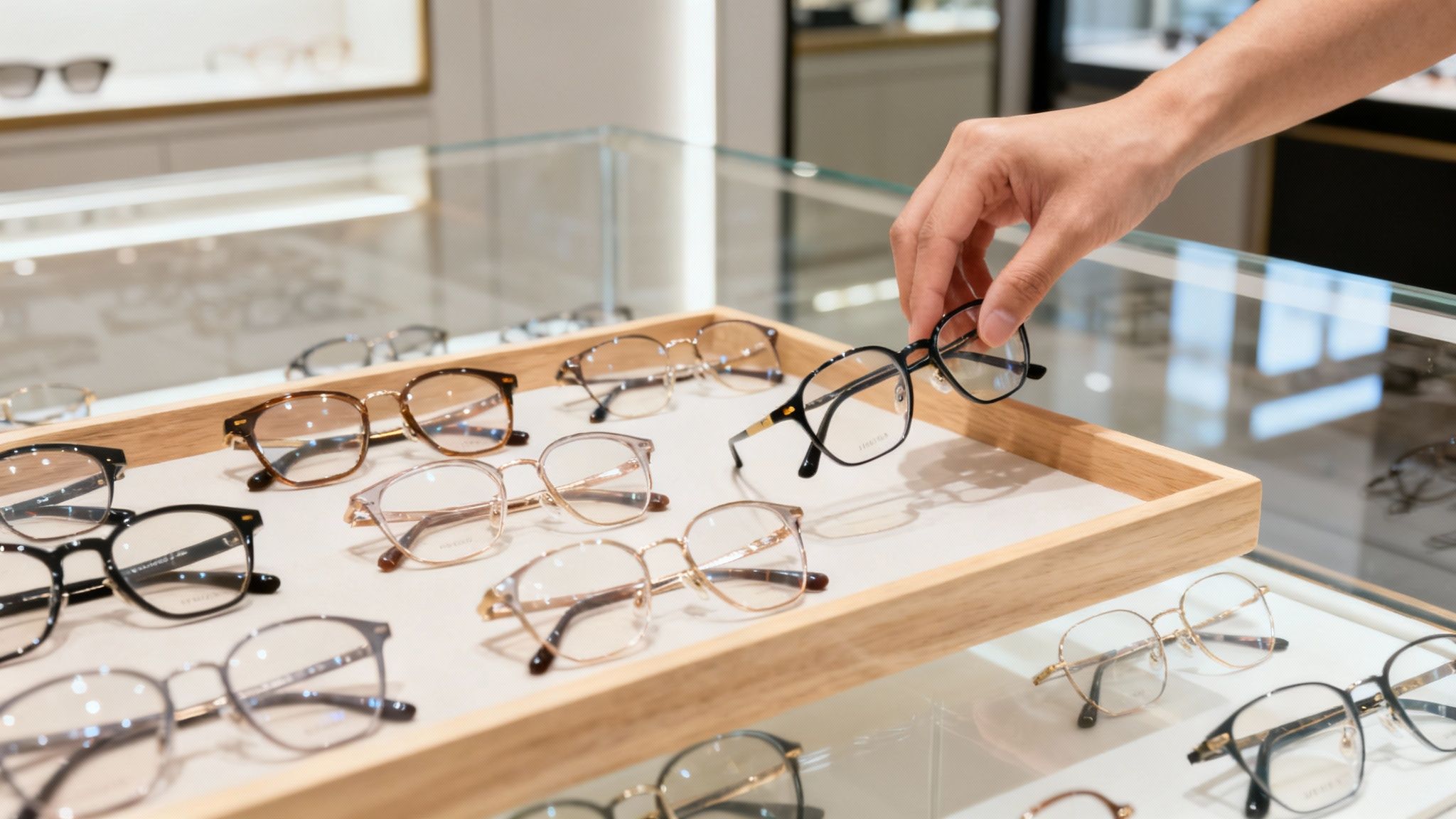
With your perfect prescription in hand, it’s time to explore our eyewear collection. We firmly believe glasses are a powerful form of self-expression, a true accessory. That's why we’ve hand-picked an amazing selection of designer eyeglasses in Glendale Heights, featuring both legendary fashion houses and innovative independent designers.
- Luxury Brands: Want to make a statement? We carry stunning frames from Cartier, Gucci, Tom Ford, Oliver Peoples, Fendi, and Saint Laurent.
- Accessible Style: We also have all the timeless and modern looks you love from brands like Ray-Ban, Coach, Kate Spade, and Michael Kors.
Our team lives and breathes eyewear. We'll personally guide you through the options, helping you find a frame that fits you like a glove and complements your features and lifestyle. We’re experts at matching frame shapes and materials to your unique needs, so you’ll leave with glasses that feel as incredible as they look.
Finding the right glasses is a personal journey. It’s about more than just seeing clearly—it's about feeling confident and comfortable in your own skin. We're here to make that journey a delightful one.
Choosing iDoctor means you never have to settle. We accept all major vision insurance plans, putting luxury eyewear within reach. Whether you’re a student at the College of DuPage or commuting on the I-355 every day, we have the perfect vision solution for you. Stop by our boutique in Glendale Heights and let us show you how the right pair of glasses can completely transform your world.
Frequently Asked Questions about Vision Care
We hear a lot of great questions from our clients here in Glendale Heights. To help you feel confident about your vision care, here are some straightforward answers to the questions we get asked most often.
How often should I get an eye exam in Glendale Heights?
For most adults, we recommend a comprehensive eye exam every one to two years. However, for children, individuals with health conditions like diabetes, or contact lens wearers, an annual exam is essential. Regular visits to our Glendale Heights clinic allow us to monitor your eye health and keep your prescription perfectly accurate.
Can I use my vision insurance for designer glasses like Cartier or Gucci at iDoctor?
Absolutely! iDoctor proudly accepts all major vision insurance plans. Our expert team will help you maximize your benefits so you can apply them toward our entire curated collection, including luxury brands like Cartier, Gucci, Tom Ford, and Oliver Peoples. We believe everyone in Glendale Heights deserves to see clearly and look their best.
What’s the difference between prescription glasses and drugstore readers?
This is a crucial distinction. Over-the-counter “readers” are simple magnifiers with the same power in both lenses. They don’t correct for individual differences between your eyes or for astigmatism. Prescription glasses, on the other hand, are custom-made based on a comprehensive eye exam by an optometrist. They provide precise correction for your unique needs, ensuring sharper, more comfortable vision.
As technology continues to evolve, new tools are even changing how clinics operate. For instance, innovations like AI Voice Agents in Ophthalmology are helping practices manage patient communication more effectively.
Ready to experience the world with perfect clarity and style? For the best optometrist in Glendale Heights, schedule your visit with iDoctor today. Our boutique is conveniently located to serve the entire Chicagoland area, and we look forward to helping you find the perfect eyewear.