Picking out new glasses at our Glendale Heights boutique is about more than just finding a style you love—it’s about finding a pair you can wear comfortably all day long and see perfectly through. Whether you're coming from just down the road on Bloomingdale Road or making the trip from a nearby suburb, the secret to that perfect fit lies in understanding how to measure eyeglass frame size. This all comes down to three little numbers printed right on the frame.
Why a Perfect Eyeglass Fit Is So Important

A frame that's too tight will dig in and cause headaches, but one that’s too loose will be a constant annoyance, sliding down your nose. This guide is here to simplify eyeglass sizing and show you exactly how to read those key measurements—lens width, bridge width, and temple length.
Here at iDoctor, located conveniently near Glenbard North High School, we take a personalized approach. We don't believe in rushed fittings. Our goal is to find the perfect frame that truly suits your face and your prescription, whether you're drawn to a timeless Ray-Ban or a standout Tom Ford design from our curated collection. Understanding why these measurements matter is the first step, and pairing that knowledge with our detailed eye exams in Glendale Heights ensures a flawless result.
For more helpful information, reviewing some general tips for choosing reading glasses can offer a broader perspective on finding the right pair.
Decoding the Numbers Inside Your Glasses
Ever noticed those tiny numbers stamped on the inside arm of your glasses? They might seem random, but they’re actually the secret code to a perfect fit. Think of them as your frame's unique identification.
You'll typically see a sequence of three numbers, something like 52□18 140. Each number represents a crucial dimension in millimeters, giving you a precise blueprint of how those frames are built.
Once you know what these numbers mean, you can confidently shop for new glasses online or in-store, knowing they'll fit just as comfortably as your favorite pair.
Understanding Your Frame Measurements
This little sequence of numbers is the industry standard for frame sizing. Here’s a quick breakdown of what each part means and why it's so important for getting a comfortable, well-proportioned fit.
| Measurement | What It Is | Typical Range (Adults) | Why It Matters |
|---|---|---|---|
| Lens Width (e.g., 52) | The horizontal diameter of one lens at its widest point. | 40-60 mm | Determines how wide the frames will look on your face and ensures your eyes are centered in the lens. |
| Bridge Width (e.g., 18) | The distance between the two lenses, where the frame sits on your nose. | 14-24 mm | A proper bridge fit is crucial for comfort; too tight and it pinches, too loose and your glasses slide down. |
| Temple Length (e.g., 140) | The length of the arm from the hinge to the tip that rests behind your ear. | 120-150 mm | This ensures the glasses sit securely and comfortably without digging in or feeling loose behind your ears. |
Having these three numbers in hand makes finding your next pair of designer eyeglasses in Glendale Heights so much easier. You can skip the guesswork and focus entirely on the style you love.
Of course, these numbers are just one part of the puzzle. For a truly perfect fit, another measurement is absolutely essential: your pupillary distance. We cover that in detail in our guide on how to measure your pupillary distance for the perfect eyewear fit in Glendale Heights.
Measuring for Glasses Without a Current Pair
What happens when you don't have an old pair of glasses to use as a guide? Don't worry, you can still get a really solid starting point right at home. I'll walk you through how to measure the most important dimension—your overall frame width—using nothing more than a ruler and a mirror.
Getting this temple-to-temple measurement right is the key to making sure a new pair of frames won't be too narrow or uncomfortably wide. From there, we'll cover how to measure your pupillary distance (PD), a crucial number that ensures your lenses are perfectly aligned with your eyes.
This infographic breaks down those key numbers you'll find printed on almost any pair of eyeglass frames.
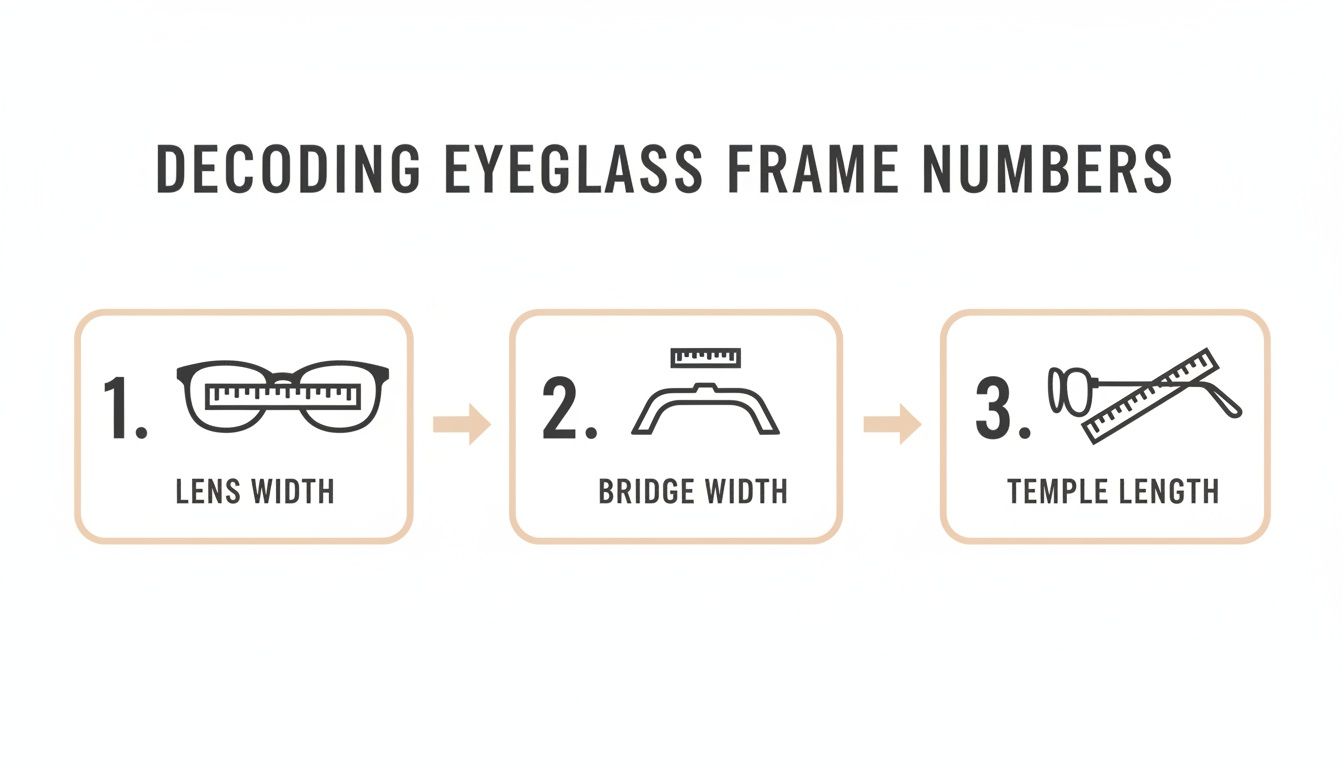
It gives you a great visual for where the lens width, bridge width, and temple length are located. While these at-home methods are fantastic for narrowing down your choices online, nothing beats the accuracy of a professional fitting. For a deeper dive into the technology we use, check out our guide on how digital optical measurements ensure the perfect eyeglass fit.
Pro Tips for Translating Numbers into Comfort
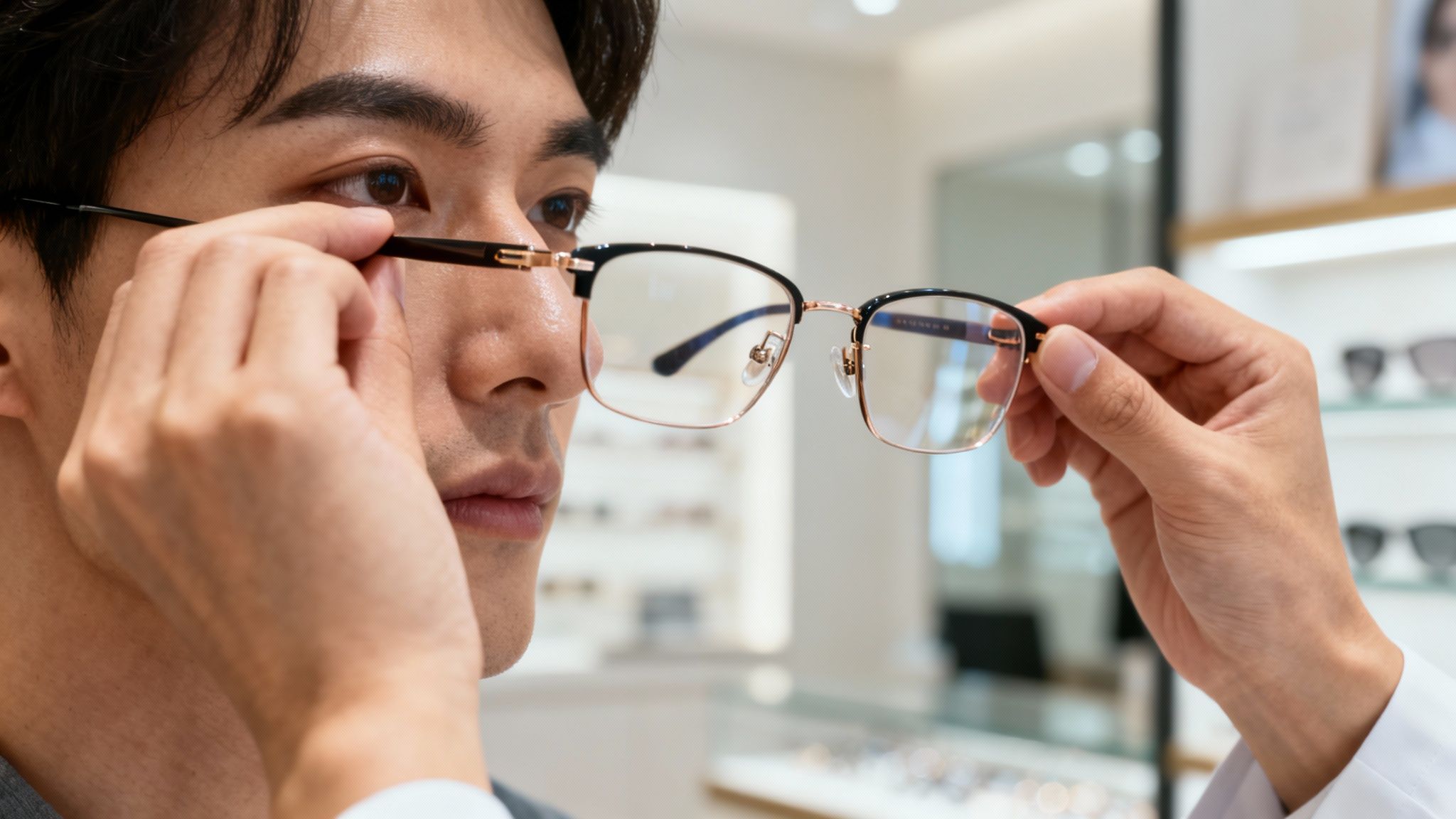
Knowing your measurements is one thing, but understanding how they translate to real-world comfort is where the magic happens. As the best optometrist in Glendale Heights, we’ve seen just about every fit issue you can imagine.
Do your glasses constantly slide down your nose? That’s a classic sign the bridge width is off. What about arms that dig in painfully behind your ears? The temple length is probably too short. For small fit problems, our guide on how to adjust glasses arms offers some great tips for making minor tweaks at home.
But remember, the numbers don't tell the whole story. The frame material plays a huge role in how glasses feel. A chunky acetate Cartier frame will sit very differently than a feather-light metal Tom Ford, even if their measurements are identical. These are the kinds of details that help you look beyond the specs on paper to find a pair that truly feels custom-made for you.
A Quick Look at How Eyeglass Sizing Evolved
Believe it or not, the way we measure and fit glasses has changed a ton over the years. What started as a purely functional tool has become a major fashion statement, and the sizing standards have had to keep up.
Think about it: glasses have been around since roughly 1286, but the styles we see today are a world away from those early designs. Back in the 1700s, lenses were often tiny, maybe around 32mm wide. Fast forward to the bold, oversized looks of the 1980s, and you’d see lens widths ballooning to over 60mm. This shift was only possible thanks to new, lighter materials that made bigger frames comfortable to wear. You can actually see some wild examples in this history of eyeglass styles.
This whole journey from function to fashion is why sizing is so important now. It's the key to finding a frame that not only looks great but feels right. It's something we see every day here at iDoctor, whether we're fitting a client from Carol Stream in a modern Gucci frame or helping someone from Lombard find that perfect classic silhouette.
Your Eyeglass Sizing Questions Answered in Glendale Heights
Finding that perfect frame size brings up a lot of questions. As your local eye doctor in Glendale Heights, we're here to help. To give you a head start, we've gathered some of the most common questions we hear in our boutique.
Does iDoctor carry designer eyeglasses in Glendale Heights?
Absolutely. We pride ourselves on offering a curated selection of luxury eyewear from brands like Cartier, Gucci, Tom Ford, and Oliver Peoples, alongside accessible favorites like Ray-Ban and Coach. We believe everyone in the Glendale Heights area deserves to find a pair of glasses they love.
How do I know if a frame is too wide for my face?
A good rule of thumb is to ensure there is no more than a finger's width of space between the arm of the glasses and your temple. When you smile, the frames shouldn't press into your cheeks. We can help you find the perfect width during a fitting at our Glendale Heights location.
Does iDoctor accept vision insurance?
Yes, we accept all major vision insurance plans. Our team is happy to help you understand and maximize your benefits for everything from eye exams to purchasing new eyewear, including contact lenses in Glendale Heights.
Why is a professional fitting better than just using my old frame’s numbers?
While your old numbers are a great starting point, they don't account for changes in frame style, material, or even small shifts in your prescription. A professional at iDoctor in Glendale Heights will consider all these factors, plus your unique facial features, to ensure unparalleled comfort and visual clarity.
You might also want to check out our guide on considering your face shape when choosing eyeglass frames for more personalized tips.