Picture this: you're enjoying a beautiful day at East Branch Forest Preserve or cruising down Bloomingdale Road in Glendale Heights, and there it is—a tiny, infuriating scratch right in the middle of your vision. It's the kind of thing that, once you see it, you can't unsee it. As a leading eye doctor in Glendale Heights, I can tell you the first thought that pops into most heads is, "Can I just buff this out?"
I get asked this all the time at our iDoctor boutique, and I have to be the bearer of bad news. For most modern eyeglasses, the answer is a hard no. Trying to buff out a scratch at home is a recipe for disaster. You’ll likely end up removing the very coatings that make your glasses work so well, causing distorted vision and even more damage.
The Reality of a Scratched Lens
That little scratch isn't just a simple gouge in the plastic or glass. It’s a deep disruption in a complex system of microscopic layers. Think of it less like a scratch on a car door and more like a tear in a high-tech fabric.
You'll find all sorts of "life hacks" online suggesting you use toothpaste or baking soda. Please, don't do it. These substances are abrasive and will strip away the crucial anti-reflective, UV-blocking, and scratch-resistant coatings that you paid for.
Instead of fixing the problem, you're essentially sanding down the surface, creating a much larger, blurry spot. This can lead to serious eye strain and headaches. It's especially true for high-end lenses from our curated collections, including brands like Cartier, Tom Ford, or Gucci, where those advanced coatings are everything. The only real fix is a professional one that keeps your vision sharp and protected.
This decision tree lays out the two main paths you can take when a lens gets scratched.

As you can see, the safest bet is always to consult an expert instead of gambling with DIY methods that could ruin your glasses for good.
Scratch Repair Feasibility at a Glance
To make it even clearer, here's a quick breakdown of what you're up against when you discover a scratch.
| Scratch Severity | Lens Type | Can It Be Buffed? | Best Course of Action |
|---|---|---|---|
| Micro-scratch (Hairline) | Coated (AR, UV, etc.) | No | Clean properly; if it's still distracting, consult an optician. |
| Noticeable Scratch | Coated (AR, UV, etc.) | Definitely No | The coatings are compromised. Replacement is needed. |
| Deep Gouge | Any Type | Absolutely Not | The lens integrity is damaged. Replace immediately. |
| Any Scratch | Uncoated Basic Plastic | Maybe, but not recommended | DIY buffing is risky; professional help or replacement is safer. |
Ultimately, trying to "fix" a scratch on a modern, coated lens is a losing battle. The risk of causing irreparable damage just isn't worth it.
Why Prevention Is Your Best Strategy
The absolute best way to deal with scratches is to stop them from happening in the first place. A few good habits can go a long way in protecting your investment and keeping your vision crystal clear.
- Clean Them Right: Always give your glasses a quick rinse with lukewarm water before wiping. This washes away tiny bits of dust and grit that can act like sandpaper. For a full rundown on the proper method, check out our guide on how to clean glasses lenses.
- Use the Right Tools: A microfiber cloth is your lens's best friend. Paper towels, your t-shirt, a napkin—they all have rough fibers that will create tiny scratches over time.
- Store Them Safely: When your glasses aren't on your face, they should be in their hard-shell case. Tossing them on a desk or into a bag is just asking for trouble.
By making these simple actions part of your routine, you can drastically increase the lifespan of your eyewear. But if a scratch does happen, your best move is always to visit your local Glendale Heights optometrist for professional advice.
Why Buffing Damages Modern Lenses
To really get why buffing is such a bad idea, you have to stop thinking of your eyeglass lenses as simple pieces of plastic. They’re high-tech marvels. Think of them less like a windowpane and more like the lens on a high-end camera—each one has multiple, paper-thin layers carefully applied to its surface.
These invisible coatings are what deliver clear, comfortable vision. You've got layers for anti-reflection, UV blocking, blue light filtering, and, ironically, scratch resistance. When you try to "buff out" a scratch, you're not just smoothing a tiny mark. You're actually grinding away this entire complex, multi-layered system.
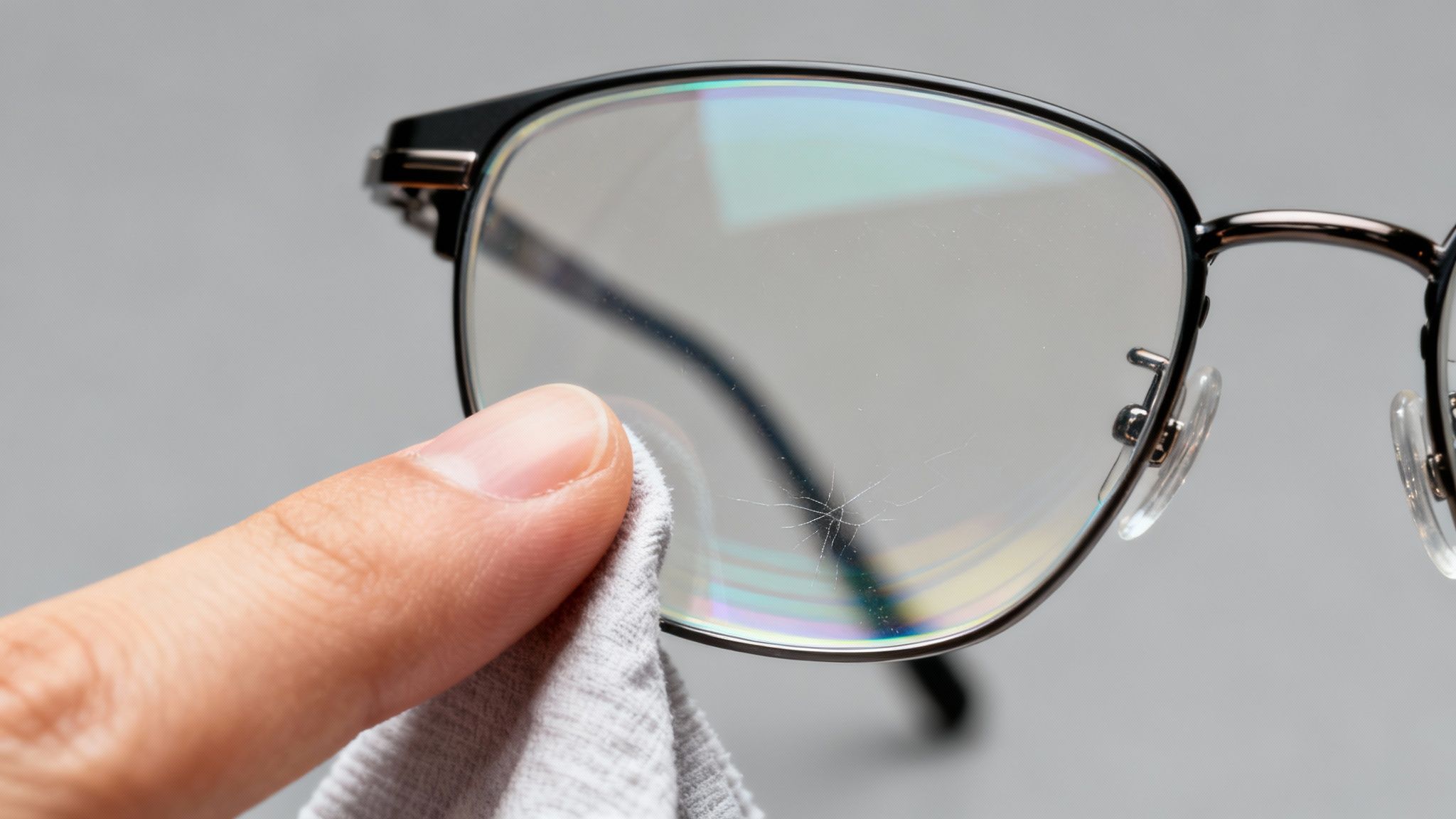
Imagine taking fine-grit sandpaper to the clear coat on your car. Sure, you might get rid of a small scuff, but you'll also destroy the protective finish and leave the paint underneath completely exposed and dull. It’s the same principle with your glasses.
The Problem with Abrasives
Most of the DIY scratch removal "hacks" you see online involve abrasives like toothpaste or baking soda. The idea is that these substances will scrape away material around the scratch until the surface is level with the bottom of the gouge. The problem is, this process does serious, irreversible damage to your lenses.
- Coating Removal: The first thing to go is always the anti-reflective (AR) coating. When that’s gone, you’re left with a blurry, distorted patch that’s usually far more annoying than the original scratch ever was.
- Optical Distortion: Your lenses are ground with incredible precision to match your exact prescription. Rubbing them aggressively can warp this delicate curvature, which compromises the accuracy of your vision correction.
- Loss of Protection: Once you strip away the coatings, you also lose essential benefits like UV protection and blue light filtering. This leaves your eyes more vulnerable to harmful light.
This is why trying to buff out scratches on a pair of high-end Cartier or Gucci glasses is a particularly painful mistake. The advanced, layered coatings are a massive part of what makes them perform so exceptionally well.
A scratch on a lens isn't just a cosmetic flaw; it's a structural failure. It’s a micro-fracture that disrupts the precise path of light to your eye, and trying to buff it away often creates an even larger area of optical distortion.
The Science of a Scratch
The damage actually goes deeper than what you can see. Scientifically, a scratch is a micro-fracture—a structural change caused by some kind of force. How easily a lens scratches and how deep it goes depends entirely on its surface hardness and the treatments it has. Research even confirms that untreated surfaces are far more prone to damage than lenses with chemical strengthening or coatings.
This is the core reason buffing just doesn't work. It doesn't heal the fracture; it just grinds down the area around it, destroying all the technology that was built into the lens in the first place. You can dive deeper into how these protective layers work in our article on why next-generation lens coatings matter.
Ultimately, buffing a modern lens just trades one problem for another, creating blurriness, glare, and compromised vision that are often much worse than the scratch you started with.
Exploring Common DIY Scratch Repair Myths
If you’ve ever Googled "how to fix scratched glasses," you've probably been hit with a tidal wave of so-called "life hacks." The internet is full of them—using toothpaste, baking soda, car wax, you name it. Let’s get straight to the point: these methods are a one-way ticket to ruining your lenses for good.
Most of these DIY myths are built on a flawed idea: that you can simply sand down the lens surface until the scratch disappears. For modern eyewear with all its advanced coatings, this is a terrible approach.
The Abrasive Fallacy: Toothpaste and Baking Soda
Toothpaste and baking soda are the most common culprits. People think because they're mild abrasives, they're safe. But on the microscopic level of your lens coatings, they're as gentle as sandpaper.
Instead of smoothing out that one annoying scratch, you're essentially creating thousands of new micro-scratches. This process grinds away your anti-reflective and UV-protective coatings, leaving behind a cloudy, distorted mess that's worse than the original problem. The scratch may be gone, but so is your clear vision.
The real issue with DIY buffing is that it doesn't repair anything. It just removes essential layers from your lens. You end up trading a small cosmetic flaw for a huge loss in optical clarity and protection, making your glasses basically unusable.
The Filler Fallacy: Waxes and Polishes
Then you have the "filler" methods, like using car wax or furniture polish. The theory is that the wax fills in the scratch and makes it invisible. It sounds plausible, but it’s a temporary fix that creates more problems than it solves.
Sure, a waxy substance might hide a tiny scuff for a couple of hours, but it does absolutely nothing to restore the lens itself. What you get instead is a greasy film that:
- Smears constantly, blurring your vision.
- Becomes a magnet for dust and grime.
- Wears off in no time, bringing the scratch right back into view.
Trying these chemical concoctions on your designer frames—whether they’re Tom Ford, Ray-Ban, or Scott Harris—is a surefire way to cause permanent damage. It voids warranties and pretty much guarantees you’ll be buying a new pair. Lens material also plays a huge role; you can learn more about the unique properties of different materials in our guide on polycarbonate eyeglass lenses.
At the end of the day, no household product can safely buff scratches out of your glasses. To get your vision back to perfect, you really need to talk to a professional.
Professional Repair vs. Lens Replacement
When you get a nasty scratch on your glasses, your first thought is probably to find a pro to fix it. But what does a "professional repair" really look like for today's high-tech eyewear? You might find some labs out there claiming they can buff or resurface lenses, but for prescription glasses, this is incredibly rare—and for good reason. It’s a huge risk.
Think about it: the curve of your lens is custom-made just for your eyes. It’s a precise, delicate surface. Any attempt to grind or polish that surface, even slightly, can completely change its shape. The result? Instead of fixing the problem, you could end up with lenses that cause headaches, eye strain, or just don't correct your vision anymore.
The Safest and Smartest Choice
The most trusted and genuinely professional solution for a scratched lens isn't a repair at all. It's a replacement. This might sound like a hassle, but it's actually a great opportunity. Replacing your lenses is the only way to guarantee you get back to that perfectly crisp, clear vision you had on day one.
Plus, it's a chance to bring your favorite frames into the modern age. You can keep that Cartier or Oliver Peoples style you love and upgrade the engine, so to speak. New lenses can come with features that might not have even been on the market when you first bought your glasses.
- Advanced Blue Light Filters: A lifesaver if you're staring at screens all day and want to cut down on digital eye strain.
- Thinner, Lighter High-Index Materials: If you have a strong prescription, these make your lenses look sleeker and feel much more comfortable.
- Superior Anti-Scratch Coatings: Today’s coatings are tougher than ever, giving your new investment a much better defense against future damage.
An Opportunity for an Upgrade
Swapping out your lenses is also the perfect moment to ask yourself if your prescription is still doing its job. Our vision changes slowly over time, and the prescription that was spot-on two years ago might be leaving you squinting now. If you're curious about the right timeline for an update, our guide on how often you should get new glasses has all the details.
It’s true that people are looking for quick fixes. The global market for glass restoration kits was valued around USD 68 million in 2025 and is expected to climb to nearly USD 98 million by 2035. Scratch removal kits alone account for about 48% of that market. But here’s the catch: those products are designed for simple glass surfaces, like a tabletop, not for the complex, multi-coated lenses sitting in front of your eyes. For a deeper dive into these numbers, you can read the full market analysis here.
Lens replacement isn't about giving up on your favorite frames. It's about restoring their purpose: to provide you with the clearest, most comfortable vision possible. It’s a proactive step toward better eye health and a better visual experience.
At iDoctor, we specialize in fitting brand-new, perfect lenses into the frames you already own and love. Whether you're driving down North Avenue or working from your home office in Glendale Heights, our focus is making sure your vision is second to none. As the go-to spot for designer eyeglasses in Glendale Heights, we have the expertise to bring your favorite pair of glasses back to life—the right way.
Protecting Your Eyewear from Future Scratches
So, we've established that buffing scratches out of your glasses is pretty much a no-go. That means the best strategy is to stop them from happening in the first place. A few simple, daily habits are all it takes to protect your investment and keep your vision crystal clear.
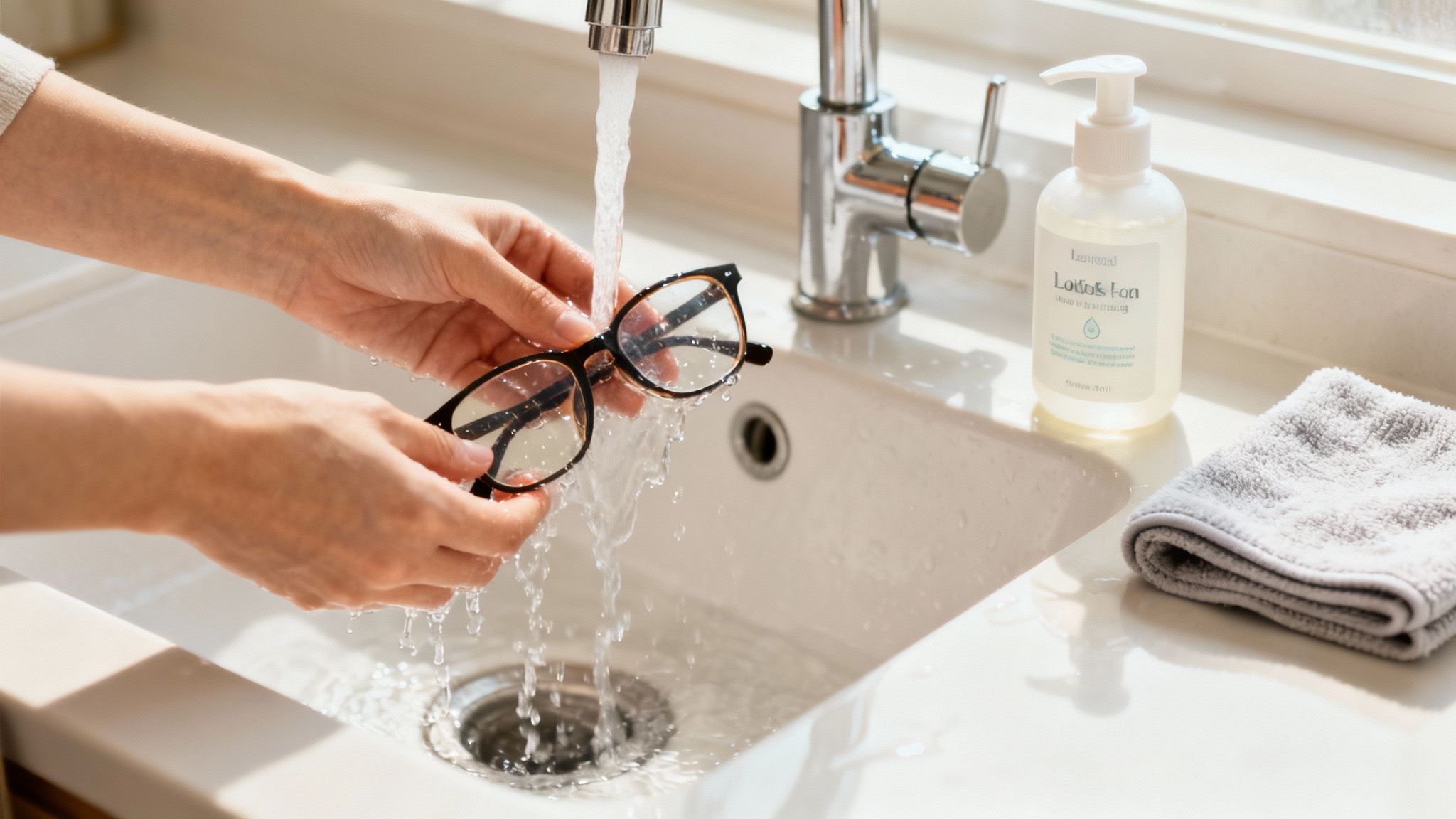
Honestly, the number one culprit behind tiny micro-scratches is cleaning your lenses the wrong way. Wiping them when they're dry is a huge mistake—it just grinds dust and grit across the lens surface, acting like fine-grit sandpaper over time.
The Correct Way to Clean Your Glasses
To sidestep this common problem, just follow a simple, lens-safe routine. This approach keeps those delicate lens coatings intact and makes sure you aren't causing the very damage you’re trying to prevent.
- Rinse First: Before you do anything else, hold your glasses under a gentle stream of lukewarm tap water. This washes away any abrasive bits and pieces.
- Use a Gentle Soap: Put a tiny drop of lotion-free dish soap on each lens and use your fingertips to gently rub it across the entire surface.
- Rinse Thoroughly: Run them under the water again to wash away every bit of soap. Any residue left behind will just cause streaks.
- Dry with Microfiber: Gently shake off the extra water, then dry the lenses and frame with a clean microfiber cloth that you only use for your glasses.
A quick word of warning: Never, ever use your shirt, a paper towel, or a napkin to dry your lenses. Their fibers are way too rough and will absolutely create fine scratches and strip your lens coatings.
Smart Storage and Protective Accessories
What you do with your glasses when they're not on your face is just as critical as how you clean them. Tossing them on a desk or into a purse is basically asking for scratches.
- Always Use a Hard-Shell Case: Think of a sturdy case as a suit of armor for your eyewear. It protects the frames from getting bent or crushed and shields your lenses from loose change, keys, and anything else that could cause damage.
- Invest in Quality Accessories: Using the right tools really does make a difference. For more ideas on how to keep your designer frames looking new, check out our guide on must-have eyewear accessories in Glendale Heights.
This focus on prevention is part of a bigger trend. People want eyewear that lasts. The global market for scratch-resistant glass was valued at USD 3.1 billion in 2025 and is expected to hit USD 7.8 billion by 2035, all thanks to better coatings and materials. By taking good care of your lenses now, you're making sure they'll serve you well for years to come.
When It’s Time to See Your Glendale Heights Optometrist
Let’s be honest: if a scratch on your glasses is big enough to notice, it's big enough to be a problem. When a scratch is distracting you or getting in the way of your sight, it’s a clear signal to stop looking for DIY solutions and get a professional opinion. The reality is, trying to buff out a scratch on modern, coated lenses usually does more harm than good.
That's where we come in. At iDoctor, we can take a close look at the damage and tell you what your real options are. More importantly, this is the perfect chance to make sure your vision is as sharp as it can be. A scratch is often a sign that your lenses have seen better days, and any lens update should start with an eye exam to see if your prescription needs a tweak.
Getting Your Vision Back on Track
Ordering new lenses without an up-to-date eye exam is a bit like getting a new paint job on a car that needs an engine tune-up—it might look better, but it doesn't fix the underlying issue. Your eyesight is all about precision, and that starts with the right prescription. We provide detailed eye exams in Glendale Heights to ensure your new lenses are perfectly dialed in to what your eyes need right now.
Think about it: a single distracting scratch can affect everything, from driving down Glen Ellyn Road to reading a book at home. Seeing your optometrist is about more than just fixing a cosmetic flaw; it’s about restoring your vision completely.
Once we’ve confirmed your prescription, we can help you find the perfect replacement lenses for your favorite frames, whether they’re Cartier, Gucci, or Kate Spade. Our team is great at fitting pristine, new lenses into existing designer eyewear, so you get back both flawless function and the style you love.
This professional approach is the only way to guarantee your vision is crisp, clear, and properly protected. We’re here to help our neighbors see their best, so you can get back to enjoying all the sights Glendale Heights has to offer—scratch-free and in perfect focus.
Still Have a Few Questions?
We get it. When it comes to something as important as your vision, you want all the facts. Here are the answers to a few questions we hear all the time from our patients here in Glendale Heights.
Can I Put New Lenses in My Favorite Old Frames at iDoctor?
Absolutely! That's one of our specialties. We know how it is when you find that perfect pair of frames—you don't want to let them go. Bring in your beloved Oliver Peoples, Cartier, or Ray-Ban frames, and our skilled opticians will expertly fit them with brand-new, crystal-clear prescription lenses. You get to keep the style you love with the vision you need.
Will My Insurance Help Pay for Scratched Lenses?
It's very likely. Many vision insurance plans will cover a portion of the cost for new lenses, particularly if your prescription has changed. We accept all major vision insurance here at iDoctor, and our team is fantastic at helping you navigate your benefits. We'll break down your coverage and make sure you get the most out of your plan to keep your replacement lenses affordable.
What's the Toughest Scratch-Resistant Coating You Have?
We pride ourselves on offering the latest and greatest in premium anti-scratch coatings. The "best" one really depends on you and your life. When you come in, we'll chat about what your day-to-day looks like. Are you mostly at a desk, or are you constantly outdoors near Glendale Lakes? Based on your lifestyle, we’ll recommend the most durable coating to keep your new lenses looking great for as long as possible.