Yes, you absolutely can get bifocal contact lenses. For many people right here in Glendale Heights, they're a fantastic way to stop the constant juggling of different pairs of glasses. These specialized lenses are engineered to correct both your close-up and distance vision in one simple, elegant solution.
Are you starting to hold menus at arm's length just to read them? Do you find yourself squinting at your phone? If so, you're likely running into presbyopia. It's a completely natural change in vision that happens to just about everyone, usually sometime after age 40. At iDoctor, a premier optometry boutique in Glendale Heights, we help our patients navigate these changes every day.
For years, the only real fix was a pair of bifocal glasses. But what if you love the freedom and wide-open view that only contact lenses can provide?
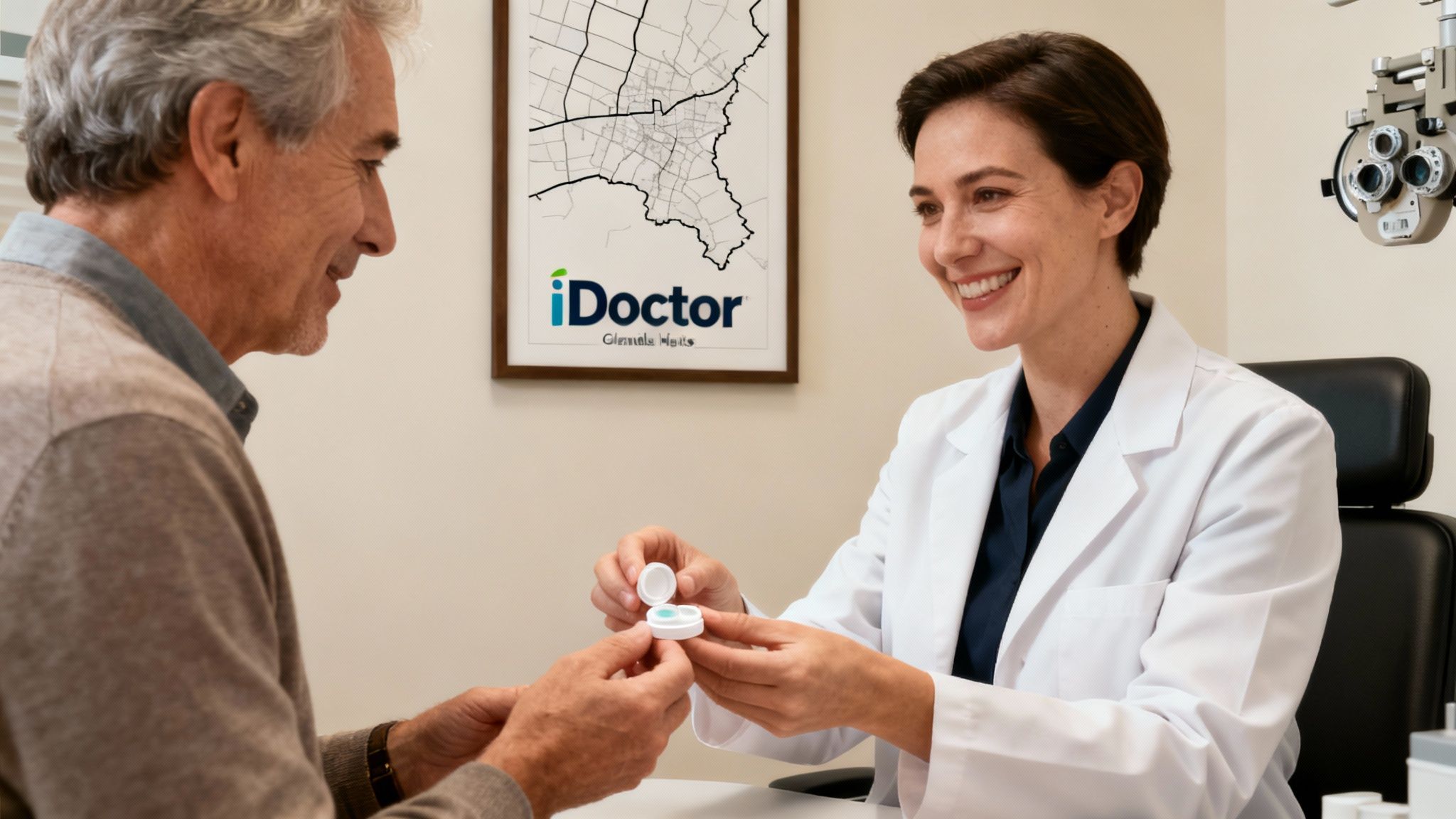
The good news is that today's contact lens technology has caught up. We now have incredible options designed to solve this exact problem. Whether you’re driving down Bloomingdale Road or reading emails at your desk, these lenses can give you crisp, clear sight without any hassle. To make sure residents of Glendale Heights know about these advances, local eye clinics often use effective healthcare SEO strategies. This guide will walk you through how bifocal and multifocal contacts work, opening up the possibilities for a life without glasses.
Why Consider Bifocal Contacts?
Many of our patients make the switch to bifocal contacts because they offer such seamless vision all day long. The main advantages are pretty clear:
- Convenience: Forget searching for your reading glasses or swapping between different pairs. Your vision is simply corrected for all distances, all the time.
- Active Lifestyle: They're a game-changer for sports, hobbies, and any activity where glasses just get in the way.
- Unobstructed View: You get a natural, full field of vision without clunky frames blocking your periphery.
At iDoctor, our goal is to find the perfect vision solution that fits your unique lifestyle. Bifocal and multifocal contacts represent a major step forward in helping our patients see clearly and comfortably at any age.
Of course, the only way to know for sure if they're the right choice for you is with a professional fitting and evaluation. Scheduling one of our detailed eye exams in Glendale Heights is the best first step to see if you're a good candidate and find the perfect lens for your eyes.
Why Your Near Vision Changes After 40
If you've started holding your phone at arm's length just to read a text, or find yourself squinting at a restaurant menu, you're in good company. This is an incredibly common rite of passage that usually kicks in around age 40, and it has a name: presbyopia. It's a completely natural part of aging that eventually affects everyone.
Think of the lens inside your eye like the autofocus on a new camera. When you're younger, it's soft and flexible, instantly shifting focus from a bird in a distant tree to the words in the book on your lap. You don't even have to think about it.
But as the years go by, that lens naturally starts to stiffen up. It loses its elasticity. This makes it much harder for the tiny muscles in your eye to bend the lens enough to focus on things up close. That's when reading a text message or seeing the dashboard clearly becomes a struggle.
It Happens to Everyone
The first thing to know is that presbyopia isn't a disease or a sign that your eyes are unhealthy. It's a universal change, and it happens even to people who've had 20/20 vision their entire lives. Suddenly, simple tasks feel frustrating, and many people find themselves reaching for their first pair of "readers."
Understanding that presbyopia is a predictable, natural process is the first step toward finding a comfortable solution. It's not about your eyes getting "weaker," but simply about the lens inside them becoming less flexible.
This is exactly why technologies like bifocal and multifocal contact lenses exist. They're designed to give you back that focusing power your eyes have lost, so you don't have to constantly juggle reading glasses. The frustration you're feeling is the very problem that modern contact lenses in Glendale Heights are designed to solve. Knowing why your vision is changing helps you have a much better conversation with your eye doctor about finding the right fix for your life.
Comparing Bifocal And Multifocal Contact Lenses
If you’ve hit that point where you’re constantly holding menus at arm’s length, you've probably started looking into options for presbyopia. While "bifocal contact lenses" might be the first term that comes to mind, the technology has come a long way. These days, most of us are fitted with a far more advanced option called multifocal contact lenses, which offer a much smoother, more natural way of seeing.
So, what’s the real difference? Let's break it down.
Classic bifocal contacts are designed a lot like their eyeglass counterparts. They have two distinct power zones built right into the lens—one for seeing things far away and another clearly defined section for up-close tasks. It's almost like a light switch for your vision: it’s either on for distance or on for near. You simply learn to look through the right part of the lens for what you're doing.
Multifocal lenses, on the other hand, are the go-to solution today. Instead of two separate zones, they use a gradual transition of different powers, often designed in a series of concentric rings. This blended approach gives you clear vision not just for near and far, but for all those crucial in-between distances, like your car's dashboard or the computer screen on your desk.
The principles behind these lenses are similar to what you'd find in glasses. Exploring the differences between progressive lenses and bifocals for eyeglasses can give you an even better sense of how this technology works.
How Multifocal Lenses Create Seamless Vision
Think of it this way: a bifocal lens is like a staircase, with a noticeable step between distance and near vision. A multifocal lens is more like a smooth ramp, letting your focus glide effortlessly from one distance to another.
This clever design allows your brain to do what it does best—naturally select the right focus for the job without you even thinking about it. You just look at something, and your brain automatically hones in on the clearest image.
This technology is a huge reason why the contact lens market is booming. The global multifocal segment alone brought in nearly $1.44 billion in 2024 and is on track to hit about $2.6 billion by 2030. It’s clear people are looking for better, more convenient vision solutions.
Because multifocals are so effective, they've really become the standard for correcting presbyopia with contacts. To get into the nitty-gritty, you can learn more about their design in our guide on how multifocal contact lenses work.
The image below perfectly illustrates the journey that brings most people to our office asking about these lenses.
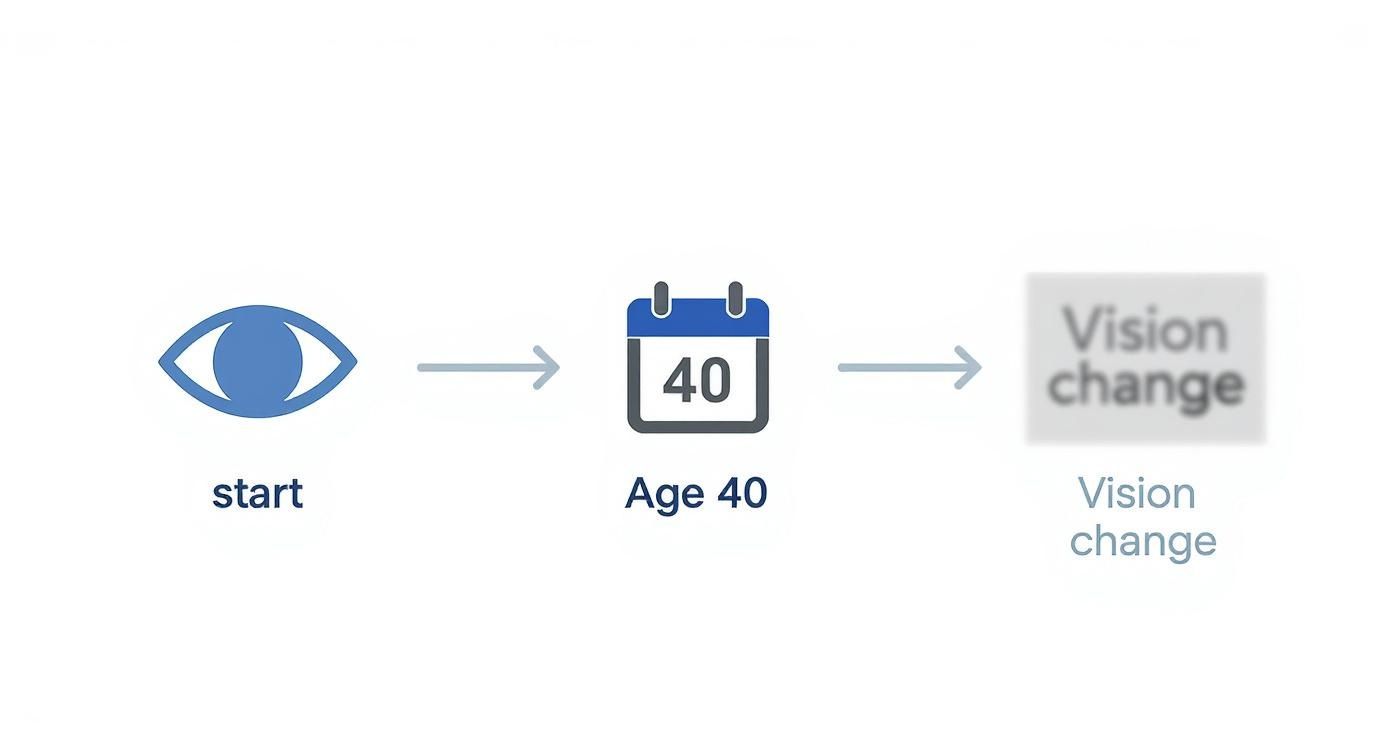
As you can see, the frustrating vision changes that typically start around age 40 are the classic trigger for seeking out advanced options like multifocal contacts.
Bifocal vs. Multifocal Lenses A Quick Comparison
While both types of lenses aim to solve the same problem, how they get you there—and the experience you have along the way—is quite different. To make it simple, I've put together a quick comparison table to highlight what sets them apart.
| Feature | Bifocal Contact Lenses | Multifocal Contact Lenses |
|---|---|---|
| Design | Two distinct power zones (near and far) | Gradual transition of powers for near, intermediate, and far vision |
| Vision Experience | Can have a noticeable "jump" between zones | Smooth, seamless vision across all distances |
| Best For | Simpler visual needs; some specialized prescriptions | Active lifestyles, computer use, and tasks requiring intermediate vision |
| Adaptation Period | Can be shorter for some, but the visual jump may be distracting | May take a few days to two weeks for the brain to adapt to the design |
Ultimately, both are great technologies, but multifocal lenses generally provide a more intuitive and modern solution for today's dynamic lifestyles.
The ultimate goal is to find a lens that integrates so perfectly into your daily life that you forget you're even wearing it. Multifocal lenses often achieve this by providing a more intuitive and natural visual experience.
What About Monovision? Another Smart Alternative
If the idea of bifocal or multifocal contacts doesn't quite click for you, there's another popular and clever approach we often use called monovision. This technique sidesteps the need for a single, complex lens and instead relies on your brain's amazing ability to process visual information.
Here’s how it works: we fit one of your eyes with a standard contact lens for excellent distance vision. The other eye gets a contact lens corrected for your up-close reading needs. It sounds a little strange at first, but it's a remarkably effective way to get the job done.
You're probably thinking, "Won't that feel weird and unbalanced?" Surprisingly, for the majority of people, the answer is no. Your brain is incredibly skilled at adapting. It quickly learns to favor the eye that's delivering the sharpest image for whatever task is at hand.
How Your Brain Pulls Off This Trick
Think about driving down North Avenue. When you're looking at street signs in the distance, your brain automatically tunes into the input from your "distance eye." A moment later, when you glance down at a text message, it seamlessly switches over to the "near eye."
This all happens in the background, without any conscious effort. After a short adjustment period, most people don't even notice the switch. They just enjoy clear vision at both distances, often without the visual compromises that can sometimes come with multifocal designs.
Monovision really highlights the powerful partnership between your eyes and your brain. We're essentially using your brain's natural filtering ability to give you clear sight, making it a straightforward and elegant solution for many of our patients here in Glendale Heights.
The Good, The Bad, and The Blurry: Pros and Cons of Monovision
Just like any other vision solution, monovision has its own unique set of trade-offs. Knowing what they are can help you and your eye doctor decide if it's the right path for you.
Here's what people often like about it:
- Crisp Vision: Because each lens has just one job—either near or far—the vision at that specific distance can be incredibly sharp and clear.
- Simple and Affordable: Monovision typically uses standard, single-vision contact lenses. This often makes it a more budget-friendly option compared to specialized multifocal lenses.
- A Smoother Transition: Some people find it much easier to get used to monovision than to the blended visual zones in a multifocal lens.
But, there are a few potential downsides to consider:
- Less Depth Perception: When your eyes aren't working together in the traditional way, you might notice a subtle change in your depth perception. This can be a factor for certain activities.
- The "In-Between" Zone: You might find that things at an intermediate distance, like your computer monitor, aren't perfectly sharp.
- It Takes Time: It can take anywhere from a few days to a couple of weeks for your brain to fully get on board with this new way of seeing.
The only real way to know if monovision is for you is to give it a try. At iDoctor, our team, considered by many to be the best optometrist in Glendale Heights, can set you up with a trial pair so you can experience it for yourself and see how it works in your daily life.
Are Bifocal Contacts the Right Choice for You?
So, you're wondering if you can actually get bifocal contact lenses and if they'll work for you. It's a great question. While the technology is pretty incredible, they aren't a one-size-fits-all solution. The best candidates are usually people who are simply tired of being chained to their reading glasses and love the freedom of contacts.
If you have presbyopia—that classic, frustrating experience of holding menus at arm's length—and also need help seeing things far away, you're on the right track. It also really helps to have generally healthy eyes, without major issues like severe dry eye syndrome or certain conditions affecting your cornea. Comfort is king, after all.
Key Traits of a Strong Candidate
If this list sounds a lot like you, it’s definitely worth a conversation with your eye doctor. People who have the most success with these lenses typically:
- Have Presbyopia: This is the main reason these lenses exist! If you're struggling to see both your phone and road signs clearly, you're the exact person they were designed for. Unsure if that's what's happening with your vision? Our guide on how to tell if you need bifocals can help clear things up.
- Are Ready for a Change: You're just over the constant juggling act—reading glasses on, reading glasses off, or switching between two different pairs of specs all day long.
- Have a Little Patience: You understand there’s a small learning curve. It can take anywhere from a few days to a couple of weeks for your brain to fully adapt to this new way of seeing the world.
A successful fitting is about more than just getting the prescription right. It’s about finding someone who’s genuinely excited about the possibility of clear vision at all distances and is willing to work with their optometrist through that short adjustment period.
Who Might Face a Few Hurdles
On the flip side, some situations can make these lenses a tougher fit, at least right away. For example, if you have very significant dry eye, you might struggle with the comfort of any contact lens, though modern materials have made huge strides in this area.
People with highly specialized jobs—think pilots or graphic designers who need perfectly crisp, uncompromising vision at one specific distance for hours on end—might find that single-vision options still serve them better.
Even so, the demand for these lenses is skyrocketing. The multifocal lens market was valued at a whopping $3.1 billion in 2021 and is projected to hit $4.1 billion by 2025. That growth is fueled by millions of people just like you looking for a better solution. You can explore more about this market growth on cognitivemarketresearch.com.
The only way to know for sure what's best for your eyes is to have a professional take a look. A custom fitting for contact lenses in Glendale Heights is the most definitive way to find your answer.
The Custom Contact Lens Fitting Process at iDoctor
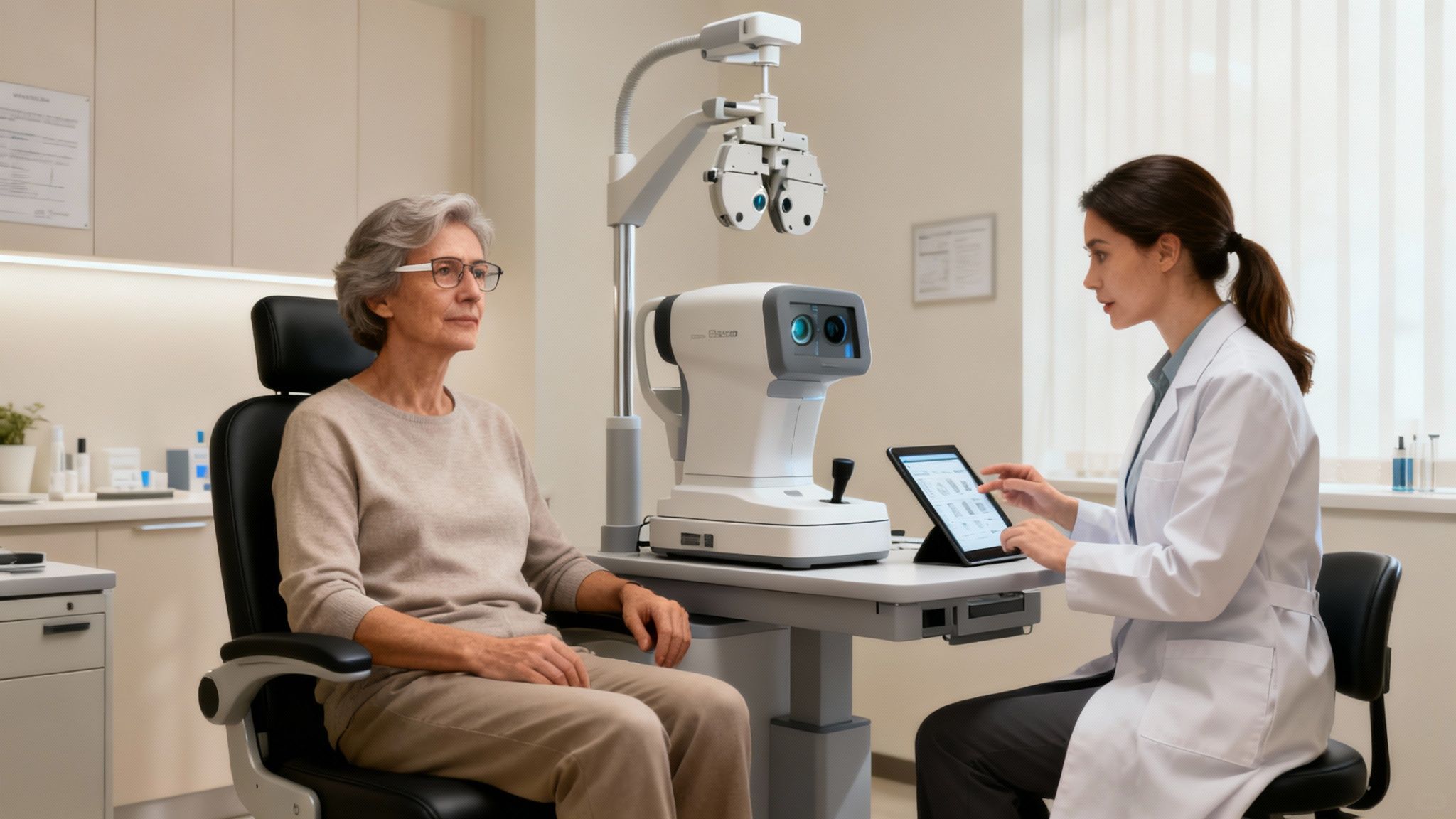
Finding the right bifocal or multifocal contacts isn't like picking a pair of reading glasses off the rack. It's a highly personalized process, and here at iDoctor, we treat it as a partnership. Our entire goal is to find the perfect fit for your eyes, your vision, and the life you lead right here in Glendale Heights. It all starts with one of our signature detailed eye exams.
We set aside a full 30 minutes for your appointment because a proper fitting can't be rushed. We take the time to truly understand your eyes, using high-resolution imaging to map the unique curvature of your cornea. We also look closely at your tear film, as that’s a critical piece of the puzzle for ensuring your lenses stay comfortable all day long.
Beyond the Prescription
Once we have the precise measurements of your eyes, the real conversation begins. We’ll talk about your day-to-day life. Are you staring at a computer screen for hours? An avid golfer who needs to see the ball and the scorecard? Do you do a lot of night driving along Army Trail Road? Your lifestyle dictates the best lens for you.
We believe the best lens is one you forget you're even wearing. That’s why we consider everything from material breathability to moisture content to match you with a lens that feels as good as it sees.
This dedication to personalized care is what makes our boutique practice different. We want to make sure you walk out with the perfect match. For a deeper look into all the factors we consider, check out our guide on finding the right contact lenses for your eyes.
Accessible Premium Care
It’s no surprise that the demand for bifocal and multifocal contacts is growing. As more of us look for alternatives to glasses, the global market for these lenses has boomed, valued at around $2.5 billion in 2023 and expected to hit $4.2 billion by 2032.
Here at iDoctor, we're committed to making this incredible technology accessible. We proudly accept all major vision insurance plans to help manage your costs, because great vision shouldn't come with a compromise.
Your Glendale Heights Bifocal Contact Lens FAQs
Thinking about making a switch to a new kind of contact lens always brings up a few questions. To help you feel more comfortable and confident with your choices, we’ve gathered answers to the things we hear most often from our patients here in Glendale Heights. We want to give you clear, straightforward information so you can finally move towards a life without constantly reaching for reading glasses.
Do I need a special appointment for a multifocal contact lens fitting?
Yes, a multifocal contact lens fitting requires more time and expertise than a standard eye exam. At iDoctor, we perform detailed eye exams in Glendale Heights that include precise corneal measurements and a lifestyle consultation to ensure we find the perfect lens design and prescription for your specific needs.
How long does it take to get used to bifocal or multifocal contacts?
For most people, it takes anywhere from a few days to about two weeks to fully adapt. Your brain needs a little time to learn how to effortlessly switch between the different vision zones built into the lenses. Our optometrists are experts at guiding you through this adjustment period and we'll schedule follow-up visits to make sure everything is going smoothly. To dive deeper into this topic, check out our detailed article on multifocal contacts.
Can I try them before buying a full supply?
Absolutely! A trial run is a non-negotiable part of our fitting process at iDoctor. We’ll send you home with diagnostic trial lenses to test out in your everyday life—at the office, driving on I-355, or just relaxing with a book at home. This lets us work together to fine-tune the fit and prescription until you are 100% happy with both your vision and comfort.
Does iDoctor accept vision insurance for contact lenses?
Yes, we do. As your local eye doctor in Glendale Heights, we believe premium eye care should be accessible. We proudly accept all major vision insurance plans, which can significantly help with the cost of your exam and contact lens supply.
Ready to see if bifocal or multifocal contact lenses are the right choice for you? At iDoctor, our expert team in Glendale Heights is here to guide you through a personalized fitting process, ensuring you find the perfect solution for your eyes and lifestyle—whether you live nearby or commute in from surrounding Chicagoland suburbs.