Ever wonder if it's finally time for glasses? It's a question that often sneaks up on us, usually disguised as a small, daily frustration. Maybe it’s a nagging headache that shows up around 3 PM every workday, or finding yourself squinting at your screen. These are the little whispers from your eyes that they might need some help. If you've been asking this question in Glendale Heights, you're not alone, and we're here to help you find the answer.
Recognizing the Daily Signs Your Vision Is Changing
The need for glasses rarely announces itself overnight. It's a slow burn. One day you’re reading just fine, and the next, you're holding your phone at a weird arm's length to make out a text message.
These little struggles are actually big clues. Think about your daily drive—are you squinting to read the road signs on North Avenue? Does the menu at your favorite spot in Glendale Heights suddenly seem a bit fuzzy? These aren't just minor annoyances; they're signals that your eyes are working overtime just to keep things in focus. For a great rundown on this, check out this guide covering the key signs and symptoms that indicate you might need glasses.
It’s More Than Just Blurry Vision
While blurry vision is the most obvious sign, plenty of other symptoms fly under the radar. Because vision changes happen so gradually, many people just adapt to them without realizing there’s an issue.
Keep an eye out for these other common red flags:
- Seeing Halos or Glare: When you're driving at night, do the headlights on Bloomingdale Road look like they have a starburst effect around them? This could be a sign of astigmatism.
- Constant Headaches: A dull ache right behind your eyes, especially after you've been reading or working on the computer, is a classic symptom of eye strain.
- Tired, Aching Eyes: Do your eyes just feel heavy and sore after focusing on something for a while? That’s your eye muscles telling you they're being overworked.
If any of this sounds familiar, you're in good company. At least 2.2 billion people around the world have a vision impairment, and a huge number of those cases are simple refractive errors that glasses can easily fix. That's about one in eight people who could be seeing better.
To help you connect the dots, here’s a quick way to check your own symptoms and what they might mean.
Quick Symptom Checker: Are Glasses in Your Future?
| Common Symptom You Experience | What It Could Mean for Your Vision | Simple At-Home Check |
|---|---|---|
| Blurry distance vision | Potential nearsightedness (myopia). | Look out a window at a sign down the street. Does it look fuzzy? |
| Trouble reading up close | Could be farsightedness (hyperopia) or presbyopia (age-related). | Hold a book or your phone at a comfortable distance. Do you have to push it farther away to read it? |
| Headaches after screen time | Digital eye strain or uncorrected astigmatism. | Take a 20-second break every 20 minutes to look at something 20 feet away (the 20-20-20 rule). |
| Seeing "starbursts" at night | Often a sign of astigmatism. | Notice if oncoming headlights or streetlights have a distracting glare or halo effect. |
| Squinting to see clearly | Your eye's natural (but temporary) way of trying to focus light. | Ask a friend to watch if you squint when looking at the TV or a menu. |
This isn't a diagnosis, of course, but it's a great starting point for understanding what your eyes are trying to tell you.
Listen to Your Daily Habits
Pay attention to the small things. Do you struggle when your focus has to shift quickly from your laptop to someone walking into the room? Have you stopped checking out books from the Glendale Heights Public Library because reading feels like a chore?
These are real-world signs that your vision has changed. And if you're dealing with persistent fuzziness, it’s worth understanding the common causes behind blurry vision so you can have a more informed conversation with your eye doctor. Picking up on these patterns is the first real step toward seeing the world clearly again.
Simple Vision Checks You Can Do at Home
Let's be clear: nothing takes the place of a comprehensive eye exam. But a few quick checks at home can help you figure out what's really going on with your vision. Think of this as gathering clues. It helps you walk into the doctor's office with specific examples instead of just a vague feeling that "something's off."
When you see an eye doctor in Glendale Heights, having these real-world examples helps us get to the root of the problem much faster. It's the difference between saying "my eyes are weird" and "I can’t read the street signs on Schmale Road until I’m right on top of them."
Putting Your Distance Vision to the Test
First, let's see how you're doing with things far away. This is an easy one. Just find a good vantage point—your living room window or front porch works perfectly.
- The Street Sign Check: Pick a sign down the block. Can you make out the letters clearly? Now, cover your right eye and look. Then cover your left. If the text seems fuzzy or the letters run together with either eye, that’s a detail worth noting.
- The TV Test: Settle into your usual spot on the couch. When the program guide pops up or scores flash on the screen during a game, is the text crisp? Finding yourself squinting or leaning in is a classic sign that your distance vision needs a hand.
This simple flowchart can help guide your next move.
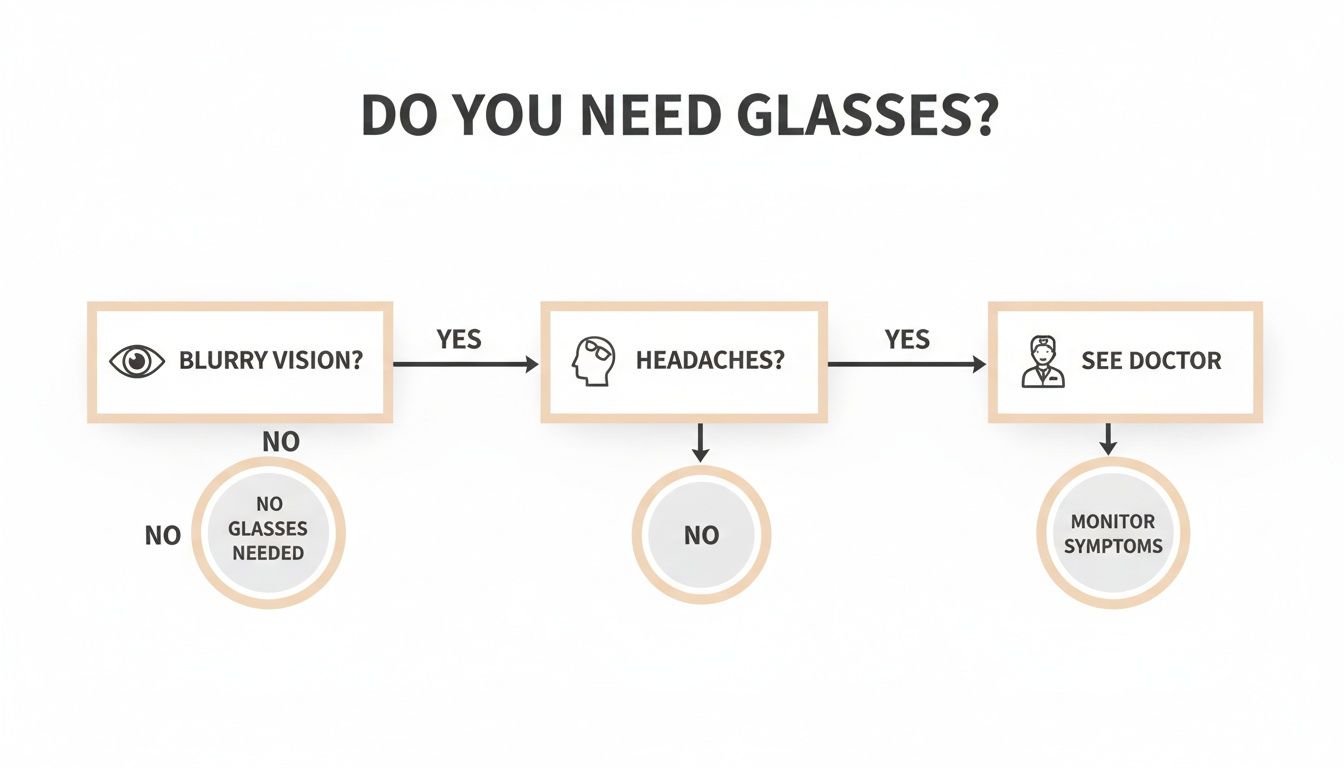
As you can see, symptoms like blurry vision or frequent headaches point directly toward getting a professional opinion. It’s the surest way to get relief.
Checking Your Near Vision and Contrast
Now for the close-up stuff. For many of us, the first hint we need glasses comes when reading starts to feel like a chore.
Grab a book, your phone, or a magazine and hold it where you normally would—about 14-16 inches away is typical. Is the text sharp? Or do you have to work at it? Try moving it a little closer. Note the point where it starts to blur.
Pro Tip: Watch for the "Trombone Effect." If you're constantly pushing your phone or a menu further away to see it clearly, you're likely dealing with presbyopia. It’s a completely normal, age-related change that affects almost everyone.
Finally, pay attention to how your vision performs in different lighting conditions. How well can you distinguish objects in a dimly lit room compared to a brightly lit one? If things lose their sharp edges or blend into the background in low light, that points to a potential issue with contrast. This can make activities like driving at dusk especially tricky and is a crucial piece of information to bring to one of our detailed eye exams in Glendale Heights.
How Vision Changes Throughout Your Life
Your eyes don't stay the same; they evolve right along with the rest of you. The signs that a child needs glasses are a world away from the clues that pop up in your 40s. Knowing what to look for at each stage of life is key.
Sometimes, vision changes happen so slowly that you adapt without even realizing anything is wrong. For parents here in Glendale Heights, this is especially true for your kids. You might catch them sitting way too close to the TV, or maybe they're squinting to see the board at Glenbard East High School. Even losing interest in reading can be a red flag. These are classic first signs of nearsightedness (myopia), and they definitely warrant a closer look.
Vision in Your 20s and 30s
For most young adults, the biggest vision challenge comes from the modern workplace. Staring at a computer screen for hours on end can lead to digital eye strain, which often shows up as tired, aching eyes and nagging headaches.
You might also notice subtle shifts in your distance vision. After a long day at the office, do you find it's a bit harder to make out street signs on your drive home down Army Trail Road? That temporary blurriness is your eye muscles getting worn out from focusing up close all day. It might seem like a small thing, but it can point to an underlying vision issue that a simple pair of glasses could fix, making your workday more comfortable and your commute safer.
Navigating Vision Changes After 40
Hitting your 40s is a major milestone for your eyes. This is the decade when almost everyone starts to deal with presbyopia—the natural, age-related decline in your ability to focus up close. It’s not a disease; it’s just the lens inside your eye losing its flexibility over time.
This change usually creeps up in some familiar, frustrating ways:
- The "Trombone Effect": You find yourself holding menus, books, or your phone farther and farther away just to get the text into focus.
- Brighter Light Needed: Suddenly, you need to turn on every lamp in the room to read a recipe or the newspaper.
- Fatigue from Close-Up Work: Hobbies like reading or crafting seem to tire your eyes out much faster than they used to.
This isn't just something you and your friends are noticing; it's a global reality. As the population ages, the number of people needing vision correction is expected to jump by roughly 55% by 2050. Presbyopia is a huge part of that, already affecting over 826 million people. This makes routine eye exams an essential piece of your healthcare puzzle after 40. You can explore more on this global vision trend with these insights from Statista.
For many people just starting to notice presbyopia, a simple pair of over-the-counter readers can help. But often, a custom solution like progressive lenses or multifocal contacts offers a much better experience by providing clear vision at all distances. The first step is just understanding what’s happening, and for a deeper look, check out our guide on how your eyes change with age.
Why a Professional Eye Exam Is Essential
So, you’ve done a few checks at home and you’re noticing some changes in your vision. What’s next? The single most important step you can take is to schedule a professional eye exam. This isn't just about confirming your suspicions; it’s a comprehensive look into the health and function of your eyes.
A basic vision screening at school or the DMV is designed to catch only the most obvious problems. It’s a pass/fail test, not a diagnosis. It simply can’t give you the detailed picture an optometrist needs to get things right.
At iDoctor, we go much deeper than a simple screening. Our detailed eye exams in Glendale Heights are thorough and typically last about 30 minutes. We’ve learned that being the best optometrist in Glendale Heights means taking the time to understand your unique eyes and using high-resolution imaging to nail down your prescription perfectly.
What Happens During a Comprehensive Exam
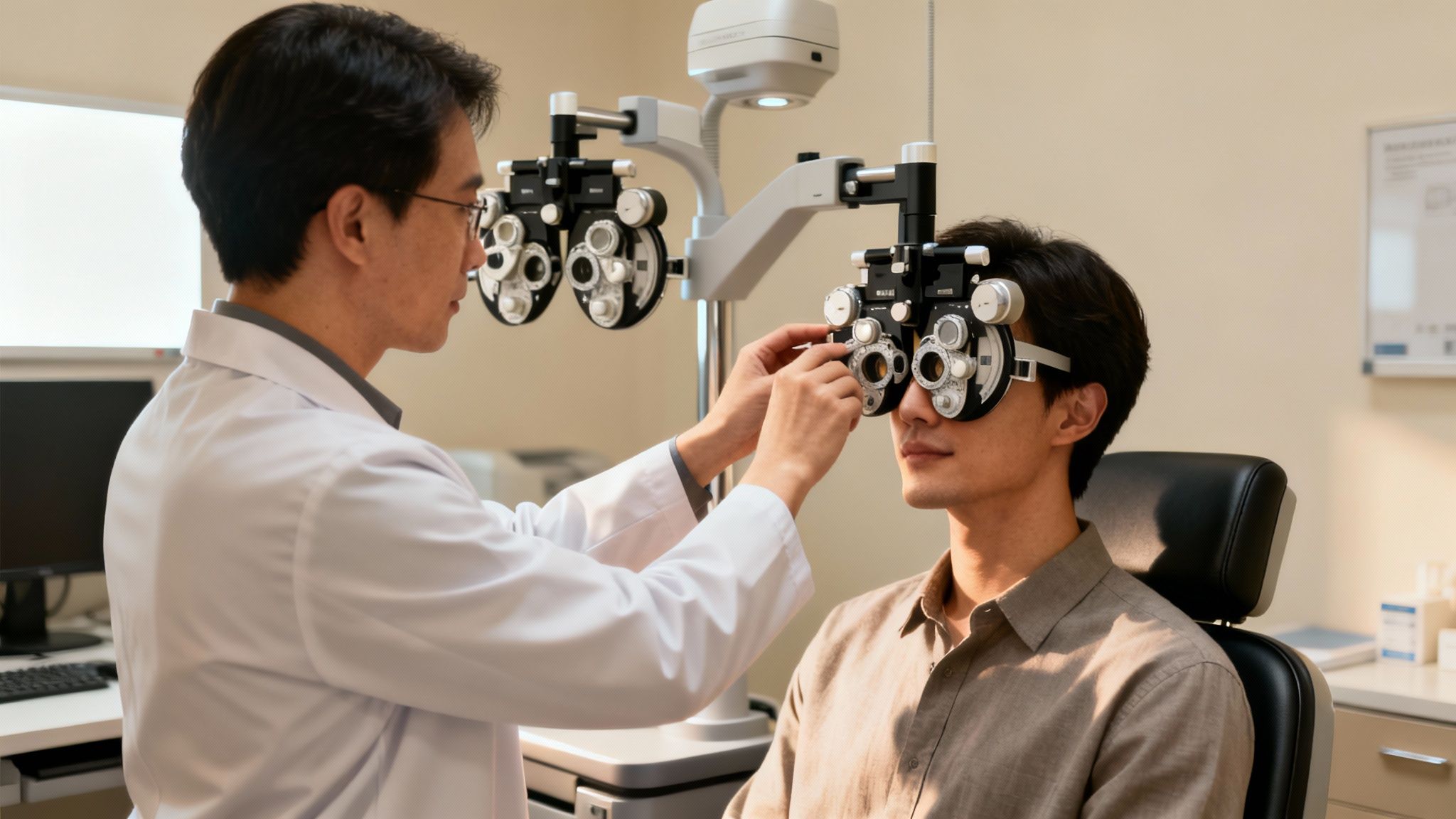
When you come in, we’ll run through a series of tests that go way beyond the classic "read the smallest line" chart. One of the key parts of the exam is the refraction test. This is the familiar "which is better, one or two?" part, where we use a phoropter to cycle through different lenses. It's an interactive process that lets us fine-tune your prescription for either glasses or contact lenses in Glendale Heights.
But finding that perfect prescription is only half the battle. A truly comprehensive exam is also an essential health check.
Your eyes are a window to your overall health. Conditions like high blood pressure, diabetes, and even high cholesterol can often be detected through changes in the blood vessels at the back of your eye—sometimes before you notice any other symptoms.
Advanced Imaging for a Deeper Look
To get a complete picture, we rely on high-resolution imaging technology. This gives us a detailed snapshot of your retina, optic nerve, and the other delicate structures deep inside your eye. It's a quick, painless process that allows us to screen for serious conditions that often creep up without any early warning signs, including:
- Glaucoma: A disease that slowly damages the optic nerve.
- Macular Degeneration: A leading cause of vision loss in older adults.
- Diabetic Retinopathy: Damage to the eye caused by diabetes.
By combining a precise refraction with these advanced health screenings, we get a 360-degree view of your visual needs. This ensures your new designer eyeglasses in Glendale Heights don't just help you see better today, but are also part of a plan for long-term eye wellness. Ultimately, this level of care is the only definitive answer to the question of whether you need glasses.
Navigating Your New Prescription and Eyewear
So, you’ve finished your eye exam and have a new prescription in hand. This is the moment when things get exciting—you're on your way to seeing the world more clearly. But what’s next? Let's walk through how to make sense of that piece of paper and find the perfect pair of glasses.
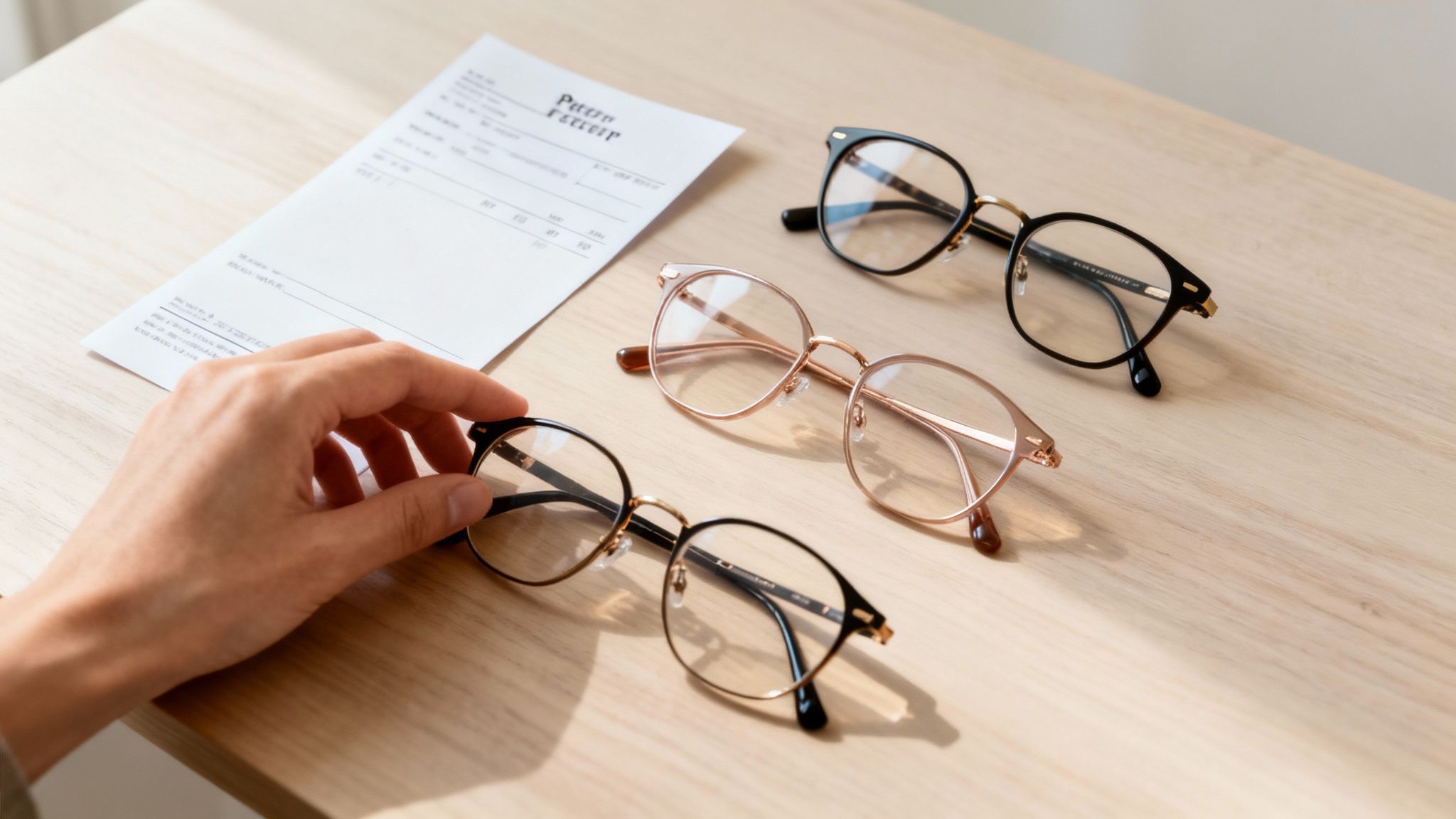
First, let's look at that prescription. You'll see a jumble of abbreviations like OD, OS, SPH, and CYL. It can look a little intimidating, but each one is just a precise measurement of what your eyes need to see their best. Think of it as a custom map for crafting your lenses. If you're the kind of person who likes to know all the details, we've broken it all down in our guide to understanding eye prescription numbers.
Choosing Frames That Fit Your Life and Style
With the technical stuff out of the way, it’s time for the fun part: finding frames you love. Eyewear is so much more than a tool for vision; it's a reflection of your personality. That's why at our independent optometry boutique, we take so much pride in our curated collection of designer eyeglasses in Glendale Heights.
We’ve brought together a selection to suit every style, from high-fashion statement pieces to classic, understated looks.
- Luxury & High Fashion: We carry stunning frames from iconic brands like Cartier, Gucci, Tom Ford, Oliver Peoples, Fendi, Saint Laurent, Prada, and Tory Burch.
- Affordable & Timeless: You’ll also find beloved classics and modern designs from Ray-Ban, Scott Harris, Michael Kors, Kate Spade, and Coach.
Your face shape, lifestyle, and daily activities all play a role in finding the right pair. Do you need something durable for an active life, or a lightweight frame for long hours at the computer? We’ll help you consider all the angles.
As you start your search, you might want to look into understanding virtual try-on technology for eyewear. It’s a neat tool that’s becoming more common and can give you a great head start.
Making Premium Eyewear Accessible
We believe that finding eyewear you truly love shouldn't be a source of financial stress. Our goal has always been to make premium eye care a reality for everyone in our Glendale Heights community.
That’s why at iDoctor, we proudly accept all major vision insurance plans, including VSP, EyeMed, and Cigna Vision. Our team is fantastic at helping you navigate your benefits and get the most out of your coverage. This way, you can focus on what really matters: finding frames that make you feel incredible. From the moment you walk in to your final fitting, we’re here to help you see clearly and feel confident.
Frequently Asked Questions for Glendale Heights Residents
We hear a lot of the same questions from our neighbors, whether they’re walking in for the first time or have been part of our patient family for years. Here are answers to a few common questions.
How often should I get my eyes checked?
For most adults with no specific risk factors, we recommend a comprehensive eye exam every one to two years. This allows us to track subtle changes in your vision and eye health, often catching potential issues before you notice them. We strongly suggest annual exams for children (especially before they start school at places like Americana Intermediate School), anyone with risk factors like diabetes, and all adults over 60.
Can I just use over-the-counter reading glasses?
While drugstore readers can be a handy temporary fix, they are simple magnifiers and not a substitute for prescription eyewear. They offer a one-size-fits-all solution that can’t correct for astigmatism or differences between your two eyes. A professional eye exam at our Glendale Heights office is the only way to get a truly accurate prescription and rule out underlying health issues.
Does my vision insurance cover contact lenses?
Most of the major vision insurance plans we accept at iDoctor do include benefits for contact lenses. The specifics can vary from one plan to another—some offer a set allowance for either glasses or contacts, while others might cover your fitting exam. Our team is always ready to help you sort through your benefits to ensure there are no surprises when you need contact lenses in Glendale Heights.
Do I need an appointment to look at designer eyeglasses?
You are always welcome to stop by our Glendale Heights boutique to browse our curated collection of eyewear from Cartier, Gucci, Oliver Peoples, and more. You don't need an appointment just to look! If you'd like a personalized fitting with one of our expert opticians, we do recommend scheduling a time so we can give you our full, undivided attention. Whether you're looking for Gucci glasses near me or just want to see the latest styles, our door is open.
For a little more guidance on what to discuss during your visit, check out our guide on the top eye exam questions Glen Ellyn residents should ask.