Ever felt like your eyeglass prescription is written in a secret code? You're not alone. Here at iDoctor, our optometry boutique in Glendale Heights, we often see patients who find the jumble of letters and numbers a bit confusing. But learning how to read an eyeglass prescription is actually pretty straightforward once you know what each part means.
It all comes down to understanding a few key terms like OD (right eye), OS (left eye), Sphere (SPH), Cylinder (CYL), and Axis. This guide will walk you through everything, making your next visit for new eyeglasses in Glendale Heights an easy and informed experience.
Your Vision, Decoded
After one of our detailed eye exams, you get that small piece of paper that looks more like a math problem than a tool for clear vision. As Glendale Heights' premier optometry boutique, we want to pull back the curtain and translate that technical jargon into plain, simple English.
Understanding your own prescription is empowering. You’re joining the millions of people who rely on corrective lenses to see clearly every day. In fact, over 66% of adults in the United States use some form of vision correction, making glasses a part of daily life for about 168 million Americans. You can see a full breakdown of how people buy eyewear in this vision care report.
This guide will walk you through every term on that little slip of paper. By the end, you'll be able to read your prescription with confidence, whether you're here with us picking out a new pair of Cartier frames or just want to be more informed about your own eyes.
A Quick Note: Glasses and Contacts Aren't the Same
It’s really important to know that an eyeglass prescription is completely different from a contact lens prescription. Eyeglasses sit a small distance from your eyes, but contacts rest directly on your cornea.
That difference in distance changes the power needed to correct your vision. Because of this, you need a separate fitting and a unique prescription for contacts. You simply can't use one for the other—it won't give you clear vision and could even be unsafe. You can learn more in our guide on the differences between contact lens and eyeglass prescriptions.
Why This Matters in Glendale Heights
From reading the street signs on Bloomingdale Road to enjoying a crisp, clear view at Camera Park, your vision is what connects you to our community. Knowing how to read your prescription is the first step in making sure that connection is as sharp as possible. It also helps you have better, more productive conversations with your eye doctor and our expert opticians.
Your prescription is more than just numbers; it's a personalized map to achieving your best possible vision. Understanding it gives you control over your eye health journey.
Whether you're searching for the best optometrist in Glendale Heights or just browsing designer eyeglasses, being an informed patient makes everything easier. Let’s make sense of it together.
Decoding Sphere, Cylinder, and Axis
Alright, let's get into the nitty-gritty of your prescription. The three most important numbers you'll see are Sphere (SPH), Cylinder (CYL), and Axis. Think of these as the fundamental building blocks that work together to give you clear, sharp vision.
First up is Sphere (SPH). This number tells you the main lens power needed to correct your eyesight, measured in a unit called a diopter. If you see a minus sign (-) in front of the number, you’re nearsighted (myopic), which is why things far away, like street signs on Glen Ellyn Road, look fuzzy. A plus sign (+) means you’re farsighted (hyperopic), making it tough to focus on things up close.
This graphic gives you a great visual breakdown of how we get from an eye exam to the numbers on your prescription.
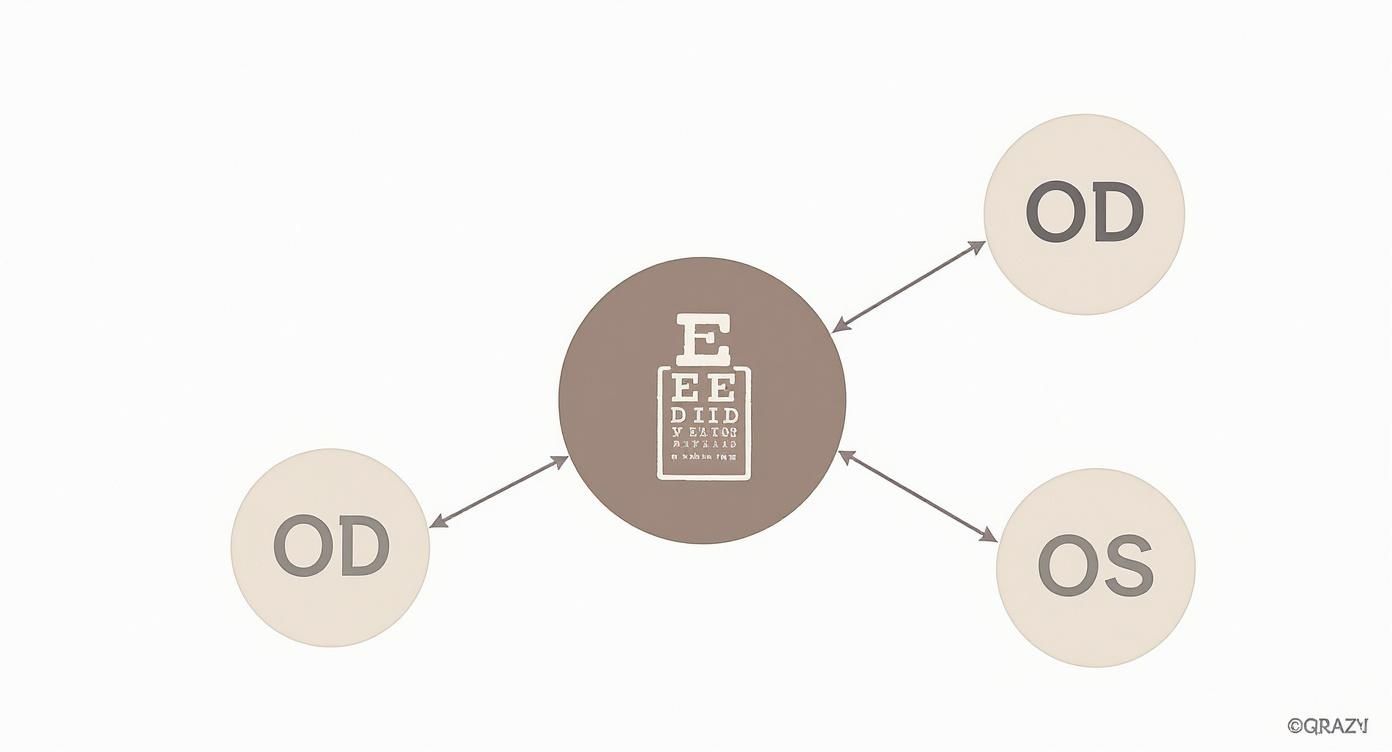
As you can see, the final prescription is a unique combination of measurements for both your right eye (OD) and your left eye (OS).
Tackling Astigmatism Correction
Now, if you see numbers in the Cylinder (CYL) and Axis columns, it simply means you have astigmatism. Don't let the name intimidate you; it's an incredibly common condition. It just means the front surface of your eye is shaped a bit more like a football than a perfectly round basketball. This irregular curve bends light unevenly, causing vision to be blurry or distorted at any distance.
The Cylinder value indicates how much lens power is needed to correct for that irregular shape. Just like the sphere, it will have a minus or plus sign. The higher the number, the more pronounced the astigmatism. We have a whole article that goes into more detail on what is astigmatism if you want to learn more.
The Axis is the final piece of the puzzle. This will be a number between 1 and 180, and it tells the lab precisely where to position the cylinder correction in your lens. Imagine it like a degree on a protractor—it pinpoints the exact orientation of the astigmatism so the lens can correct it perfectly.
The Bottom Line: Sphere handles nearsightedness or farsightedness, while Cylinder and Axis work as a team to correct the unique shape and orientation of your astigmatism. All three are essential for getting your vision as crisp as possible.
Putting It All Together
Let's walk through a real-world example you might see for someone here in Glendale Heights:
- OD: -2.50 SPH
- OS: -2.00 / -0.75 x 165
Looking at this, we can see the person's right eye (OD) is nearsighted by -2.50 diopters. Since there are no CYL or Axis values, there's no astigmatism in that eye.
Their left eye (OS), however, is nearsighted by -2.00 diopters and also has a mild astigmatism. The -0.75 cylinder is oriented at the 165-degree axis. Understanding how these numbers come together really highlights the precision that goes into crafting a perfect pair of Saint Laurent or Tom Ford glasses just for you.
Decoding Advanced Prescription Details
Beyond the big three—sphere, cylinder, and axis—your prescription might have a few other numbers tucked away. These aren't just random notations; they address very specific vision needs, from the reading struggles that creep in over time to subtle eye alignment issues. Getting these details right is the difference between "okay" vision and truly sharp, comfortable sight.
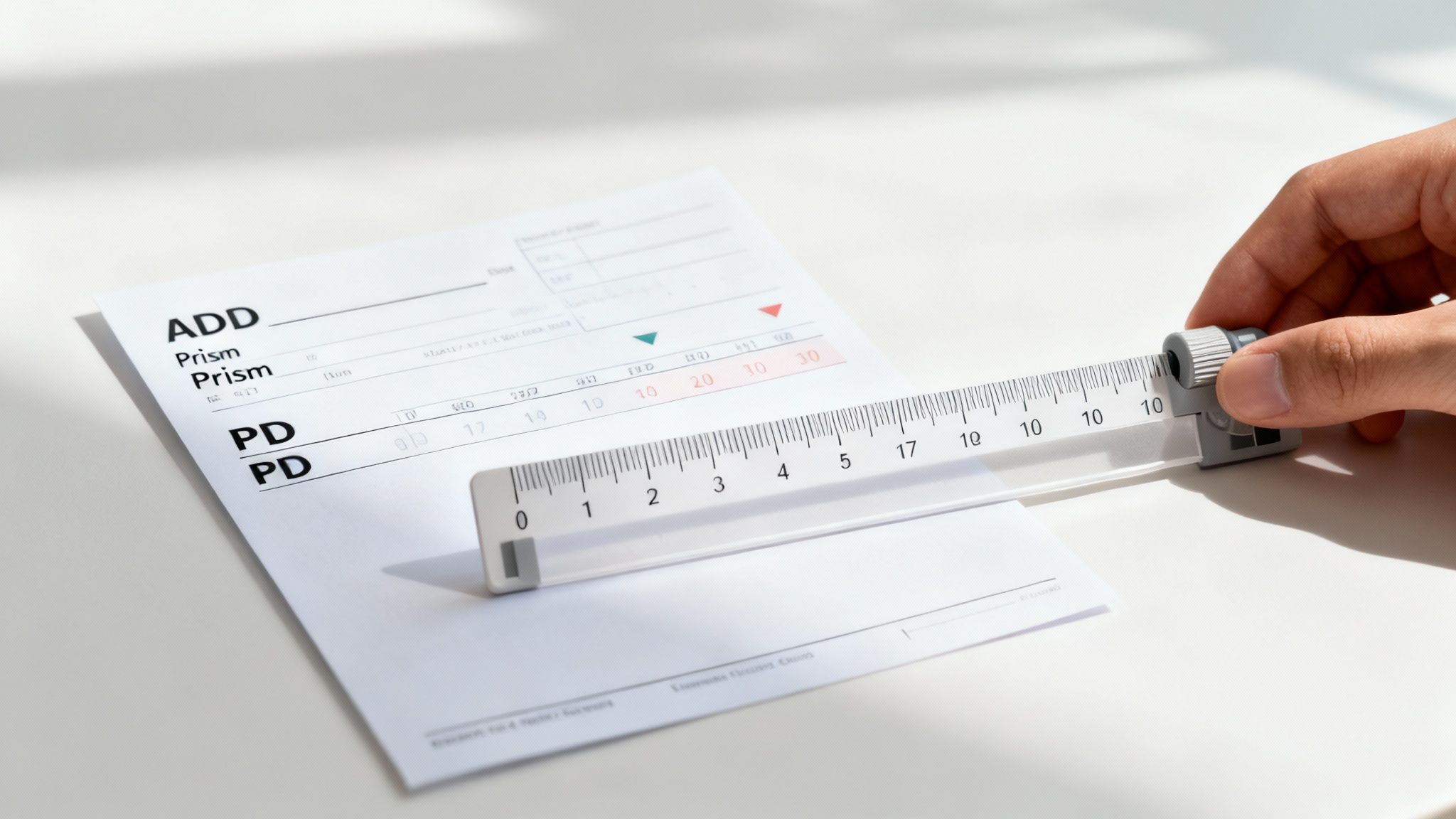
One of the most frequent additions you’ll see is the ADD value. This is the extra magnifying power added to bifocal or progressive lenses to correct presbyopia—that completely normal, age-related frustration of not being able to focus up close. As buying glasses online has become more popular, knowing what this number means is more important than ever.
An ADD value usually falls somewhere between +1.00 and +3.00 diopters. It's simply added to your main distance prescription to create the reading portion of your lens. It's a huge market, and you can find some fascinating reading glasses market trends at marketresearch.com.
Correcting Eye Alignment and Ensuring a Perfect Fit
Now for the less common, but equally critical, details. If you spot Prism and Base on your prescription, it means your eyes need a little help working together as a team. This correction is prescribed when your eyes aren't perfectly aligned, which can lead to double vision, headaches, and some serious eye strain.
The prism value, measured in prism diopters (PD), actually bends the light before it enters your eye, helping them align without the strain. The Base simply tells the lab which direction to orient the prism: up, down, in, or out. This is a perfect example of a correction that requires professional expertise to get just right.
An accurate prescription is the blueprint for clear vision. Each number, from the ADD power for reading to the precise Prism correction, plays a vital role in crafting lenses that are perfectly suited to your eyes.
Finally, we have one of the most crucial measurements for a good pair of glasses: your Pupillary Distance (PD). This is the distance in millimeters between the centers of your pupils, and it’s non-negotiable for getting your lenses made correctly. The PD ensures the optical center of each lens is placed directly in front of your pupil.
When the PD is off, you'll feel it. The side effects can be pretty uncomfortable:
- Persistent eye strain and headaches: Your eyes are fighting to see through the wrong part of the lens.
- Vision that feels blurry or distorted: The corrective power isn't where it needs to be.
- Progressive lenses that don't work: The different viewing zones for distance, intermediate, and reading will be completely misaligned.
Your PD might be a single number, like 63mm, or two separate numbers for each eye (e.g., 31.5/31.5). While you can try to measure this at home, I always recommend getting it done by a professional. It’s the only way to guarantee accuracy, especially if you have a strong prescription or are investing in complex lenses for frames from brands like Gucci or Prada. For a deeper dive, check out our guide on how to measure your pupillary distance for the perfect eyewear fit in Glendale Heights.
Let's Look at Some Real-World Prescriptions
Theory is one thing, but seeing how these numbers work in practice is where it all starts to make sense. Let's walk through a few common prescriptions I see all the time here in Glendale Heights, from a straightforward case of nearsightedness to a more complex progressive lens. This will help you see the patterns and understand what your own prescription is telling you.
We'll break down each example—OD for the right eye and OS for the left—to see how the values work together to correct specific vision problems.
Simple Nearsightedness: The "I Can't See the Board" Case
This is probably the most common prescription we write. Let's imagine a student from Glenbard West High School who’s having trouble seeing what the teacher is writing on the board.
- OD: -2.25 SPH
- OS: -2.00 SPH
- PD: 62
Here, the right eye (OD) needs -2.25 diopters of correction to see clearly at a distance. The left eye (OS) is a little better off, only needing -2.00. You'll notice there are no CYL or Axis numbers. That's our clue that this person doesn't have astigmatism—it’s a simple, clean correction for nearsightedness.
Farsightedness with Astigmatism: The "Computer Strain" Scenario
Now, let’s think about someone working from home in Carol Stream. They complain about eye strain, headaches, and blurry vision after a few hours on the computer, and things in the distance aren't perfectly sharp either.
- OD: +1.50 / -0.75 x 090
- OS: +1.75 / -1.00 x 085
- PD: 31/32
This prescription tells a different story. The right eye (OD) is farsighted (+1.50 SPH) but also has a mild astigmatism (-0.75 CYL) that needs to be corrected at a 90-degree angle (axis). The left eye (OS) is a bit more farsighted (+1.75 SPH) with slightly more astigmatism (-1.00 CYL) at an 85-degree axis. See the dual PD? That gives us a much more precise measurement for each eye, which is critical for getting the lenses perfectly centered.
The key is understanding how these numbers work together. The sphere handles the main focusing power, while the cylinder and axis fine-tune the lens to match the unique curvature of the eye. It's this combination that delivers that perfectly crisp vision.
Nearsighted with Presbyopia: The "Progressive Lens" Prescription
Finally, let's look at a more complex situation. This might be a patient who has been nearsighted their whole life but now finds themselves holding their phone at arm's length to read a text. They need a lens that does it all.
- OD: -3.50 / -1.25 x 175, ADD +2.00
- OS: -3.75 / -1.25 x 180, ADD +2.00
- PD: 64
This person is quite nearsighted (-3.50 and -3.75) and also has a decent amount of astigmatism. But the most important part here is the ADD +2.00. This number represents the extra magnifying power added to the bottom of the lens for reading and other close-up work.
At iDoctor, getting this ADD power and its placement just right is crucial, especially when we're fitting premium frames from brands like Oliver Peoples or Cartier. It’s what allows your eyes to move seamlessly from looking down the road to reading a menu without any trouble.
Comparing Common Prescription Scenarios
To help you visualize these differences, here's a quick table showing how various vision needs translate into the numbers on your prescription. It’s a great way to see the "why" behind the numbers.
| Vision Condition | Example OD (Right Eye) Prescription | How to Interpret It |
|---|---|---|
| Simple Nearsightedness | -2.25 SPH | Only needs a "sphere" value to correct distance vision. No astigmatism. |
| Simple Farsightedness | +1.75 SPH | Only needs a "sphere" value to correct near vision. No astigmatism. |
| Nearsighted with Astigmatism | -2.00 / -1.00 x 180 | Has both nearsightedness (SPH) and an irregular cornea shape (CYL/Axis). |
| Farsighted with Astigmatism | +1.50 / -0.75 x 090 | Has both farsightedness (SPH) and an irregular cornea shape (CYL/Axis). |
| Progressive/Bifocal | -3.50 / -1.25 x 175, ADD +2.00 | A complex lens that corrects distance (SPH/CYL/Axis) and adds reading power (ADD). |
Seeing these examples side-by-side really clarifies how a few simple numbers can be combined to create a lens perfectly tailored to just about any pair of eyes.
Turning Your Prescription into the Perfect Pair of Glasses
Alright, you’ve cracked the code on your eyeglass prescription. Now for the fun part: picking out your new glasses. Think of that piece of paper as your personal blueprint—it’s the key to understanding why certain lenses and frames will work best for you.
Here at iDoctor, our opticians in Glendale Heights live and breathe this stuff. We take your prescription and use it to guide you through our collection, making sure you walk out with glasses that not only fit your style but are also perfectly tailored to your vision.
From Numbers on a Page to the Right Lenses
Those numbers on your prescription are more than just data; they directly point us to the best lens technology for your eyes.
For instance, if you have a high sphere (SPH) number, your lenses will naturally be thicker. That’s when we’ll likely suggest high-index lenses. They’re a game-changer because they’re made from a material that bends light more efficiently, so we can make them significantly thinner and lighter. The result? No more "coke bottle" look, just comfortable, all-day wear.
If your prescription has an ADD value, that tells us you need a little help with up-close reading. This is where your lifestyle really comes into play.
- Progressive Lenses: These are the modern go-to. They give you a smooth, invisible transition from seeing far away to your computer screen and down to the book in your lap. They’re a fantastic, no-line option that looks great in a sophisticated pair of Tom Ford or Oliver Peoples frames.
- Bifocal Lenses: A more traditional choice, bifocals have two distinct viewing areas separated by a visible line. They are straightforward, effective, and often a more budget-friendly solution for certain visual needs.
We know there's a lot to consider, so we’ve put together a full breakdown on the different kinds of eyeglass lenses to help you get familiar with all the options.
Why a Professional Fitting is Non-Negotiable
Ordering glasses online can seem easy, but your prescription is only one piece of the puzzle. The fitting is the other half, and that’s where an experienced optician makes a world of difference. Getting precise measurements for things like your pupillary distance (PD) and the optical center of the lens is absolutely critical for clear vision.
A perfect prescription in a poorly fitted frame is like a custom-tailored suit that’s two sizes too big—it just won’t work. Our opticians make sure every measurement is spot-on for incredible clarity and comfort.
This is especially true for more complex prescriptions, like those for progressives or prism correction. An error of just a few millimeters can be the difference between sharp, effortless vision and a future filled with eye strain and headaches. When you come into our Glendale Heights boutique, we sweat the small stuff. We take the time to get every detail right, from perfectly aligning the lenses in your new Gucci frames to making those tiny adjustments that make them feel like they were made just for you.
Don't Settle for an Outdated Prescription
One of the biggest mistakes we see is people trying to get new glasses with an old, expired prescription. Your vision can change subtly over time, often without you even realizing it. Using an outdated prescription is a recipe for frustration—it can lead to headaches, tired eyes, and blurry vision, which completely defeats the purpose of getting glasses in the first place.
Your starting point should always be a current prescription from one of our detailed eye exams in Glendale Heights. It’s the only way to guarantee your investment in new eyewear—whether it’s a classic pair of Ray-Bans or elegant Cartier glasses—gives you the crisp, comfortable vision you deserve. From driving around Glendale Lakes Golf Club to relaxing with a good book, your eyesight is simply too important to guess.
Answering Your Top Prescription Questions
Over the years serving Glendale Heights and the greater Chicagoland area, we've gotten some fantastic questions from our patients. Here are answers to a few of the most common ones we hear in our boutique.
Do I need an appointment to buy designer eyeglasses in Glendale Heights?
While you're always welcome to browse our curated collection of Cartier, Gucci, and Oliver Peoples frames, an appointment ensures you have dedicated time with our expert opticians. We can help you find the perfect style and ensure a precise fitting. Plus, we accept all major vision insurance plans to make your purchase seamless.
Can I use my eyeglass prescription to buy contact lenses?
That's a definite no. Eyeglass and contact lens prescriptions are two completely different things, and they are absolutely not interchangeable. Glasses sit a small distance away from your eyes, while contacts rest directly on the eye's surface, which requires different power calculations and measurements. You will always need a separate fitting to get a prescription for contact lenses in Glendale Heights.
What if my new glasses just don't feel right?
It’s common to have a brief adjustment period with a new pair of glasses. But if you're dealing with ongoing headaches, blurry vision, or any kind of discomfort, please give us a call right away. Don't just try to "tough it out." Often, the fix is a simple, minor frame adjustment that we can take care of for you right here in our boutique.
Choosing the right frames is a big part of loving your new glasses. Getting this step right ensures your prescription works its best. Our guide on how to choose eyeglasses offers great tips to help you find the perfect match for your face and lifestyle.
As the best optometrist in Glendale Heights, our promise is to ensure your vision is both crystal clear and completely comfortable. If you ever have a doubt about your prescription or how your new glasses are performing, we are here to help you see perfectly.
Your vision is our priority. At iDoctor, we combine clinical excellence with a curated selection of designer eyewear to provide an unmatched experience for our Glendale Heights community. Schedule your detailed eye exam with us today and see the difference.
https://idoctoril.com