It’s a feeling many people in Glendale Heights know all too well. You’ve just picked up your brand-new glasses, excited for sharper vision, but putting them on feels… strange. Maybe you're dealing with a mild headache or what feels like new glasses eye strain. If you live anywhere from Bloomingdale to Carol Stream, you’re not alone in this experience.
The good news? This is almost always a normal part of the process. Think of it like breaking in a new pair of running shoes—they’re designed to give you better support, but your feet need a little time to get used to the new fit. Your brain and eyes are doing the same thing: learning to work together with a clearer, crisper view of the world.
Why New Glasses Can Feel Strange at First

That initial "off" feeling you get with new eyewear comes down to a fascinating process called neuro-adaptation. For months or even years, your brain has gotten used to processing the world through your old prescription, or maybe no prescription at all. It built a comfortable system for interpreting those specific visual signals.
When you put on your new glasses, you’re suddenly sending your brain a much sharper, more accurate image. It’s a visual upgrade! But your brain needs a moment to catch up and essentially rewire its old pathways to handle this new, high-definition data. This temporary learning curve can cause symptoms like mild dizziness, odd depth perception, or that classic feeling of eye strain. It’s actually a positive sign that your eyes and brain are actively working to embrace your improved vision.
What is Neuro-Adaptation?
Here’s a simple analogy: imagine you've listened to your favorite album on an old, crackly radio for years. The first time you hear it on a high-end sound system, it might almost sound wrong. You’re hearing new details, instruments, and clarity that your brain has to learn to process. The song is the same, but the input is vastly different.
The exact same thing is happening with your sight. Your brain is recalibrating to the crystal-clear world your new glasses are showing it.
For most people, this adjustment period is pretty brief, lasting anywhere from a few days up to about two weeks. The best way to speed things up is to wear your new glasses consistently. If you keep switching back and forth with your old pair, you’re just confusing your brain and making the adjustment take longer.
Common Symptoms of Adjusting to New Glasses
Knowing what to expect can make this transition period feel much less concerning. During the first few days, you might notice:
- Mild Headaches: This is often just your eye muscles getting a new workout as they learn to focus through the lenses.
- Eye Fatigue: Your eyes might feel a bit tired or strained by the end of the day. Perfectly normal.
- Depth Perception Changes: You might misjudge a step or feel like objects are closer or farther than they really are.
- The "Fishbowl" Effect: Some people report a slight distortion or bending at the edges of their vision. This usually disappears quickly.
These symptoms should be mild and get better each day. Of course, it's important to know the difference between normal adaptation and a sign that something might be off with your prescription. If you're curious about this, our guide on how wearing the wrong glasses can cause headaches dives deeper into the topic.
It’s worth remembering that needing vision correction is incredibly common. In the U.S. alone, nearly 70% of adults use some form of it. Add our modern screen habits to the mix—where daily use can easily top nine hours—and you can see why eye strain is a growing concern for everyone, not just those with new glasses.
What to Expect While You're Getting Used to Them
Getting a new pair of glasses isn't like flipping a switch. It's more like breaking in a new pair of shoes—it takes a little time for things to feel just right. Your brain and your eyes are a team, and they need a moment to learn this new way of seeing the world together.
This whole process is called neuro-adaptation. Think of it this way: for years, your brain has been compensating for blurry vision, working hard to fill in the gaps. Now, it's suddenly getting a rush of crystal-clear information through your new lenses. It just needs some time to rewire its old habits and get used to this new, sharper reality.
A Typical Adjustment Timeline
Everyone's journey is a bit different, but most people go through a pretty predictable pattern. Knowing what's coming can make those first few strange days feel totally normal and manageable.
- Day 1: You might notice a "fishbowl" effect, where things at the edge of your vision look a bit curved or warped. It's also common to feel a little off-balance as your depth perception adjusts. This is totally normal—it's just your brain's first reaction to the new view.
- Days 3-5: The most intense feelings, like that fishbowl sensation or any mild dizziness, should really start to fade by now. Your brain is hard at work building new pathways, and your eyes are learning how to focus differently. It's still common to feel some eye fatigue by the end of the day.
- Week 1: You should be feeling much more comfortable. The initial weirdness is probably gone, and you're starting to really enjoy how crisp and clear everything looks. You're almost there!
- Week 2: For most people, two weeks is the sweet spot. By the end of the second week, your glasses should feel completely natural, like they've always been there. That initial new glasses eye strain will feel like a distant memory.
The golden rule here is consistency. The best way to speed things up is to wear your new glasses as much as you can. You're essentially teaching your brain that this is the new normal.
This break-in period is so important for getting that perfect, comfortable vision you're after. To dive deeper into this topic, take a look at our guide on how long it takes to get used to new glasses.
Tips for a Smoother Transition
Want to help your brain adapt faster? The trick is to be consistent and avoid sending it mixed signals.
- Wear Them All Day: As soon as you wake up, put on your new glasses. The more you wear them, the quicker your brain will make the switch.
- Avoid Your Old Pair: It's so tempting to grab your old glasses when things feel a little "off," but try to resist. Every time you switch back, you're confusing your brain and basically hitting the reset button on your adjustment period.
- Take Eye Breaks: Your eye muscles are getting a real workout in the beginning. Remember the 20-20-20 rule: every 20 minutes, look at something 20 feet away for 20 seconds. It gives your focusing muscles a much-needed rest.
- Check the Fit: If your frames are sliding down your nose, the center of the lens won't be lined up with your pupils, and that alone can cause strain and headaches. A perfect fit is non-negotiable. If they feel loose, pop into our Glendale Heights boutique. A quick, simple adjustment from one of our opticians can make all the difference.
Why Your New Glasses Might Feel "Off"
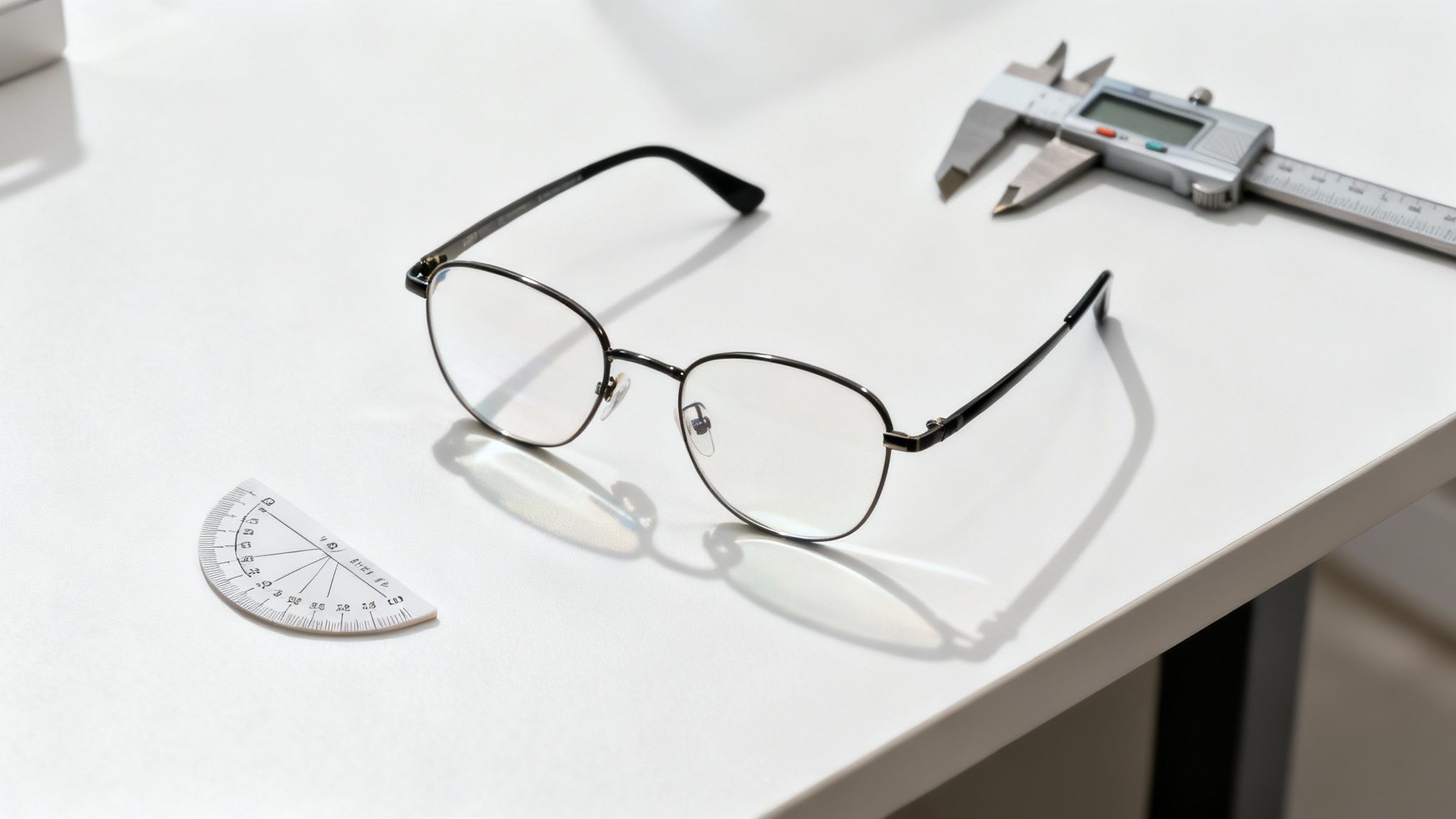
If you're past the first few days and the feeling of new glasses eye strain just isn't letting up, something more specific might be going on. While your brain does most of the heavy lifting when adapting, the technical specs of your glasses are the foundation of good vision. A tiny error can make a huge difference.
Even a subtle mismatch in a measurement or a switch in lens material can be enough to cause noticeable strain. Getting familiar with these factors can help you figure out what feels wrong and explain it clearly to your optometrist.
The Critical Role of Pupillary Distance (PD)
One of the most frequent culprits behind stubborn eye strain is an incorrect Pupillary Distance (PD). This is simply the distance, measured in millimeters, between the centers of your pupils. It’s a crucial number that tells the optical lab exactly where to put the “sweet spot”—the optical center—of each lens.
Think about it like focusing a pair of binoculars. If they aren’t lined up perfectly with your eyes, the image is blurry, doubled, or just plain uncomfortable. An incorrect PD measurement forces your eye muscles to work overtime to merge two slightly off-center images, leading directly to headaches and exhaustion.
An accurate PD isn't just a suggestion; it's essential for comfortable vision. This is why a professional measurement is far more reliable than trying to do it yourself with a ruler and a mirror.
Lens Materials and Design Really Matter
Not all lenses are made the same. Sometimes, even if your prescription hasn't changed, a switch to a different lens material or design can restart the adjustment clock.
- Lens Material: Different plastics bend light in slightly different ways. For example, high-index lenses are great for strong prescriptions because they're thinner and lighter, but they can sometimes create more color-fringing (what we call chromatic aberration) around the edges of objects. That can be distracting at first.
- Base Curve: This is the primary curve on the front of your lens. If your new glasses have a drastically different base curve than your old pair, it can change your peripheral vision and create that weird "fishbowl" effect.
- Aspheric Lenses: These lenses have a more complex, flatter curve that helps reduce distortion. But if you’re coming from standard spherical lenses, the visual world can look surprisingly different.
If you’re also dealing with dryness or irritation, which can make any eye strain feel worse, simple remedies can offer significant relief. Exploring the benefits of warm eye compresses is a soothing strategy that can help manage discomfort during your adjustment period.
Navigating the World of Progressive Lenses
Progressive lenses are a fantastic piece of technology, giving you seamless vision at every distance. But let's be honest: they are also notorious for having the longest and most challenging adjustment period.
A progressive lens has different zones for different tasks:
- Distance Vision: The top portion of the lens.
- Intermediate Vision: The narrow channel in the middle, perfect for computer screens.
- Near Vision: The bottom area for reading.
The tricky part is the periphery. The sides of the lenses have soft-focus areas that can cause a "swim" effect, making you feel disoriented or even a little dizzy at first. Getting used to them means retraining your brain to point your nose—not just your eyes—at whatever you want to see clearly.
All these technical details show just how much precision matters. Even things like the tilt of the frame on your face (pantoscopic tilt) or the distance from the lens to your eyeball (vertex distance) are critical. To dive deeper into this, check out our post on the benefits of custom eyewear measurements for comfort and style in Glendale Heights. If any of these are off, it can throw your whole visual system out of whack and cause that nagging strain.
How Digital Screens Can Make Eye Strain Feel Worse
Getting used to new glasses is already a big job for your brain. It's like learning a new skill, and it takes some time to feel natural. But throw in the hours most of us spend glued to our computers, phones, and tablets, and you've got a whole new layer of complexity. This constant screen time can take the normal adjustment symptoms and crank them up to eleven.
Think about it: your eyes and brain are working overtime just to get used to the new prescription. When you add a bright, glowing screen to the mix, you're also asking them to fight off glare, focus on pixelated text, and process high-energy blue light. It's a recipe for fatigue and can make the whole adjustment period feel way more frustrating than it needs to be.
The Double Whammy of Computer Vision Syndrome
You've probably heard of Computer Vision Syndrome (CVS), or digital eye strain. It’s that familiar collection of symptoms—headaches, blurry vision, tired and achy eyes—that creeps in after too much screen time. The tricky part is, these symptoms are almost identical to what you feel when breaking in new glasses.
When you’re dealing with both at once, the effects can really pile on. A tiny bit of distortion from your new lenses might be something you'd barely notice looking out a window, but it can feel completely disorienting when you're trying to focus on a spreadsheet. That feeling of eye fatigue from your brain adapting to the new prescription? It can feel ten times worse after just an hour of staring at a screen.
This isn't just you, either. Since the pandemic, screen time has gone through the roof, and so have complaints about eye fatigue. Recent surveys show that nearly 59% of employees are reporting more symptoms, with many growing more concerned about eye strain and light sensitivity. You can see more on these findings and how screen time is affecting employees' vision here.
How Modern Lenses Can Give You an Edge
The good news is that we have some fantastic lens technologies designed specifically to tackle digital eye strain. These aren't just fancy add-ons; they're functional tools that can make the adjustment period so much smoother. When you're choosing your next pair of lenses, definitely ask your optometrist about these options.
- Anti-Reflective (AR) Coatings: This is a must-have for screen users. An AR coating dramatically cuts down on the reflections bouncing off the front and back of your lenses. Less glare from office lights and your monitor means more light gets through to your eyes, giving you sharper, clearer, and far more comfortable vision.
- Blue Light Filtering Lenses: These lenses are built to filter a portion of the high-energy blue light that pours out of our digital devices. This can help ease that tired-eye feeling and may even help regulate your sleep cycle, which often gets thrown out of whack by late-night scrolling.
For a deeper look at managing screen-related issues, we put together a guide on how to reduce screen glare on your glasses.
Practical Habits for Screen-Time Comfort
Beyond the lenses themselves, a few simple changes to your routine can work wonders while your eyes adapt. Setting up an eye-friendly workspace is probably the single most effective thing you can do.
Remember the 20-20-20 Rule: Every 20 minutes, look away from your screen and focus on something at least 20 feet away for a full 20 seconds. This is a game-changer. It gives the tiny focusing muscles in your eyes a chance to relax and reset.
Here are a few more easy tips to help you through the transition:
- Check Your Workstation Setup: Try to position your computer screen about an arm's length away. The top of the monitor should be at or just a bit below your eye level. Getting this right takes the strain off not just your eyes, but your neck and shoulders, too.
- Get Your Lighting Right: Harsh overhead lights are a major source of glare. If you can, dim them and position your screen so you don't get reflections from windows. A simple desk lamp can give you focused light where you need it without causing extra glare.
- Don't Forget to Blink: It sounds silly, but it's true. When we're absorbed in our screens, our blink rate can drop by as much as 50%. This leads to dry, gritty, and irritated eyes. Make a conscious effort to blink more often to keep your eyes naturally lubricated.
When to Schedule a Follow-Up Appointment
Most of the time, that initial eye strain from new glasses fades on its own within a week or two. But it's really important to know the difference between your eyes simply adjusting and a genuine problem with the glasses. Your comfort and clear vision are what matter most, and you shouldn't have to just "tough it out" if things feel seriously off.
I like to use a workout analogy: a little muscle soreness after trying a new exercise is normal. Sharp, persistent pain, however, is your body's way of saying "stop and get this checked out." The same goes for your eyes. Listening to what they're telling you is the key to a smooth and successful adjustment.
Red Flags That Warrant a Call
If you're dealing with any of the symptoms below, especially if they hang around for more than a few days, it's time to call your optometrist. These aren't typical adjustment issues; they often point to a potential error in the prescription, the measurements, or even how the lenses were made.
Don't feel like you have to wait for the two-week mark if you're experiencing:
- Severe or Continuous Headaches: A mild, fleeting headache can be part of the process. A throbbing headache that won't quit is not.
- Persistent Double Vision: Seeing two of everything is a definite sign that something is wrong with how your lenses are focusing light.
- Significant Visual Distortion: If that "fishbowl" effect feels extreme or isn't getting any better after a few days of wear, it needs a second look.
- Noticeable Imbalance or Vertigo: Feeling dizzy, off-balance, or noticing that one eye sees much more clearly than the other are clear signals that an evaluation is needed.
This chart can help you decide whether to give it a little more time or book that re-check.
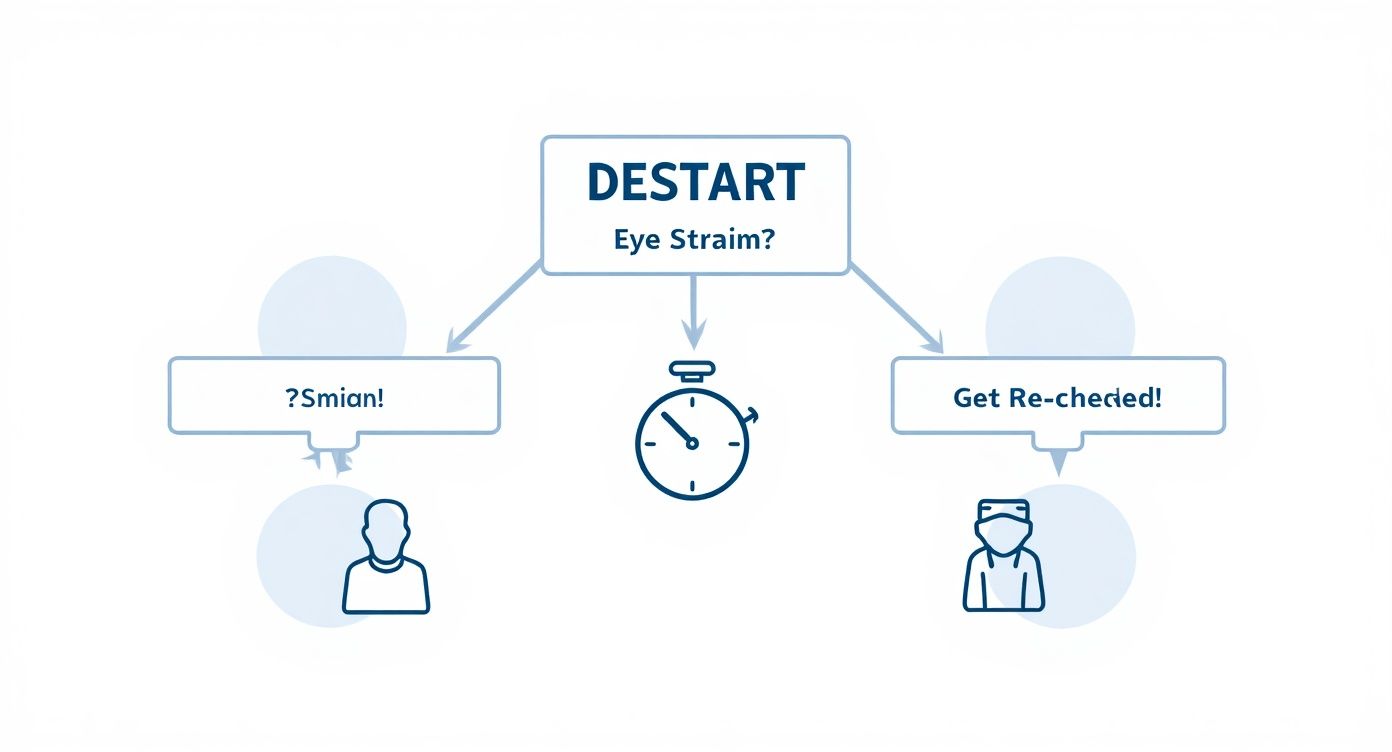
The takeaway here is pretty clear: while things like screen time can make general eye strain worse, if the problems persist even when you're not staring at a device, it’s probably the glasses themselves.
Your Next Steps for Clear, Comfortable Vision
If any of those red flags sound familiar, your first step is simple: call your eye doctor's office and clearly explain what's going on. Here at iDoctor, we always tell our patients to reach out if they have the slightest concern. A quick prescription re-check is easy and painless, and it gives you immediate peace of mind.
Never feel like you're being a bother for asking for a follow-up. A precise prescription and a perfect fit are exactly what you paid for, and it's our job to make sure you get it. Your vision is just too important to compromise.
Finding the best optometrist in Glendale Heights can make all the difference. Our team is here to help you get to the bottom of any discomfort. We can double-check everything—from the prescription itself to the pupillary distance and frame alignment—to make sure your new glasses are doing their job perfectly.
Remember, the goal is effortless, comfortable vision. We’re here to help you get there.
Your Partner For Perfect Vision in Glendale Heights

Breaking in a new pair of glasses is a lot easier when you have an expert in your corner. Here at iDoctor in Glendale Heights, we’re dedicated to making sure your vision isn't just crystal clear, but genuinely comfortable. We know that dealing with new glasses eye strain can be a real headache, and we're here with the expertise to solve it.
Our philosophy is that great vision starts with great care. That's why we offer 30-minute detailed eye exams in Glendale Heights using high-resolution imaging to get your prescription exactly right. Getting it perfect from the start is the best way to head off those frustrating adjustment issues. We’re not just here to sell you glasses; we're here to provide a complete vision solution that works for you.
A Personalized Eyewear Experience
From the initial fitting to helping you find frames that feel like they were made for you, our team is all about the personal touch. We’ve carefully curated our collection to include stunning luxury brands like Cartier and Gucci, right alongside timeless favorites like Ray-Ban and Coach. Whether you’re looking for a bold pair of Gucci glasses near me or something more understated, our team can help you find the perfect fit.
Your comfort and confidence in your new eyewear are our highest priorities. We believe a perfect fit and an accurate prescription are non-negotiable for healthy, effortless vision.
Whether you're driving over from North Avenue or live right here in town, we want to be your local resource for a lifetime of healthy sight. Learn more about our practice in Glendale Heights and see for yourself why patients from all over the Chicagoland suburbs trust us with their eye care. We look forward to helping you see your world more clearly.
Local FAQ: New Glasses in Glendale Heights
Here are a few common questions we hear from patients at our Glendale Heights boutique. We want to make sure you have all the information you need to feel confident and comfortable in your new eyewear.
Where can I get designer eyeglasses in Glendale Heights?
You can find a curated collection of luxury and designer eyewear right here at iDoctor. We carry top brands like Cartier, Gucci, Tom Ford, Oliver Peoples, and Prada, as well as popular brands like Ray-Ban and Kate Spade. Our team specializes in helping you find frames that not only look fantastic but also fit perfectly to ensure comfortable, all-day wear.
I live near Glenbard North High School. How long does a typical adjustment take?
Whether you're a student at Glenbard North or live anywhere in the area, the adjustment timeline is usually the same. We recommend giving your new glasses one to two weeks of consistent, all-day wear. This gives your brain the time it needs to adapt to the new prescription. However, if symptoms like severe headaches or dizziness persist, don't wait. Call our Glendale Heights office for a follow-up.
Does your Glendale Heights office accept vision insurance?
Yes, absolutely. At iDoctor, we believe high-quality eye care should be accessible. We accept all major vision insurance plans, including VSP, EyeMed, and Cigna Vision. Our staff is happy to help you understand and maximize your benefits for everything from your eye exam to your new contact lenses in Glendale Heights.
Ready for clear, comfortable vision without the strain? Visit iDoctor for a personalized eye care experience in Glendale Heights.