The real-world cost for a great pair of prescription sunglasses can land anywhere from $125 for a solid, all-inclusive package to well over $1,000 for a luxury designer pair with all the bells and whistles. The final price tag really hinges on the frames you pick, the type of lenses you need, your specific prescription, and any special features you choose to add. For our neighbors in Glendale Heights, understanding these factors is the first step to finding the perfect pair.
Understanding the True Cost of Prescription Sunglasses
When you're out enjoying a sunny day at Camera Park or driving down Bloomingdale Road, being able to see clearly while protecting your eyes from the sun isn't a luxury—it's essential. For most people in Glendale Heights, the first question is always the same: "What's this actually going to cost me?" The answer isn't one simple number; it's a range that depends on a few key decisions you'll make.
Think of it like ordering a pizza. You have your basic cheese pizza, which is your starting price. But then you start adding toppings—pepperoni (designer frames), extra cheese (special lens coatings), a gourmet crust (advanced lens materials). Each addition makes it better, but each one also adds to the final bill. This guide will break down every component so you know exactly where your money is going.
What Determines the Price
Several different pieces come together to determine the final cost of your prescription sunglasses. Once you understand what they are, you can make a smart choice that fits your budget, your vision, and your personal style.
Here are the main things that drive the cost:
- The Frames: This is often the biggest price swing. A stylish, well-made frame from a brand like Scott Harris will be more accessible than a handcrafted, high-fashion frame from Cartier or Tom Ford.
- The Lenses: Your prescription itself plays a big role. A standard single-vision lens is much more straightforward and affordable than a complex progressive lens that has to correct for both near and distance vision in one seamless lens.
- Lens Materials: Basic plastic lenses are the starting point. If you have a strong prescription, you might upgrade to thinner, lighter high-index lenses, or if you lead an active life, you might opt for impact-resistant polycarbonate. Both are fantastic upgrades, but they do add to the cost.
- Lens Coatings & Features: This is where you can really customize your vision. Add-ons like polarization (a must-have for cutting glare), anti-reflective coatings, and scratch-resistance dramatically improve how your sunglasses perform, but they also increase the price.
To give you a clearer picture, here's a quick breakdown of what you can expect to pay.
Quick Look At Prescription Sunglass Price Ranges
This table summarizes the typical price ranges you'll encounter, from budget-friendly options to premium designer pairs.
| Category | Typical Price Range | What's Included |
|---|---|---|
| Value Packages | $125 – $250 | Basic frames, single-vision plastic lenses, UV protection. |
| Mid-Range Options | $250 – $500 | Brand-name frames, higher-quality lenses (polycarbonate), polarization, scratch-resistant coating. |
| Premium/Designer | $500 – $1,000+ | Luxury designer frames, high-index or progressive lenses, premium anti-glare coatings, and other advanced features. |
As you can see, the "right" price really depends on what you value most—be it brand recognition, visual performance, or just a great deal.
Market Trends and Rising Costs
The world of eyewear is always changing, with new lens technologies and fashion trends influencing what we pay. As lens technology gets better, it also gets more complex to produce, and that innovation often comes with a higher price tag.
The global market for prescription sunglasses hit $7.17 billion in 2024, and we've seen average prices climb by 20-30% into the $200-$450 range. This is largely because more people are opting for advanced features like progressive lenses and have a greater awareness of long-term eye health.
This isn't just about fashion; it's about function. People are looking for real solutions to problems like glare from digital screens and the long-term risks of UV damage. You can actually explore detailed market analysis on GrandViewResearch.com to see these trends for yourself.
Before you even start shopping, it's a great idea to have an up-to-date prescription from a detailed eye exams in Glendale Heights. This ensures your new sunglasses will give you the sharp, clear vision you need. Here at iDoctor, we're ready to help you navigate all these choices, making sure you find the perfect pair that fits both your vision and your wallet.
Decoding the Price Tag: What Are You Actually Paying For?
Ever wonder why one pair of prescription sunglasses might cost $150 while another soars past $800? It’s not arbitrary. Think of it like building a custom bike—every component you select, from the frame material to the gear set, affects the final price and, more importantly, the ride. Your sunglasses work the same way.
The frame is the foundation. A simple, sturdy plastic frame is like a reliable cruiser bike: it’s functional, looks good, and gets the job done. But a handcrafted titanium or Italian acetate frame from a designer like Gucci or Cartier? That’s the high-performance road bike, built with premium materials, precision engineering, and a design that turns heads.
The Core Components of Cost
Next up, you have the lenses—the engine of your eyewear. Standard single-vision lenses are the most straightforward and affordable option. But if you need to see clearly both up close and far away, you'll be looking at progressive lenses. These are a significant step up, offering a seamless transition between different focal distances. The right lens for you is determined by your prescription, which we figure out during a comprehensive eye exam. For a deeper dive into what that involves, you can learn more about the cost of a comprehensive eye exam in our guide.
Finally, there are the coatings and treatments. These are the special features that take your sunglasses from good to great.
- Polarization is a must-have for cutting down glare, kind of like having the right tires to handle slick, sunny roads.
- Anti-reflective and scratch-resistant coatings are your clear coat, protecting your investment and keeping your vision crisp and unobstructed.
This chart gives you a quick visual breakdown of how these three key areas—frames, lenses, and coatings—stack up to create the final price.
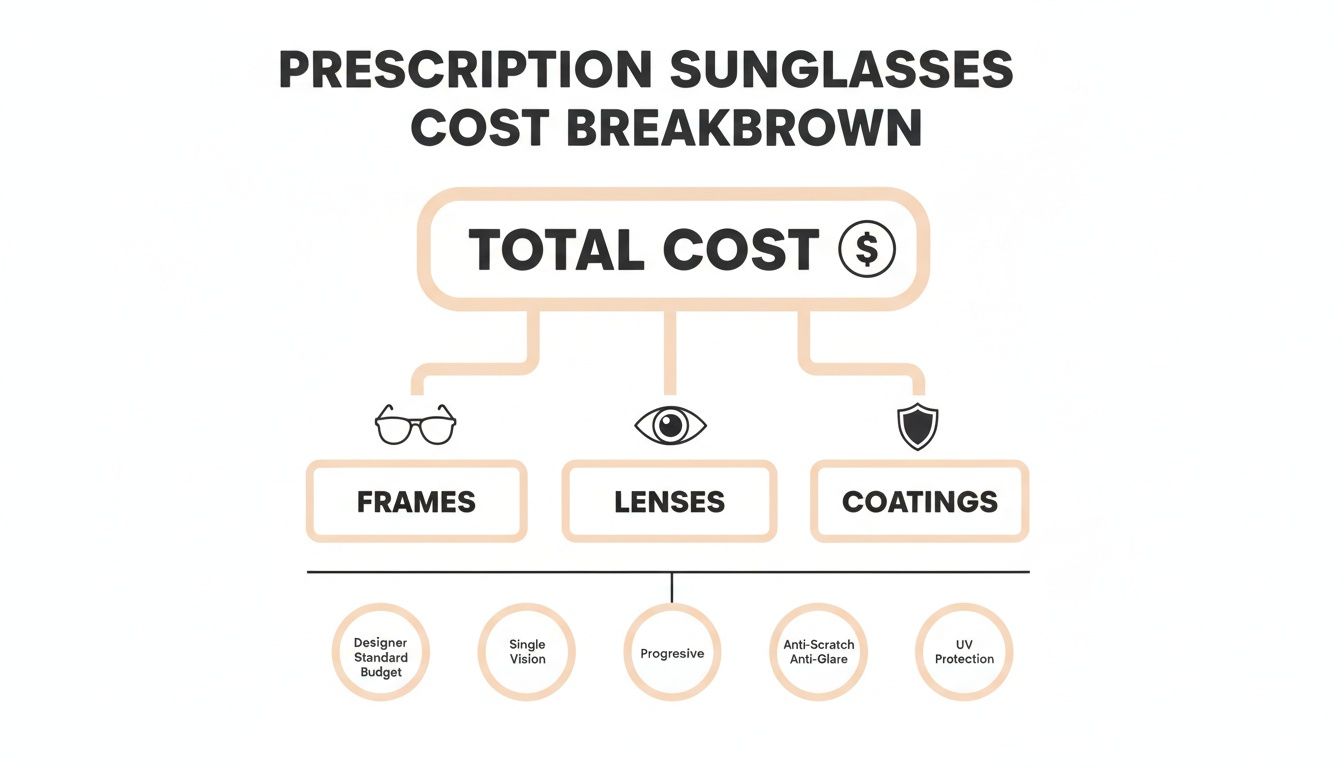
As you can see, the total cost is simply the sum of its parts. This gives you the power to build a pair that fits your vision needs and your budget perfectly.
Market Forces and Your Wallet
It's also worth noting that the demand for high-quality prescription sunglasses is on the rise. The global market is valued at roughly $7-9 billion in 2024, with the U.S. market making up about $1.9 billion of that. This isn't just a fashion trend; it's driven by a greater awareness of eye health and a growing need for vision correction, thanks in part to all our screen time. Constant innovation, like advanced photochromic lenses that automatically darken in the sun, also adds to the value—and the cost—of modern eyewear.
Understanding the breakdown is key. The final price tag isn't just a random number; it's a direct reflection of the materials, technology, and craftsmanship you choose. Each component is an investment in your vision, comfort, and style.
Ultimately, every choice shapes the final cost of your prescription sunglasses. Whether you need a simple, durable pair for your daily drive or a sophisticated statement piece, knowing what you're paying for helps you make a decision you'll feel great about. Here at iDoctor, our team is ready to walk you through all the options to find that perfect balance of function and fashion.
Choosing Your Frames: From Practical to Premium
The frames you pick are so much more than just a holder for your lenses. They're the core of your sunglasses' style and comfort, and honestly, they're one of the biggest drivers of the final price tag. Here at iDoctor in Glendale Heights, we’ve put together a collection that covers all the bases—from timeless, practical styles to high-fashion luxury. We guarantee there's a perfect fit for your look and your budget.
Think of it like buying a car. Some are built for reliable, everyday use, while others are engineered for a pure, high-end experience. Both get the job done, but the materials, the craftsmanship, and the design philosophy are worlds apart. This is where your personal style really gets to shine.
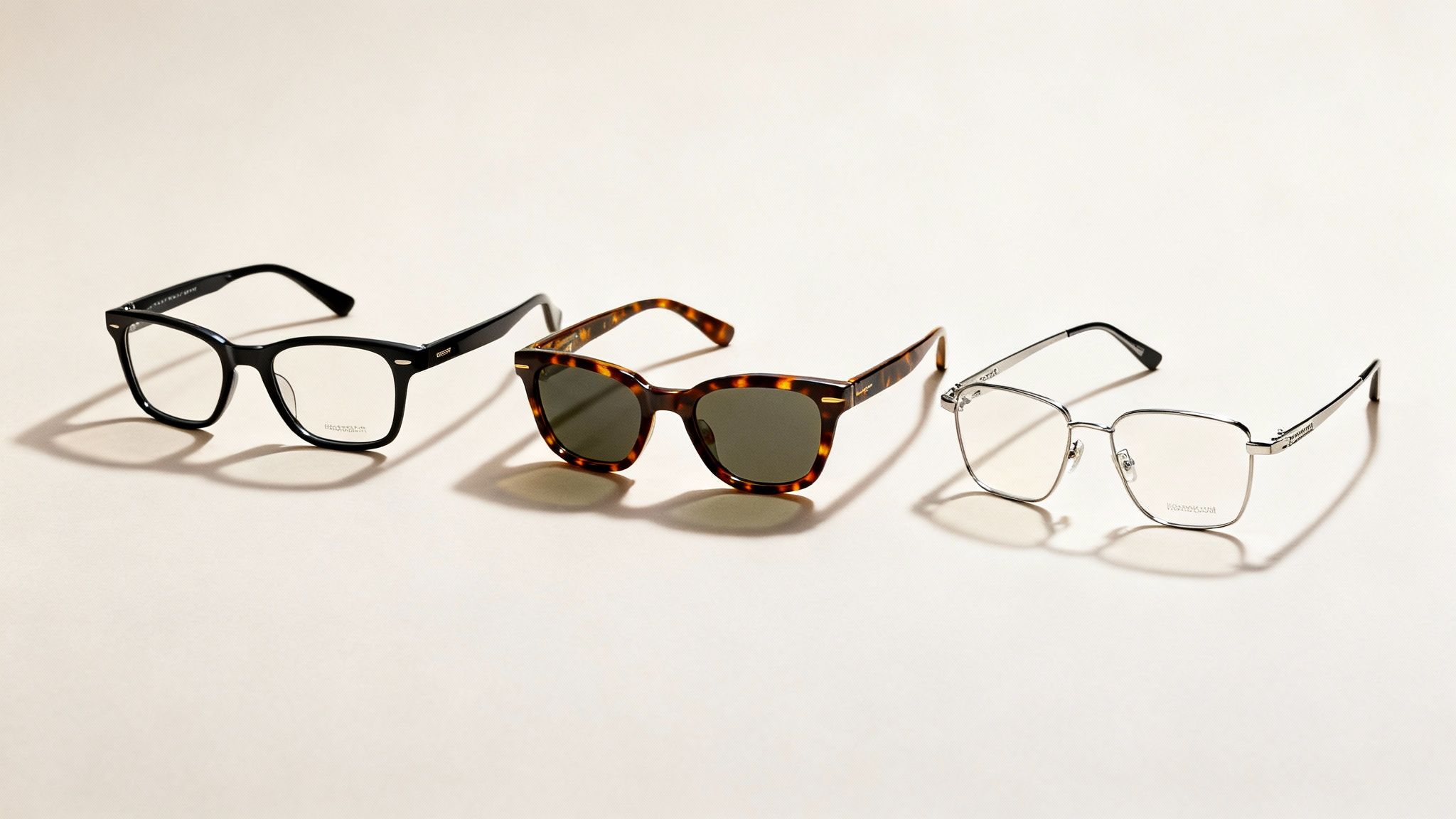
Practical and Affordable Style
On the more accessible end of the spectrum, you’ll find our collection of durable, stylish frames from brands everyone knows and loves, like Ray-Ban, Coach, Kate Spade, and Michael Kors. These frames offer incredible value without ever skimping on quality or good looks. They're typically made from tried-and-true materials built for daily life.
- Standard Acetate: This is a high-quality plastic that’s strong, light, and comes in a huge range of colors and patterns. It’s what gives you a comfortable fit and style that lasts.
- Standard Metals: Materials like stainless steel or monel create that sleek, minimalist look. They’re great because they resist corrosion and feel sturdy yet lightweight.
Choosing a frame from one of these brands is a smart investment in a classic look from a name you can trust. They’re the perfect go-to for anyone who needs functional, fashionable eyewear that performs great, day in and day out.
The World of Premium and Luxury Frames
For those who see eyewear as a key part of their wardrobe, our luxury collections offer craftsmanship and design that are simply on another level. When you pick up a frame from an iconic fashion house like Gucci, Tom Ford, Cartier, Fendi, or Oliver Peoples, you’re paying for more than just the logo. You’re investing in superior materials, intricate details, and an exclusive design that truly stands out.
So, what makes them worth the higher price? It really boils down to a few key things:
- Premium Materials: Luxury frames often use top-tier materials like Italian Mazzucchelli acetate, famous for its rich colors and durability, or titanium, which is both ultra-lightweight and hypoallergenic.
- Handcrafted Details: Many designer frames feature handmade elements, from custom-engineered hinges to delicate engravings that you just won't find on mass-produced frames.
- Innovative Design: These are the brands that set the trends. They are constantly pushing the boundaries with unique shapes, material combinations, and signature details that define modern eyewear.
The difference is something you can feel. A premium frame often has a better balance, sits more comfortably, and just feels more substantial. It’s an investment in a piece of functional art you'll wear every day, blending medical necessity with high fashion.
Knowing a bit about the different materials and construction methods can help you make a great choice. To dive deeper, take a look at our guide on the different types of spectacles frames, where we break down the pros and cons of various options.
Making the Right Choice for You
At the end of the day, the best frame is the one that fits your face, your lifestyle, and your budget. Whether you’re heading to a summer event at Camera Park or just dealing with daily traffic on North Avenue, your sunglasses should feel like they were made for you.
Here at iDoctor, our expert opticians are here to help you navigate these choices. We can show you how a Scott Harris frame delivers amazing value and then let you feel the exquisite Italian craftsmanship of a Fendi frame. By trying on different options, you can experience the difference for yourself and decide what’s most important to you. We believe everyone in Glendale Heights deserves to find a pair that makes them look and feel fantastic.
Selecting Lenses and Coatings for Your Lifestyle
Once you've found the perfect frames, it's time to talk about what goes in them: the lenses and coatings. This is where the real magic happens. It’s how we transform a stylish accessory into a high-performance tool tailored specifically to your eyes and how you live your life.
Think of it like building a custom car. The frame is the chassis and body—the part everyone sees. But the lenses and coatings are the engine, suspension, and tires. They dictate the performance, comfort, and safety of your ride.
Finding the Right Lens for Your Vision
The first piece of the puzzle is your prescription. Different lenses are built to solve different visual challenges, and the complexity of the lens naturally affects the price.
- Single-Vision Lenses: This is the workhorse of the optical world. Simple, effective, and affordable, single-vision lenses correct for just one field of vision—either for seeing things far away or for up-close tasks like reading.
- Progressive Lenses: If you struggle to see both a menu and the person across the table, progressives are your answer. They’re a modern marvel, often called "no-line bifocals," that give you seamless, clear vision at all distances. Because the technology is more sophisticated, they come at a higher price point.
- High-Index Lenses: Have a stronger prescription? You’ve probably dealt with thick, heavy "coke bottle" lenses in the past. High-index lenses are a game-changer. They’re crafted from a material that bends light more efficiently, so they can be made much thinner and lighter, improving both how they look and how they feel on your face.
Your day-to-day life really matters here. If you just need a pair for driving, single-vision lenses might be perfect. But if you’re trying to read a book by the pool while also keeping an eye on the kids, the sheer convenience of a progressive lens is worth every penny.
Enhancing Your Lenses with Protective Coatings
Lens coatings are the finishing touches that elevate your lenses from good to great. They protect your eyes, improve visual clarity, and safeguard your investment. Each one adds a specific layer of performance.
The demand for these advanced features has a real impact on cost. In North America, where the optics market hit a staggering $39.32 billion in 2024, the average price for a pair of prescription sunglasses lands somewhere between $200-$500. A big reason for that is the popularity of add-ons like anti-glare coatings, which alone can add $50-$100 to the final bill. You can dig deeper into eyewear market trends on skyquestt.com to see how technology influences global pricing.
The right coatings aren't just an extra expense; they're an investment in functional value. They protect your eyes, cut down on daily strain, and help your lenses last longer—a small price for a huge upgrade in comfort and safety.
Let's break down the most popular and beneficial coatings we recommend at our Glendale Heights boutique.
Key Coatings and Their Benefits
- Polarization: Honestly, this is a non-negotiable for sunglasses. A polarized filter is specifically designed to eliminate the blinding glare that reflects off flat surfaces. It’s a lifesaver when you're driving on a sunny day or spending time near water. The difference in clarity and comfort is astounding.
- Anti-Reflective (AR) Coating: Ever get annoyed by those distracting reflections on the back of your sunglasses? An AR coating gets rid of them. It leads to sharper vision, less eye fatigue, and even looks better, since people can see your eyes clearly instead of a reflection of themselves.
- Scratch-Resistant Coating: Let’s face it, life happens. While no lens is totally scratch-proof, this durable coating acts as a shield against the minor scuffs and scrapes from everyday use. It’s an easy way to keep your lenses clearer, longer.
- UV Protection: This is fundamental. Proper sunglasses must block 100% of UVA and UVB rays. At iDoctor, this isn't an add-on; it's a standard feature on every pair of prescription sunglasses we make. Protecting your eyes from long-term sun damage is our top priority.
Choosing the right combination of lenses and coatings creates a pair of sunglasses that are perfectly in sync with your life, ensuring your vision is always clear, comfortable, and protected.
Comparing Lens and Coating Costs and Benefits
To help you visualize how these choices impact the final price, here's a quick rundown of what to expect. Think of this as your menu for building the perfect pair.
| Feature | Primary Benefit | Estimated Added Cost |
|---|---|---|
| Progressive Lenses | Seamless vision at all distances (near, intermediate, far) | $150 – $350+ |
| High-Index Lenses | Thinner, lighter lenses for strong prescriptions | $75 – $200+ |
| Polarization | Eliminates glare, reduces eye strain, enhances clarity | $75 – $150 |
| Anti-Reflective (AR) Coating | Reduces reflections, improves night vision and aesthetics | $50 – $100 |
| Scratch-Resistant Coating | Increases durability and protects against daily wear | $30 – $75 |
Each addition is a direct investment in your visual comfort and the longevity of your eyewear. By understanding the value each feature brings, you can make an informed decision that balances your budget with your lifestyle needs.
Using Insurance, FSA, and HSA to Reduce Your Costs
One of the first questions people ask when they walk into our Glendale Heights boutique is, "Will my insurance actually cover prescription sunglasses?" I'm happy to report the answer is usually a resounding "yes," and that can make a huge difference in the final prescription sunglasses cost.
Most vision insurance plans give you a yearly allowance for both frames and lenses. Think of it as a credit you can apply directly to your purchase, which dramatically lowers what you have to pay out of pocket. Here at iDoctor, we accept all the major vision plans—VSP, EyeMed, Cigna Vision, you name it—so our patients can easily put their benefits to work.
Maximizing Your Vision Insurance Benefits
To get the most out of your plan, you just need to know a few key terms. Your plan probably has a frame allowance (a specific dollar amount for frames) and another allowance for the lenses themselves. You might also have a copay, which is just a small, fixed fee you pay for certain lens features or coatings.
Our team can take the guesswork out of it. We'll check your eligibility and break down exactly what your plan covers before you even pick up a single pair of frames. No surprises at the register. For a deeper dive, take a look at our guide on how to maximize your vision insurance benefits for designer eyewear in Glendale Heights.
Tapping into Your FSA and HSA Funds
On top of your vision plan, don't forget about your Flexible Spending Account (FSA) or Health Savings Account (HSA). These are fantastic tools for saving money because prescription sunglasses are a qualified medical expense, meaning you can pay for them with pre-tax dollars.
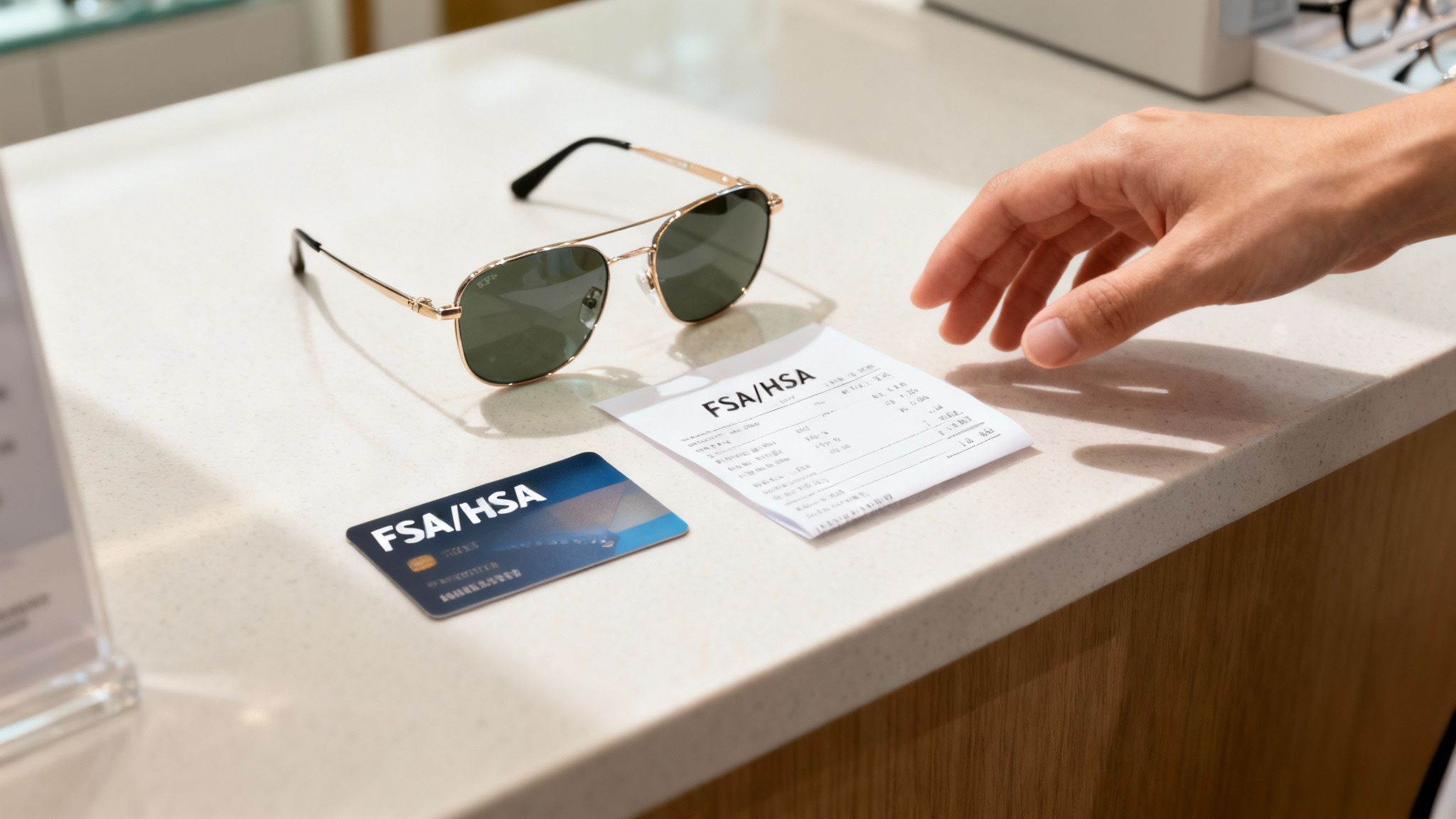
Using pre-tax money from an FSA or HSA to buy prescription sunglasses is like getting an automatic discount of 20-30%, depending on your tax bracket. It's one of the smartest ways to lower your costs on essential medical items.
That's right—the entire purchase, from the frames to the lenses and all the coatings, can be paid for using your FSA or HSA card. It's a simple, straightforward way to make your healthcare funds stretch further.
How to Use Your Benefits at iDoctor
We make using your benefits at our Glendale Heights boutique as easy as possible. Here’s how it works:
- Bring Your Info: Just bring your vision insurance card and your FSA or HSA card with you to your appointment.
- We'll Verify Everything: Our team will look up your plan details to confirm your allowances and any copays. We’ll give you a clear picture of what insurance will cover.
- Shop with Confidence: Now for the fun part. You can browse our collections from Ray-Ban, Gucci, and Tom Ford, knowing exactly how your benefits will lower the cost.
- Effortless Checkout: We bill your insurance company directly for their portion. You can then use your FSA or HSA card to cover the remaining balance, just like a debit card.
Taking advantage of these accounts is a great financial move. And for more general ideas on saving, you can always check out some smart online shopping tips that apply to more than just eyewear. By combining insurance with smart spending, you can walk out with the perfect pair of prescription sunglasses without breaking the bank.
Find Your Perfect Pair at iDoctor in Glendale Heights
Choosing the right prescription sunglasses can feel like a juggling act—you're trying to balance your vision needs, your personal style, and your budget. Here at iDoctor, we get it. We know the final prescription sunglasses cost is a huge part of the equation, and our whole approach is designed to make the process clear, simple, and all about you.
We're right here in the neighborhood for our friends in Glendale Heights, Bloomingdale, and Carol Stream. But the journey to your perfect pair of sunglasses doesn't start on the showroom floor. It starts in the exam room with one of our detailed eye exams in Glendale Heights. We use high-resolution imaging to dial in your prescription with absolute precision, making sure your new shades deliver the sharpest, most comfortable vision possible.
Your Lifestyle Is Our Guide
Once we have your updated prescription, our expert opticians step in to help you explore our collection. We don't just ask what styles you like; we want to know how you live. Your day-to-day life is the single most important clue to finding the perfect lenses and frames.
For instance, do you spend your weekends teeing off at Glendale Lakes Golf Club or hiking the trails at East Branch Forest Preserve? Are you driving down busy roads like North Avenue every day for your commute? Knowing this helps us recommend the lens features that will genuinely make a difference for you.
Finding the perfect pair is about more than just a price tag; it's about investing in a solution that protects your eyes, enhances your vision, and makes you feel confident every time you step outside.
Value and Luxury Under One Roof
We firmly believe that great vision and great style should be accessible to everyone. That’s why our showroom is filled with options for every budget. Our team can walk you through an incredible value package, starting at just $125, that combines a quality frame, your prescription lenses, and an anti-reflective coating. It's a fantastic, all-in-one solution.
On the other hand, if you have an eye for high-end craftsmanship, we'd love for you to feel the difference a luxury brand makes. You can experience the lightweight strength of a Tom Ford frame or see the stunning details in a pair of Oliver Peoples. Our collection of designer frames in Glendale Heights has something to match every taste.
In the end, our goal is to help you find a pair of prescription sunglasses that you’ll love wearing for years. Whether you're focused on value, looking for a touch of luxury, or need a specific feature like polarization for driving, we’re here to make it a transparent and even fun experience. Stop by our Glendale Heights boutique today and let us help you find your perfect pair.
Frequently Asked Questions
Can I get prescription sunglasses from any designer brand?
For the most part, yes. Most designer frames from brands like Gucci, Prada, and Saint Laurent are designed to accommodate prescription lenses. At iDoctor in Glendale Heights, we carry a curated collection of luxury eyewear specifically chosen for its quality and ability to be fitted with prescription sun lenses.
Where in Glendale Heights can I find Tom Ford glasses near me?
You can find an expertly curated selection of Tom Ford glasses and sunglasses right here at iDoctor. Our boutique in Glendale Heights is an authorized retailer, and our opticians can help you find the perfect style and fit it with your custom prescription lenses.
Are polarized lenses worth the extra cost?
Absolutely. Polarized lenses are one of the most beneficial upgrades you can make to your sunglasses. They work by filtering out horizontal light waves, which is what causes blinding glare from surfaces like wet roads, snow, or water. For driving around the Chicagoland area or enjoying outdoor activities, they dramatically improve visual comfort and safety, making them well worth the investment.
How often do I need an eye exam to get new prescription sunglasses?
We recommend a comprehensive eye exam every one to two years, even if you don't feel like your vision has changed. Your eyes can shift gradually, and an up-to-date prescription is essential for clear vision and to rule out any underlying eye health issues. An accurate prescription ensures your new sunglasses will work perfectly.
Ready to see the difference for yourself? At iDoctor, we're here to walk you through everything, from the eye exam to picking out the perfect frames and lenses. We'll help you navigate your insurance and find a pair that fits your look and your budget. Stop by our Glendale Heights boutique and let's get started.