Ever find yourself holding a menu at arm's length just to make out the words? Or maybe you've started squinting at your phone screen? If so, you're not alone. This is a common experience for many of our neighbors here in Glendale Heights, especially for adults hitting their 40s, and it's often the first sign you need a reading prescription.
A reading eye prescription is simply the specific correction your eyes need to see things up close without blurriness or strain. It's not about your distance vision; it’s all about focusing clearly on a book, your phone, or a computer screen. This correction is often called the "Add" power because it's added to your main distance prescription.
Your Guide to Understanding a Reading Eye Prescription
If you've ever felt that familiar frustration trying to read a text message, you know how much it can impact your day. Many of our neighbors right here in Glendale Heights start noticing this change and wonder what's going on with their vision.
Think of this guide as your personal translator for all the numbers and letters on your prescription slip. At iDoctor, we believe in making eye care approachable, so we're going to break it all down in simple language.
We'll walk through:
- What a reading prescription actually is and how it differs from your distance one.
- Why conditions like presbyopia make near-vision correction necessary as we get older.
- How to make sense of all the abbreviations and what they mean for your eyes.
This is your roadmap to decoding your vision. Whether you're trying to read a great book from the Glenside Public Library or just check directions on your phone while driving down Bloomingdale Road, getting the right correction makes all the difference.
A reading prescription isn't just about making text bigger. It’s about giving your eyes the precise focusing power they’ve lost over time, which cuts down on eye strain and brings everything back into sharp focus.
By the time you're done reading, you'll have a much clearer picture of your own vision. For a deeper dive, check out the common signs you need reading glasses in our detailed article.
Decoding The Numbers On Your Prescription Slip
Ever glanced at your eye prescription and felt like you were trying to decipher a secret code? All those abbreviations, plus signs, and minus signs can seem pretty cryptic at first. But don't worry, it's not as complicated as it looks.
Think of it as a precise set of instructions for the lab that will craft your lenses. Every number and term tells them exactly what your eyes need to see clearly. Let’s walk through what each of those "secret codes" actually means.
Your Eye Prescription Terms Explained
First off, you'll almost always see OD and OS. These are just old-school Latin abbreviations for your right eye (oculus dexter) and your left eye (oculus sinister). From there, the prescription gets into the specifics for each eye.
The table below breaks down the common terms you'll find on that little slip of paper.
| Term/Abbreviation | What It Means | What It Corrects |
|---|---|---|
| SPH (Sphere) | This is the main strength of your lens. A (+) sign means you're farsighted, and a (-) sign means you're nearsighted. | Farsightedness or Nearsightedness |
| CYL (Cylinder) | If you have a number here, it's for astigmatism. It measures the extra power needed to fix it. | Astigmatism (an imperfectly shaped cornea) |
| Axis | Measured from 1 to 180, this tells the lab the exact orientation of the cylinder correction on your lens. | The specific angle of your astigmatism |
| ADD (Addition) | This is the "add-on" magnifying power for reading, found in bifocals, progressives, or reading glasses. | Presbyopia (age-related trouble with close focus) |
| PD (Pupillary Distance) | The distance between the centers of your pupils, measured in millimeters. Crucial for aligning the lenses correctly. | Ensures lenses are properly centered |
Once you know these terms, that jumble of numbers starts to make a whole lot more sense. It's simply a detailed map leading to your best possible vision.
This diagram helps visualize how all those different elements work together to pinpoint your vision needs and guide the creation of your perfect eyewear.
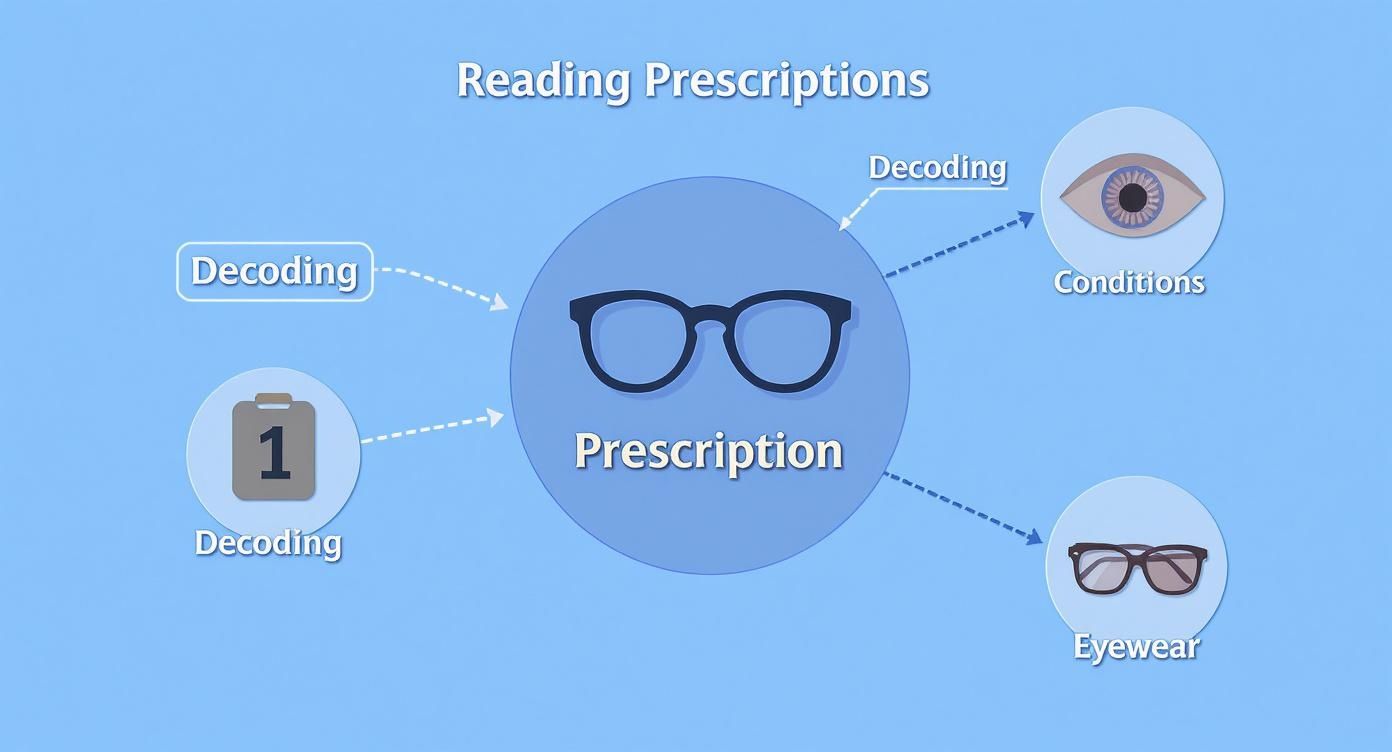
As you can see, understanding these numbers is the key to knowing exactly what vision issues are being corrected and why a certain type of lens is recommended for you.
The All-Important Number For Reading
For anyone who finds themselves holding a menu at arm's length, the most important part of the prescription is the ADD value.
The ADD power is the extra magnification layered into the bottom portion of your lenses, specifically to bring close-up objects into sharp focus. It’s the direct solution for presbyopia—the completely normal, age-related change that makes reading a challenge.
And if you're experiencing this, you're in good company. Presbyopia affects roughly 1.8 billion people worldwide, which is about 25% of the entire global population. Most people find relief with a fairly mild ADD power, usually somewhere between +1.00 and +3.00. This little boost is often all it takes to make reading, texting, and screen time comfortable again.
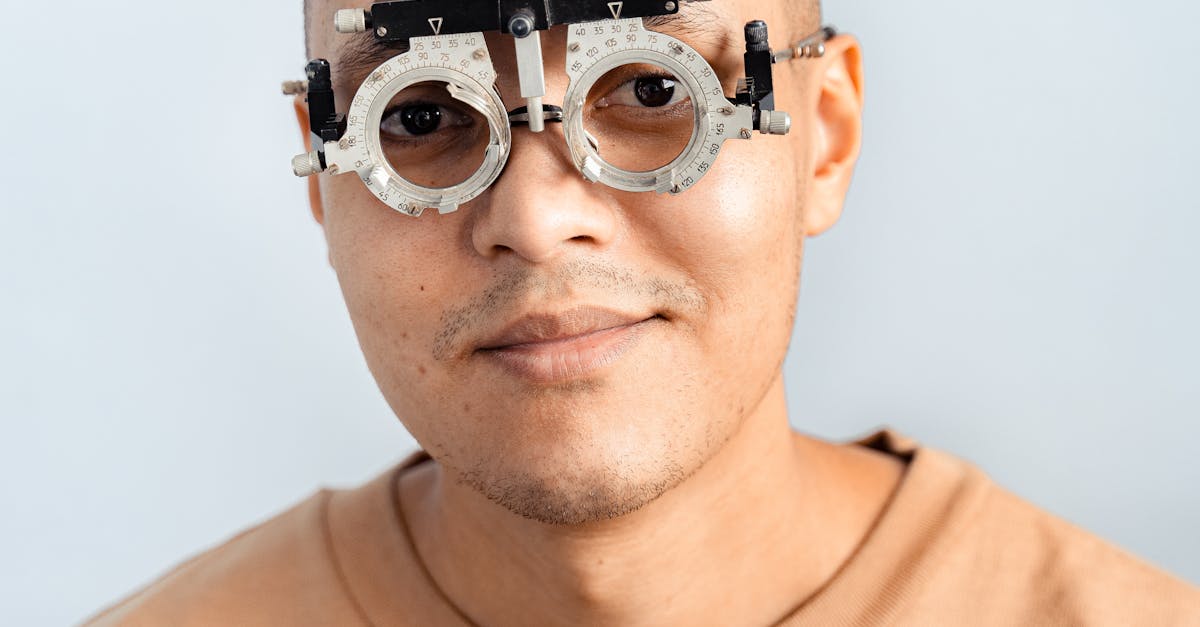
Of course, the foundation of great glasses is an absolutely precise prescription. Getting every measurement just right is critical, and modern tools have made a world of difference. To see how we achieve this level of accuracy, take a look at our article on how digital phoropter technology offers more accurate vision testing.
Reading vs. Distance: What’s the Difference?
One of the first things people want to know is how a reading prescription is different from their distance one. It's a fantastic question because the two are absolutely related, but they're designed for completely different jobs.
Think of your distance prescription as your visual foundation. It’s what you need to see things clearly far away, like when you’re driving or watching a movie. Your reading prescription, on the other hand, is built right on top of that foundation. It adds the extra focusing power—that "Add" value—that your eyes need to handle close-up work comfortably. This is why a single pair of glasses often can't do it all.
How Reading and Distance Prescriptions Work Together
Let's break down how an optometrist actually figures out your reading power. It’s a straightforward bit of math: we just combine the "Add" value with the sphere (SPH) number from your distance prescription.
Here are a few real-world examples:
- If you’re nearsighted (myopic): Imagine your distance SPH is -2.00, and you need an ADD of +1.50 for reading. Your reading-only prescription would be -0.50 (-2.00 + 1.50). You still need some correction up close, just a lot less than you do for distance.
- If you’re farsighted (hyperopic): Let's say your distance SPH is +1.00 and your ADD is +2.00. Your reading prescription becomes +3.00 (+1.00 + +2.00). In this case, your eyes need a much stronger boost to focus on things nearby.
- If you have perfect distance vision (plano): What if your distance vision is perfect (SPH is 0.00, or "Plano")? If you need a +1.75 ADD for reading, then your reading prescription is simply +1.75. This is a classic scenario for people first developing age-related presbyopia.
This simple math shows exactly why your distance glasses won’t work for reading, and vice versa. Your eyes just have different optical demands for each task.
It’s incredibly common to need vision correction, especially as we get older. In the U.S., about 94% of adults aged 55-64 wear glasses, a huge jump from the 62% of those aged 18-34. You can discover more insights about eyewear usage trends and see just how widespread reading prescriptions really are.
Grasping this difference is the first step toward finding the perfect lens solution for your lifestyle. While having separate pairs of glasses is always an option, many people love the convenience of lenses that do both. You can learn more by comparing progressive lenses vs reading glasses in our detailed guide. The right solution means you'll have sharp, comfortable vision whether you’re driving down Army Trail Road or relaxing with a good book at home in Glendale Heights.
Choosing the Right Lenses for Your Reading Needs
Okay, so you've got your reading prescription in hand. What's next? This is where we translate those numbers into the actual tool that will help you see clearly. Your prescription is the blueprint, but the type of lens you choose is what brings that blueprint to life. The trick is to match your specific vision needs with a solution that actually fits your daily routine.
For most people, the choice boils down to a few popular options. Each has its pros and cons, and the right one for you really depends on a simple question: do you only need help with reading, or do you need correction for both near and distance vision?
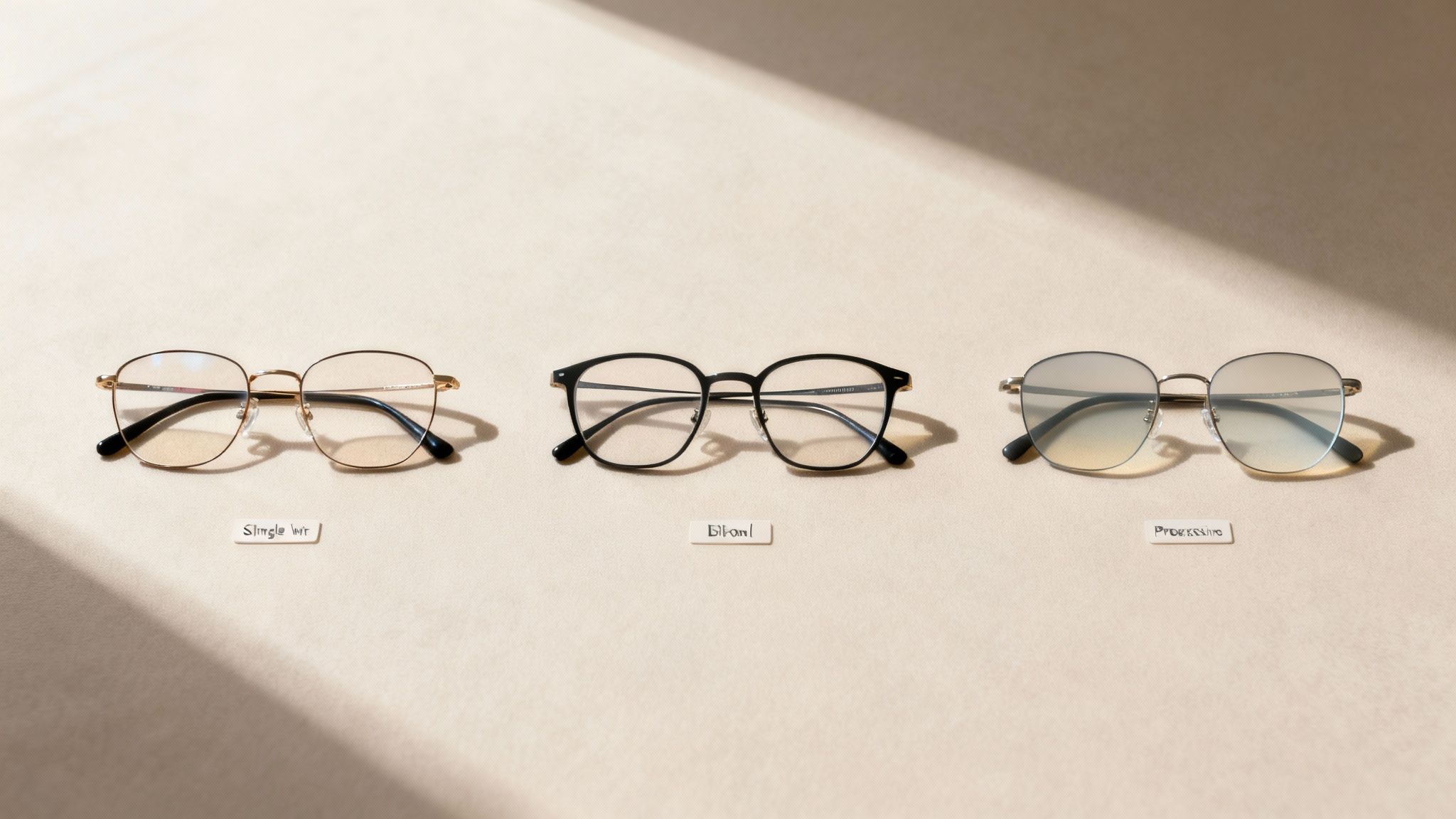
Single-Vision Reading Glasses
The most straightforward fix is a good old pair of single-vision reading glasses. These lenses have one job and one job only: to make things crystal clear for up-close tasks. Think reading a book, staring at your computer screen, or scrolling through your phone.
- How They Work: The entire lens is made with just one prescription—your specific reading power.
- Best For: This is the perfect solution for anyone with naturally good distance vision who just needs that extra boost for near work because of presbyopia. They're also great for contact lens wearers who need a pair of readers to pop on for close tasks.
- The Downside: The big drawback is the constant on-and-off. You have to take them off every time you want to see something clearly across the room.
These glasses are a fantastic, dedicated tool. If you're curious to learn more, we break it all down in our guide to understanding single vision lenses and how they function.
Bifocal Lenses: The Two-in-One Solution
What if you need help seeing both far away and up close? That’s where bifocals come in. They offer a practical two-in-one approach. You can always spot a bifocal lens by that tell-tale line that separates the two different prescription powers.
The top, larger part of the lens is for your distance vision, while the smaller segment at the bottom holds your reading prescription. For decades, this design was a game-changer, saving people from constantly having to swap between two pairs of glasses. The only catch is that the hard line creates an abrupt jump between near and far, which can take some getting used to.
Progressive Lenses: The Modern Choice
For the smoothest, most seamless experience, progressive lenses are the top-of-the-line option. Instead of a step, think of them as a gentle visual ramp. The biggest giveaway? There are no lines.
Progressive lenses offer a gradual transition of power from the top of the lens (for distance) all the way down to the bottom (for reading). This gives you clear vision at every distance—far, intermediate, and near—all in one pair of glasses.
This seamless design makes them incredibly versatile for modern life. Whether you're a student at the College of DuPage looking from a whiteboard to your laptop, or a professional in Glendale Heights multitasking all day long, progressives can keep up. Here at iDoctor, our experts can walk you through all these options and find the perfect fit—from a simple pair of readers to a fully custom progressive lens—to bring your world into focus.
Why a Professional Eye Exam Is So Important
In a world of quick fixes, it's tempting to just grab a pair of reading glasses from the drugstore. They seem like a simple solution, right? But while these generic "cheaters" can offer a temporary boost, they're a one-size-fits-all answer to a problem that's deeply personal. Your eyes are completely unique, and a professional eye exam is the only way to get a reading prescription that’s truly made for you.
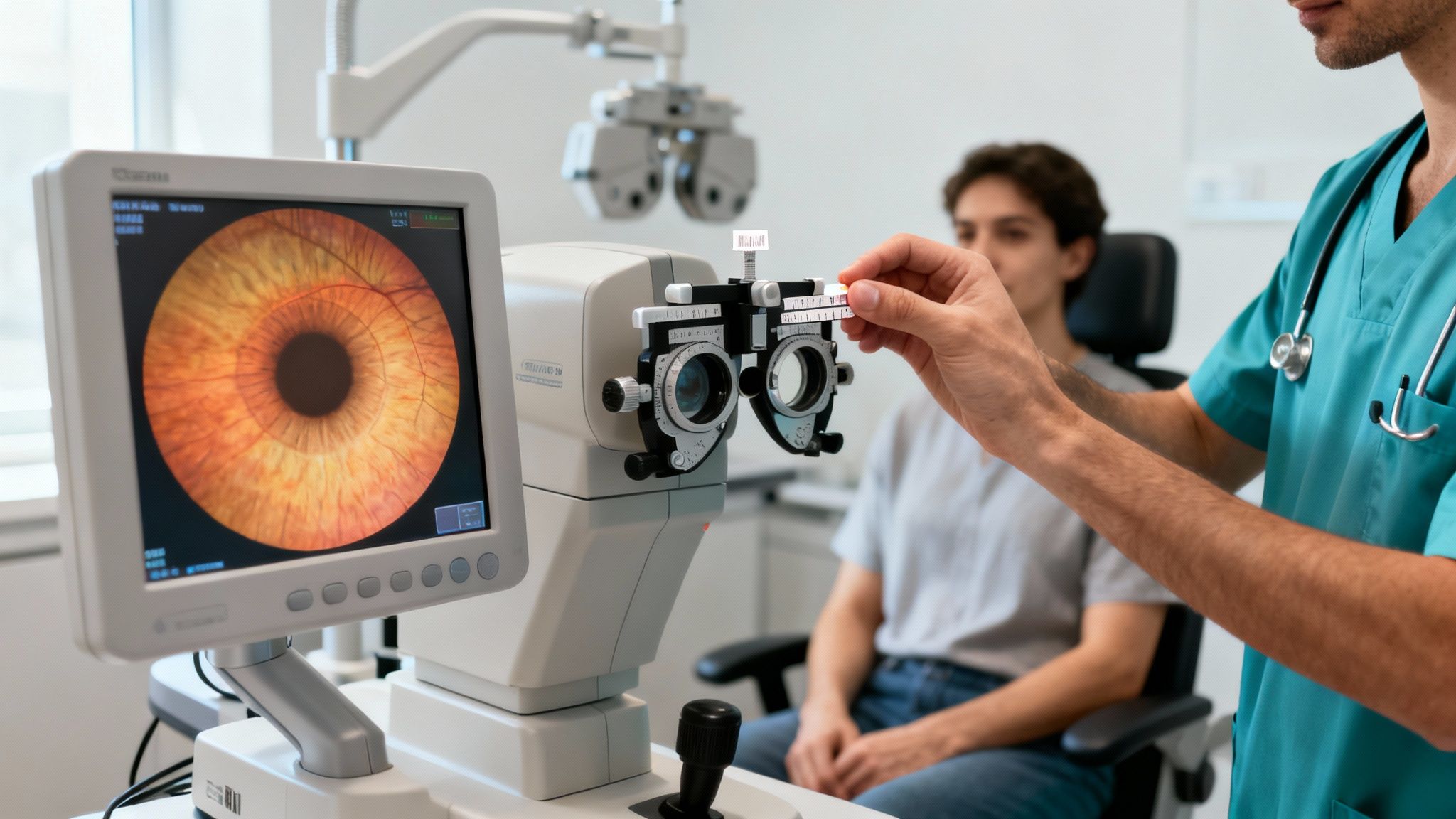
A proper eye exam does so much more than just figure out a few numbers for your lenses. Think of it as a critical health check-up for your eyes. At iDoctor, our detailed eye exams in Glendale Heights use high-resolution imaging to get a crystal-clear picture of both your vision and your overall eye health, ensuring every detail of your prescription is spot-on.
More Than Just a Prescription
The convenience of off-the-shelf readers is hard to deny, and the market shows it. The global reading glasses market was valued at around USD 39.6 billion in 2021 and is on track to hit nearly USD 47.1 billion by 2025.
But all that growth doesn't change a fundamental truth: generic glasses can't correct for individual vision quirks like astigmatism or different prescriptions in each eye. Trying to force your eyes to work with an ill-fitting prescription often leads to some pretty uncomfortable side effects.
Common issues from the wrong correction include:
- Persistent headaches
- Noticeable eye strain
- Dizziness or a feeling of being off-balance
- Blurry or distorted vision
These symptoms pop up because your eyes are working overtime, constantly struggling to compensate for a prescription that just isn't right for them.
The Importance of a Precise PD Measurement
One of the most critical measurements for any pair of glasses is your Pupillary Distance (PD). This is simply the exact distance between the centers of your pupils, and getting it right is non-negotiable for comfortable vision.
An accurate PD ensures the optical center of each lens is perfectly aligned with your eye. Without this precise alignment, you may experience eye strain and headaches, even if the prescription strength is correct.
Over-the-counter readers are built with a generic, "average" PD that simply doesn't fit most people perfectly. During a professional eye exam, we take this and other crucial measurements to ensure your custom lenses are crafted for optimal clarity and comfort. Investing in professional care isn't just about seeing better today—it's about protecting your long-term vision and wellness.
Find Your Perfect Pair of Glasses in Glendale Heights
So, you’ve got your reading prescription in hand. That’s the hard part, right? Well, it’s only half the story. The next step is finding a pair of frames that not only works with your prescription but also feels like you. This is where the science of optometry meets the art of personal style, and it’s what we live for at iDoctor, Glendale Heights’ own optometry boutique.
We believe that great vision should look great, too. That's why we’ve carefully selected a collection of frames from some of the world's most iconic eyewear designers. If you’re looking for that touch of luxury, we have stunning pieces from Cartier, Gucci, Tom Ford, and Oliver Peoples. We also carry timeless and stylish frames from brands you know and love, like Ray-Ban, Kate Spade, and Coach. There's truly something here for every style and budget.
Service That Sees You as a Person, Not Just a Prescription
Choosing new glasses should be an exciting, personal experience. Forget the impersonal feel of big-box stores where you’re just another number. As an independent boutique, we focus on genuine, one-on-one service. We'll help you discover frames that truly complement your face shape, fit your daily life, and express your personality.
We’re proud to be part of this community, serving everyone from families near the Glendale Lakes Golf Club to our neighbors all over the Chicagoland suburbs. Our experts take the time to get it right, ensuring your new frames are fitted with absolute precision for incredible comfort and clarity.
The right pair of glasses should feel like they were made just for you. We combine your accurate prescription with frames that fit flawlessly, so you can see clearly and feel confident.
Come see the iDoctor difference for yourself. Stop by our store on Bloomingdale Road and let us help you find the perfect pair of glasses right here in Glendale Heights.
Frequently Asked Questions
Got questions about your reading prescription? You're not the only one. Here are some of the most common things we discuss with our patients here in Glendale Heights to help you feel more comfortable and confident about your vision.
Can I Just Use Over-the-Counter Readers?
While grabbing a pair of "cheaters" from the drugstore might seem like a quick fix, they're a one-size-fits-all solution for a problem that's unique to you. They offer the same simple magnification for both eyes and don't correct for astigmatism or any differences between your right and left eye. A prescription from an expert eye doctor in Glendale Heights ensures your glasses are built specifically for your eyes, leading to much sharper vision and less eye strain.
How Often Do I Need to Get My Reading Prescription Checked?
For most adults, we recommend a comprehensive eye exam every one to two years. Your vision changes over time, especially as presbyopia sets in and progresses. Regular check-ups at our Glendale Heights office ensure your prescription stays current and allow us to monitor your overall eye health, catching potential issues early.
Where can I find designer eyeglasses in Glendale Heights?
Right here at iDoctor! We offer a curated collection of luxury and affordable eyewear from top designers like Cartier, Gucci, Tom Ford, Ray-Ban, and Kate Spade. Our team can help you find the perfect frames to match your new prescription and personal style.
Does My Vision Insurance Cover Prescription Reading Glasses?
Absolutely. Most vision insurance plans include coverage or an allowance for prescription eyeglasses, and that includes dedicated reading glasses. At iDoctor, we accept all major vision insurance plans, like VSP, EyeMed, and Spectera. Our team is great at helping you navigate your benefits to get the most out of your coverage.
Ready to see what a difference a truly professional and personalized eye care experience can make? The team at iDoctor is here to provide top-notch eye exams and help you find the perfect eyewear in Glendale Heights. Let's get you scheduled.
https://idoctoril.com