A comprehensive eye exam is so much more than just figuring out if you need glasses. Think of it as a complete health check-up for your eyes, one that can spot silent problems that could threaten your sight down the road. It goes way beyond reading an eye chart to give us a full picture of your entire visual system. Here in Glendale Heights, taking care of your vision is a key part of your overall wellness.
Your Window into Total Eye Health
Lots of people believe an eye exam is just about getting a new prescription. While that's definitely part of it, it's really just the tip of the iceberg. A truly comprehensive eye exam is a preventative health measure, offering a deep dive into the wellness of your eyes, from the front surface all the way to the delicate optic nerve at the back.
Here at iDoctor in Glendale Heights, we see your exam as a critical opportunity to protect your vision for a lifetime. It’s less like a simple test and more like a detailed physical for your eyes, covering all the bases to ensure we have a complete understanding of your eye health.
Why It's More Than a Vision Screening
You've probably had a basic vision screening at school or the DMV. Those quick checks typically only measure your visual acuity—how clearly you can see things far away. A comprehensive exam, on the other hand, is a much more thorough evaluation that looks at many different aspects of your eye health and function.
This difference is absolutely critical. Serious, vision-stealing conditions like glaucoma, diabetic retinopathy, and macular degeneration often sneak up without any symptoms in their early stages. A thorough exam is the only reliable way to catch them before they can cause permanent damage.
To make the distinction crystal clear, here’s a quick breakdown:
Vision Screening vs Comprehensive Eye Exam at a Glance
| Feature | Basic Vision Screening | Comprehensive Eye Exam |
|---|---|---|
| Purpose | Identifies potential vision issues. It's a "pass" or "fail" test. | Diagnoses and treats a wide range of eye diseases and vision problems. |
| Performed By | Often a school nurse, volunteer, or DMV employee. | An optometrist or ophthalmologist. |
| What's Checked | Usually just distance vision (visual acuity). | Visual acuity, eye pressure, eye muscle coordination, peripheral vision, eye health (front to back), and more. |
| Pupil Dilation | No | Often includes dilation to get a clear view of the retina and optic nerve. |
| Outcome | A recommendation to see an eye doctor if you "fail." | A precise prescription, a diagnosis of any conditions, and a personalized treatment plan. |
As you can see, a screening is a good starting point, but it's no substitute for the in-depth analysis you get from a full exam with a qualified eye doctor.
The Importance of Regular Exams
Consistent, regular exams are the bedrock of maintaining good vision for life. The American Academy of Ophthalmology suggests that all adults have a baseline eye exam by age 40, as this is when early signs of disease often start to appear.
Globally, the numbers are staggering: about 2.2 billion people live with some form of vision loss, and that figure has jumped by over 15% since 2020. This is largely due to aging populations and the rise of chronic diseases, which really underscores the need for proactive eye care.
Of course, how often you need an exam depends on your age, risk factors, and overall health. To learn more, check out our guide on how often you should get an eye exam. Scheduling regular visits with your eye doctor in Glendale Heights is truly the best defense you have for protecting one of your most vital senses.
What Happens During Your Eye Exam
Walking into an eye exam shouldn’t be a mystery. We want you to feel comfortable and in the loop, so let's pull back the curtain on what a comprehensive eye exam at iDoctor actually involves. Think of it less like a test and more like a detailed health check and a conversation about your vision.
It all starts with a chat. We’ll talk about your medical history, any specific issues you've noticed (like blurry vision or headaches), and what your daily life looks like. Are you a student spending hours on a laptop? A driver navigating the roads around Glendale Heights? This conversation is key because it helps us customize the entire exam to fit your unique needs.
Finding Your Perfect Prescription
Next up is the refraction test—this is the part most people are familiar with. It's how we dial in your precise prescription for glasses or contacts.
You'll look through a device called a phoropter, which holds a series of lenses, and we'll ask that classic question: "Which one looks clearer, one or two?" It's a lot like tuning a high-performance camera. Each choice you make helps us zero in on the sharpest possible focus, finding the exact lens power to correct for nearsightedness, farsightedness, or astigmatism.
A Microscopic Look Inside Your Eyes
After we figure out your prescription, we move on to the slit-lamp examination. The best way to describe a slit lamp is as a powerful, binocular microscope made just for eyes. It gives us a magnified, 3D view of every tiny structure, from the very front surface to the back.
Here’s what we're looking at:
- The Cornea: Your eye's clear front window. We check it for scratches, dryness, and other issues.
- The Iris and Pupil: The colored part of your eye and the opening that controls light.
- The Lens: The structure that focuses light, which is where cataracts can form over time.
- The Retina and Optic Nerve: By shining a light through your pupil, we can see the critical components at the back of your eye.
This detailed tour is essential for spotting things like cataracts or corneal ulcers that are impossible to see otherwise.
Checking for Silent Signs of Trouble
One of the most critical parts of any comprehensive exam is tonometry, which measures your intraocular pressure (IOP). High eye pressure is a major risk factor for glaucoma, a disease that can steal your sight without any early warning signs. It's a true silent threat.
We typically use a gentle "puff of air" tonometer for this. It's a quick, painless test that calculates the internal pressure of your eye. Keeping an eye on your IOP is one of the best defenses we have against glaucoma, making it a cornerstone of preventative care.
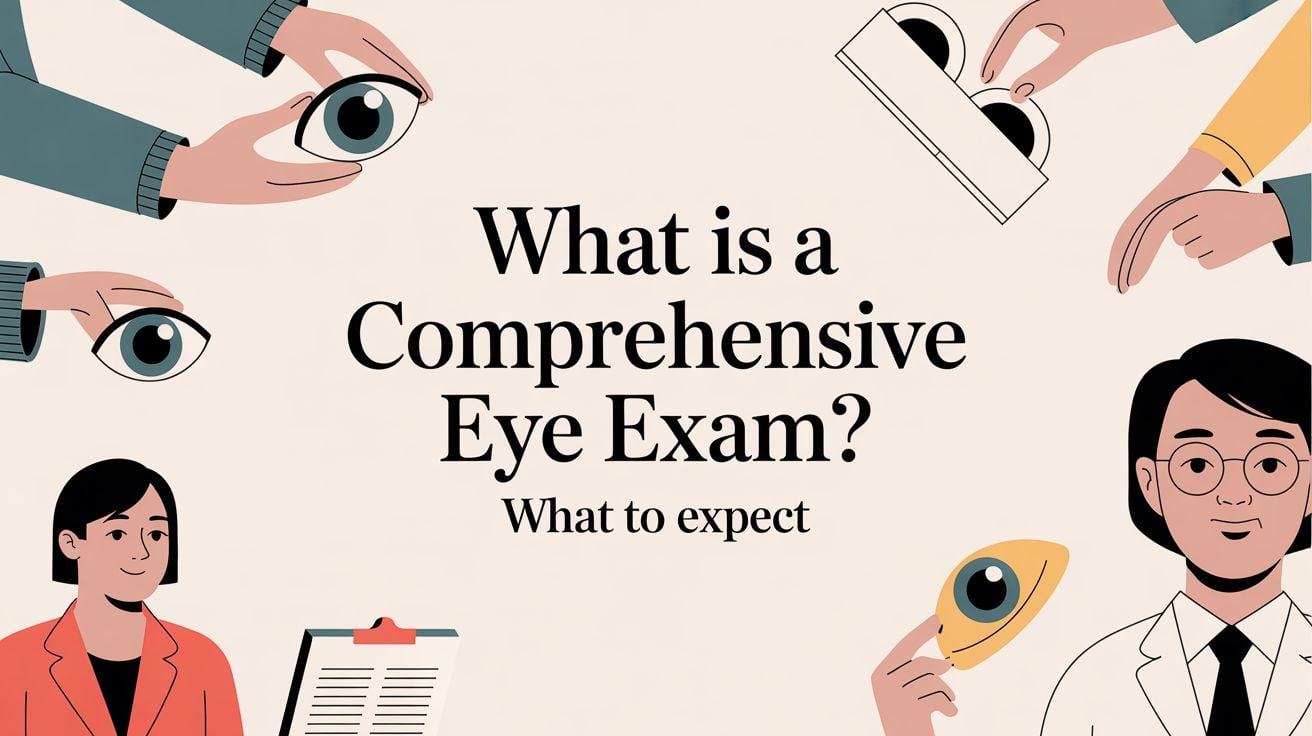
This simple diagram shows how a basic screening only scratches the surface, while a comprehensive exam provides a deep, diagnostic view.
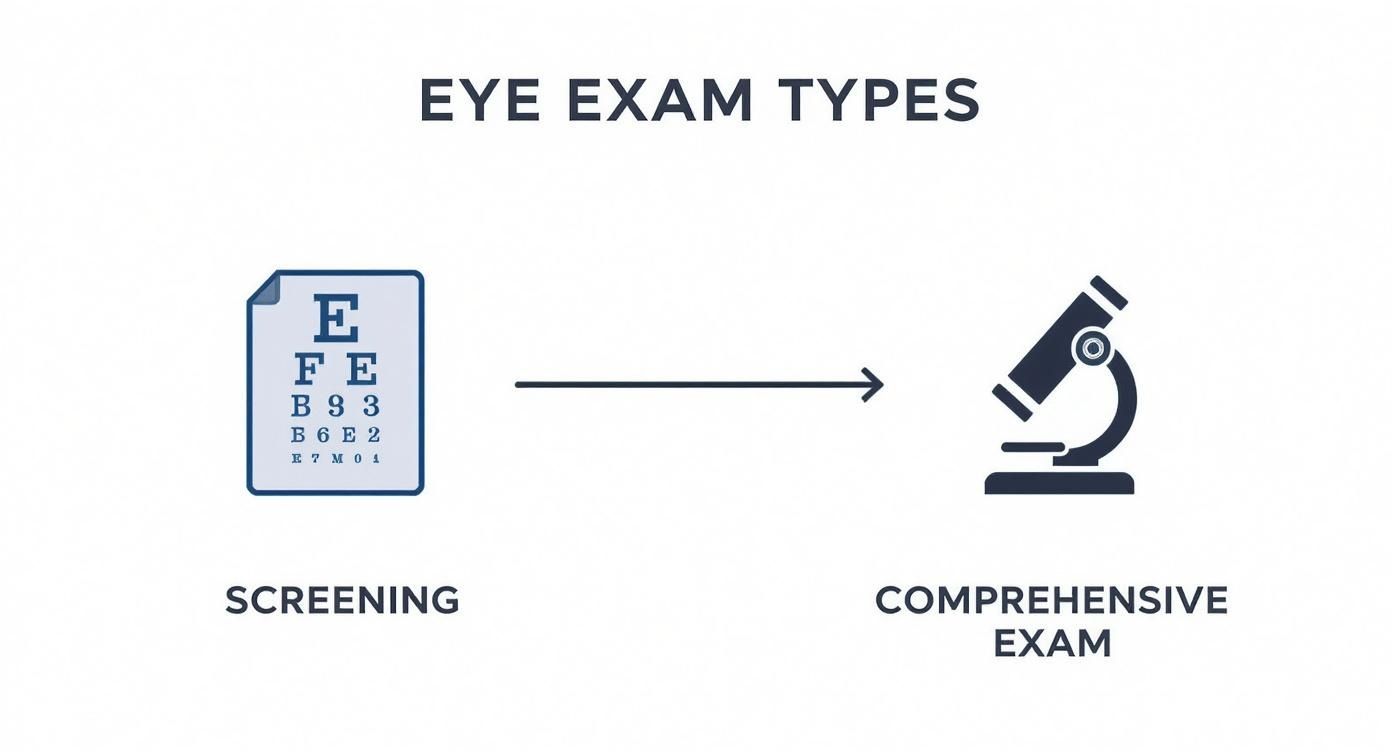
As you can see, a screening is just a starting point. The comprehensive exam is the real deep dive your eyes deserve.
Advanced Imaging for Ultimate Peace of Mind
Finally, we use advanced retinal imaging to capture a high-resolution photo of the inside of your eye. This technology lets us see your retina, optic nerve, and blood vessels with incredible clarity. It's like getting a detailed snapshot of your eye's inner workings.
This image becomes a permanent part of your health record, which is invaluable. It allows us to track even the most subtle changes over the years and is a powerful tool for detecting early signs of diabetic retinopathy, macular degeneration, and even high blood pressure.
A single retinal image can reveal the earliest signs of disease, often years before you would notice any symptoms yourself. This proactive approach is fundamental to preserving your vision for a lifetime.
Each of these steps builds on the last, giving us a complete picture of your eye health. If you want to learn even more, check out our guide on what happens during an eye exam. Our goal is to leave no stone unturned, so you can walk out with total confidence in your vision.
The iDoctor Difference: Advanced Care in 30 Minutes
So, what really makes an eye exam at iDoctor different? It comes down to one simple idea: we combine top-tier technology with genuine, personal attention. In an age where medical appointments often feel rushed, we block out a full 30 minutes for every patient. This means you get our undivided focus.
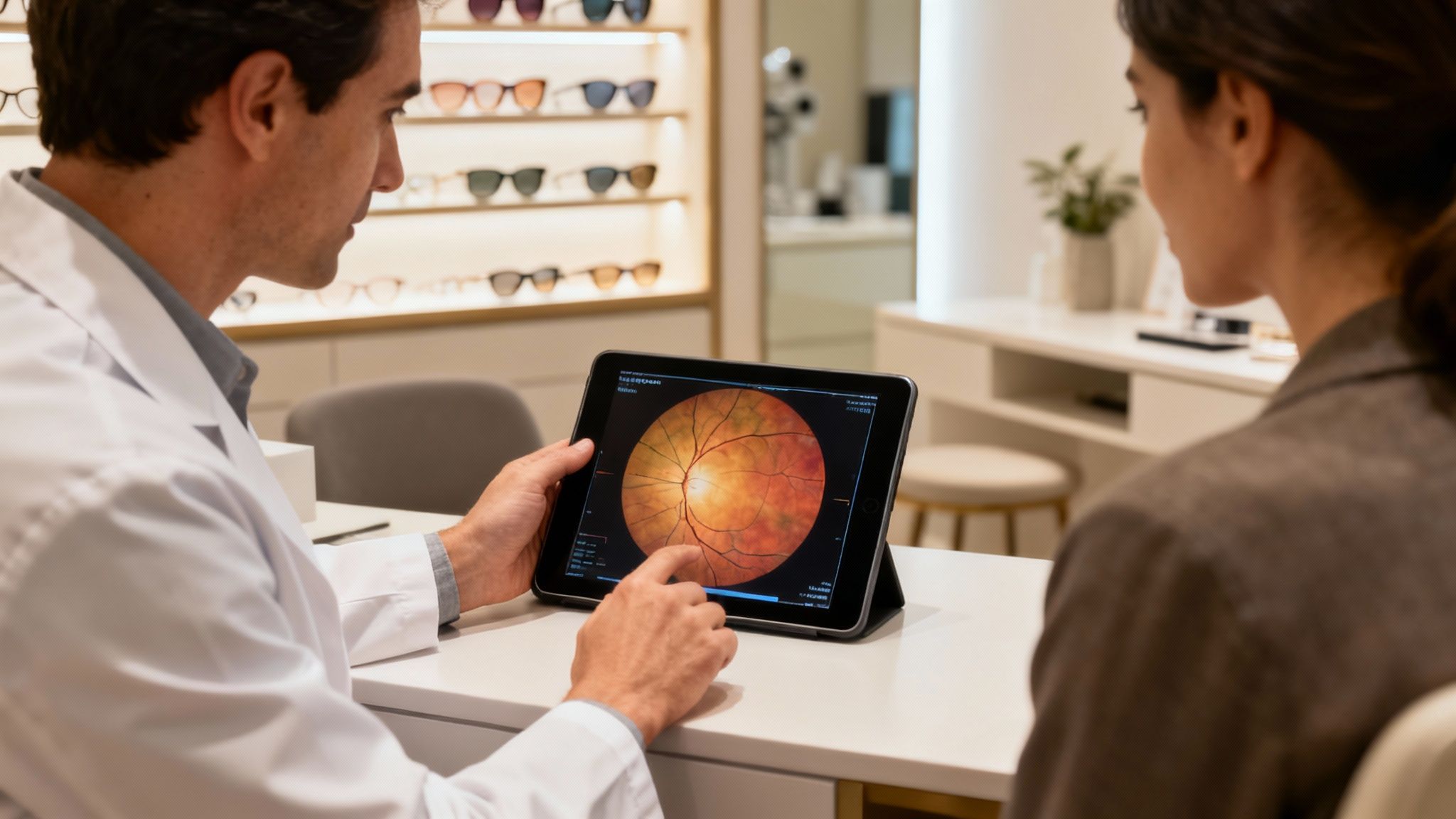
That dedicated time is about more than just a thorough evaluation. It’s our chance to actually talk with you, not just at you. We’ll walk you through what we see, explain it in plain English, and make sure you have the time to ask every single question on your mind. Your peace of mind is just as important as the health of your eyes.
Technology That Sees More
A big part of our commitment to you is our investment in high-resolution diagnostic tools. This isn't just about bells and whistles; this equipment lets us see the intricate, delicate structures inside your eye with incredible clarity. Think of it as a high-definition map of your eye health.
This level of detail is a game-changer for early detection. We can spot the most subtle changes to your retina or optic nerve—the kind that often have no symptoms—long before they ever affect your vision. It's about being proactive, not reactive.
This precision also translates directly into a better prescription. We’re able to fine-tune your vision correction down to the smallest detail, giving you the sharpest and most comfortable vision you can get. If you're curious about the specifics, you can check out our guide on digital retinal imaging.
From Precise Diagnostics to Perfect Eyewear
A great eye exam is just the beginning. Once we’ve dialed in your prescription and have a complete picture of your eye health, the experience flows right into finding the perfect eyewear. We believe the quality of your glasses or contacts should match the quality of your diagnosis.
This is where the fun starts. You get to browse our carefully selected collection of frames. We work hard to bridge the gap between clinical precision and your personal style.
- Luxury Collections: For those who appreciate timeless design, we feature iconic brands like Cartier, Gucci, Tom Ford, Oliver Peoples, Fendi, Saint Laurent, and Prada.
- Affordable Style: We also stock a huge range of accessible and stylish options from names you know and love, including Ray-Ban, Scott Harris, Michael Kors, Kate Spade, and Coach.
- Complete Solutions: Whether you need everyday glasses, prescription sunglasses, or a contact lenses in Glendale Heights fitting, our team is here to guide you to the perfect solution for your life and budget.
At iDoctor, we see the whole picture. Your visit is a complete journey, from the assurance of an advanced exam to the confidence of finding eyewear you can't wait to show off. We make sure every piece connects, so you can walk out of our Glendale Heights office with healthy eyes and a look you absolutely love.
Why Regular Eye Exams Are Essential for Everyone
Think of a comprehensive eye exam as a vital part of your family’s overall health routine, just like a dental check-up or an annual physical. It’s one of the best proactive steps you can take to protect not only your vision but your general wellness, too. Our eyes have different needs at every stage of life, which makes these regular check-ups so important for lifelong health.
For kids, clear vision is the bedrock of learning and development. It’s surprising how often an undiagnosed vision issue can be mistaken for a behavioral problem or a learning disability in the classroom. Making sure your child can see clearly is one of the most powerful ways to support them, from their first day at Glen Hill School all the way to graduation.
Protecting Your Vision Through Adulthood and Beyond
As adults, we face a whole new set of visual demands. Most of us spend a significant chunk of our day staring at screens, which can easily lead to digital eye strain, headaches, and uncomfortable dry eyes. A thorough eye exam can pinpoint the cause of this discomfort, and we can offer real solutions—from special lens coatings that filter blue light to simple advice on healthier screen habits to make your workday feel a lot better.
As we get older, our risk for serious eye diseases naturally increases. This is when regular eye exams become your first line of defense against conditions that often creep up without any noticeable symptoms.
- Cataracts: This is when the natural lens inside your eye gets cloudy over time, causing vision to become hazy or blurry.
- Glaucoma: Often called the "silent thief of sight," glaucoma damages the optic nerve, typically with no warning signs until vision loss has already occurred.
- Macular Degeneration: This disease impacts your sharp, central vision, which is crucial for reading, driving, and even recognizing the faces of loved ones.
Catching these conditions early is absolutely everything. When we spot them before they progress, we have a much better chance of managing them effectively and protecting your eyesight for years to come.
Your Eyes: A Window to Your Overall Health
An eye exam does so much more than just check how well you can see. It offers a unique, non-invasive look into your entire body's health. The tiny blood vessels in the back of your eye can actually show the earliest signs of systemic health problems that you might not even know you have.
You can think of your retina as a tiny monitor that displays the health of your body’s circulatory system. During your exam, an optometrist can spot subtle changes that might point to a bigger health issue.
We have seen cases right here in our Glendale Heights office where a routine eye exam was the very first indicator of a serious health issue. It's a powerful reminder that an eye exam is about much more than just glasses.
For example, we can often detect the first signs of:
- Diabetes: We can see tiny leaks or swelling in the retinal blood vessels, a condition known as diabetic retinopathy.
- High Blood Pressure (Hypertension): This can cause bends, kinks, or even tears in the delicate blood vessels of the eye.
- High Cholesterol: Sometimes, this shows up as small yellow deposits in the cornea or retina.
Finding these markers early on is critical. It allows for timely intervention and often starts an important conversation with your primary care doctor. This collaborative approach is a key part of keeping you healthy. An eye exam isn't just about your sight; it's an essential piece of your total health puzzle. That's why scheduling an appointment with the best optometrist in Glendale Heights is such a smart move for your well-being.
Preparing For Your Eye Exam
Walking into your eye exam shouldn't feel like a pop quiz. With a little bit of prep, you can make sure your visit is smooth, productive, and focused on what matters most—your vision. We want you to feel completely at ease and in control from the moment you step into our office.
A productive exam is really a partnership. The more information you can share with us, the better we can pinpoint your exact needs and create a personalized plan for your eye health. Before heading over, just take a few minutes to get your thoughts and a few key items in order.

What Should I Bring To My Appointment?
Thinking ahead can make all the difference. Here’s a quick rundown of what you should have on hand to help us get a complete picture of your vision and health history.
- Your Current Glasses: Don't forget any and all pairs you use—your main eyeglasses, reading glasses, computer glasses, and even your prescription sunglasses.
- Contact Lens Info: If you wear contacts, please come to the appointment wearing them. It's also super helpful if you can bring the boxes or a copy of your previous prescription.
- A List of Medications: Make a quick note of all medications you take regularly, including over-the-counter drugs, vitamins, and supplements. Some can have a surprising impact on your eyes.
- Your Vision Concerns: Have you been getting headaches? Seeing halos around lights at night? Squinting to read text messages? No issue is too small to mention. Jotting down a few notes can ensure you don't forget anything.
For a deeper dive, check out our guide on 8 ways to prepare for a comprehensive eye exam over on the blog.
Your Eye Exam Preparation Checklist
Feeling organized is the best way to feel confident. This simple checklist covers everything you’ll need for a successful and stress-free appointment.
| What to Bring | What to Prepare | Questions to Ask |
|---|---|---|
| Your current glasses and contact lenses | A list of all medications, vitamins, and supplements | "Are there any early signs of eye conditions I should know about?" |
| Your vision insurance card and ID | A brief history of any personal or family eye health issues (glaucoma, etc.) | "Based on my lifestyle, what type of lenses would be best for me?" |
| A list of any specific vision problems or symptoms you've noticed | A list of questions you have for the optometrist | "How can I reduce eye strain from my computer use?" |
| Sunglasses for the trip home (if you're getting your eyes dilated) | Be ready to discuss your daily activities (work, hobbies) to assess visual needs | "Are my current glasses/contacts still the best option for me?" |
By gathering these items and thoughts beforehand, you empower your eye doctor to provide the most accurate and personalized care possible.
Understanding Costs and Insurance
Let's talk about the financial side of things. We know that navigating insurance benefits and out-of-pocket costs can be confusing, which is why our team is committed to making it crystal clear. No jargon, no surprises.
At iDoctor, we proudly accept all major vision insurance plans. Our team will happily verify your benefits before your visit, so you’ll know exactly what your plan covers for the exam and any new eyewear.
It’s just one less thing for you to worry about.
Having vision insurance makes a huge difference in whether people keep up with their eye health. A national survey found that while 64% of U.S. adults had a recent eye exam, the gap was significant: 73% of those with vision coverage had an exam, versus only 46% of those without. It's clear that good benefits encourage proactive care.
Many of our patients also take advantage of tax-free accounts like Flexible Spending Accounts (FSA) and Health Savings Accounts (HSA). These are fantastic tools for covering co-pays, deductibles, and the cost of a fresh pair of designer eyeglasses. In fact, many people use these accounts for their prescription eyewear, making it a smart and popular way to pay.
Protecting Your Vision for a Lifetime in Glendale Heights
Think of a comprehensive eye exam as more than just a routine appointment—it's one of the most important things you can do to safeguard your health. The process is simple, the technology is incredible, and catching problems early is the absolute best way to protect your sight for the long haul. It's a true investment in your well-being, making sure you can keep taking in all the sights our community has to offer.
Here at iDoctor, we're proud to serve our neighbors right here in Glendale Heights and across DuPage County. Whether it's a drive down North Avenue or a sunny afternoon at Camera Park, clear vision makes every moment better, and we're here to help you experience it all.
Your Partner in Eye Health
We get it—choosing an eye doctor is a big decision built on trust. We don't just want to be the place you get designer eyeglasses in Glendale Heights; we want to be your trusted partner in eye health for life. We pair our advanced diagnostic tools with a friendly, welcoming atmosphere to make your visit as thorough as it is comfortable.
Your vision is priceless. By making regular eye exams a priority, you're taking an active role in preserving one of your most important senses, and we're honored to be part of that journey with you.
Of course, great eye care doesn't stop when you leave our office. What you eat can have a huge impact on your vision, especially as you get older. For some practical tips, check out our guide on the best foods for eye health.
Experience the iDoctor Difference
Ready to see the world with fresh eyes? We invite you to schedule your detailed eye exam in Glendale Heights and see what makes iDoctor unique. Let us give you the clarity and peace of mind you deserve.
Frequently Asked Questions
We get a lot of great questions at our Glendale Heights office, and we love answering them. Our mission is to make sure you walk into your appointment feeling confident, informed, and ready. Here are some of the things people often ask.
How often do I need an eye exam in Glendale Heights?
For adults with no vision problems, every two years is a good rule of thumb. However, we recommend an annual exam if you are over 40, wear glasses or contacts, or have health conditions like diabetes. Our best optometrist in Glendale Heights will help create a schedule that's right for you.
Can I get Tom Ford glasses near me at iDoctor?
Yes, you can! We are proud to be an authorized retailer of Tom Ford eyewear. Our curated collection also includes other luxury brands like Cartier, Gucci, and Oliver Peoples, as well as affordable favorites like Ray-Ban and Coach.
Does your Glendale Heights office accept VSP insurance?
Absolutely. We want to make high-quality eye care accessible. That's why we accept all major vision insurance plans, including VSP, EyeMed, and more. Our team is happy to verify your benefits before your appointment so there are no surprises.
Ready to put your vision first with a team that truly cares? The experts at iDoctor are here to offer exceptional eye care, from our detailed 30-minute exams to our beautiful collection of designer eyewear. Let’s get you on the schedule and show you what makes us different.