If you’ve started holding your phone at arm's length just to read a text, you're not alone. It's a classic sign that it might be time for reading glasses. This is a common experience for many of us here in Glendale Heights, and thankfully, the solution is usually simple: finding the right magnification, or diopter strength, to bring your up-close world back into focus. At iDoctor, located right here in Glendale Heights, we help people solve this problem every day.
Finding Your Ideal Reading Glasses Strength
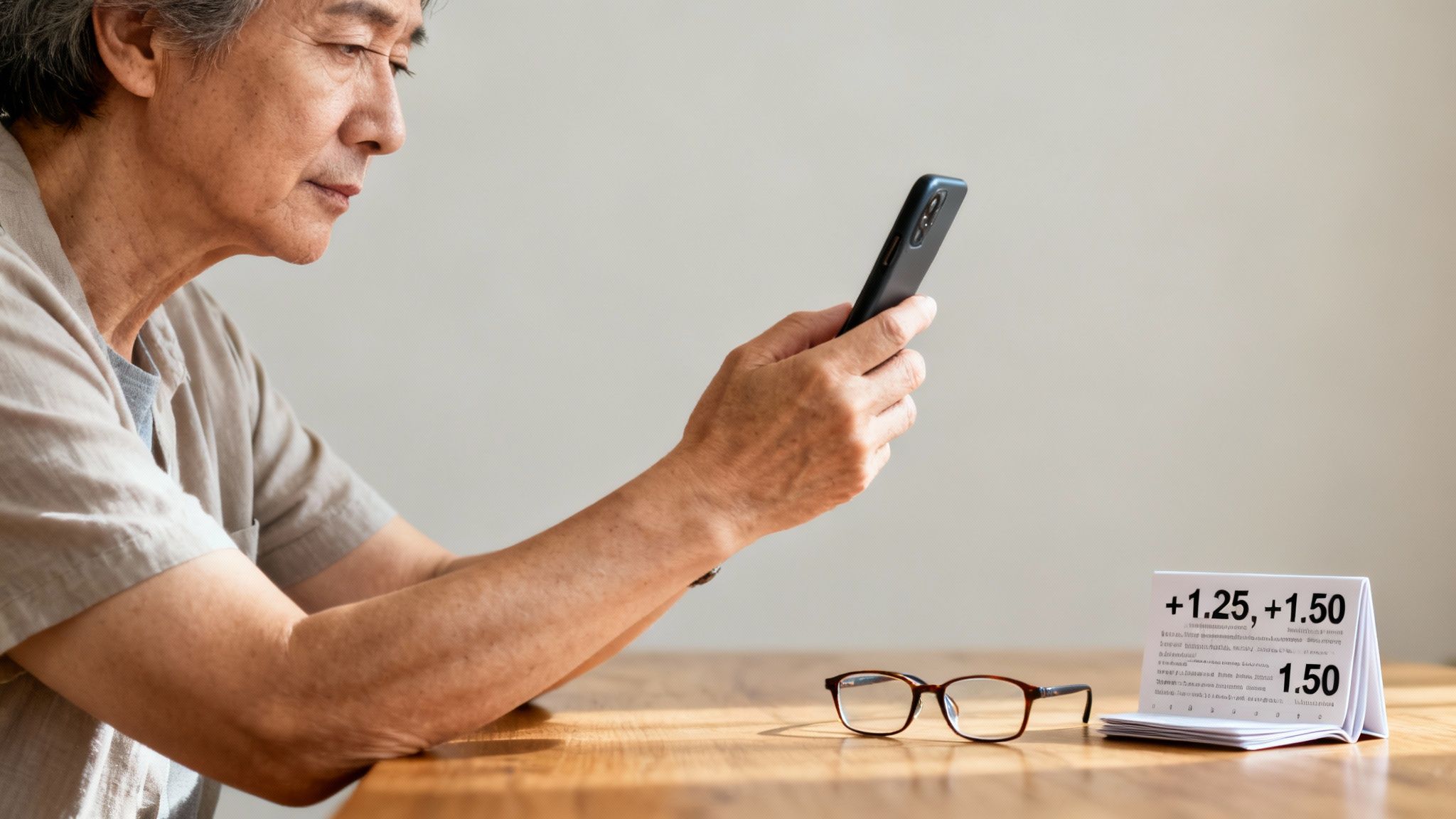
That subtle (or not-so-subtle) change in your close-up vision is almost always due to presbyopia. It's a completely natural part of aging where the lens inside your eye gradually loses flexibility. It happens to just about everyone, typically kicking in sometime in our early 40s.
The strength of reading glasses is measured in diopters, which you'll see as positive numbers like +1.25, +2.00, or +2.50. These numbers simply indicate the level of magnification. Nailing the right strength is crucial for preventing the headaches and eye strain that come from using glasses that are too weak or too strong.
Age as a Starting Point
While not a perfect science, your age is a surprisingly reliable starting point for figuring out what reading power you might need. As presbyopia progresses over time, the strength required for clear vision naturally increases.
This table offers a general guideline for selecting a starting strength for reading glasses based on your age. Use this as an initial estimate before performing a more detailed self-test or consulting an optometrist.
Estimated Reading Glass Strength By Age
| Age Range | Common Diopter Strength | Typical Use Case |
|---|---|---|
| 40–45 | +0.75 to +1.25 | Just starting to notice blurriness with small print. |
| 45–55 | +1.50 to +2.00 | Consistently need glasses for books, menus, and phone use. |
| 55+ | +2.25 to +2.50+ | Require stronger magnification for most close-up tasks. |
Think of these numbers as a helpful rule of thumb. Over-the-counter reading glasses typically go up in 0.25 diopter steps (e.g., +1.00, +1.25, +1.50), so this gives you a good range to begin your search.
Keep in mind, this is just a guide. Your lifestyle, the typical distance you hold your reading material, and your unique eye health play a huge role.
For example, someone who primarily reads on a computer screen might need a different strength than someone who does intricate craftwork up close. To get a better handle on what all the numbers on a vision report mean, take a look at our post on understanding eye prescription numbers.
Ultimately, the only way to know your exact strength is with a comprehensive eye exam. For our neighbors near Army Trail Road or anywhere in Glendale Heights, the team at iDoctor can give you a precise measurement, ensuring your glasses provide perfect clarity and comfort.
Why Your Close-Up Vision Is Changing
If you’ve started holding menus at arm's length or find yourself squinting at price tags, welcome to the club. You’re likely experiencing a completely normal part of aging called presbyopia. It's the reason most of us start reaching for reading glasses, usually sometime after turning 40.
Think of the lens inside your eye like a new, flexible camera lens. When you're younger, it’s soft and easily changes shape to focus on anything you look at, whether it's the beautiful scenery at East Branch Forest Preserve or the fine print on a text message.
As the years go by, that lens naturally gets a bit stiffer and loses some of its elasticity. This makes it much tougher for your eyes to snap into focus on things right in front of you.
The Everyday Signs of Presbyopia
This isn't just about text becoming a little fuzzy. Presbyopia creeps into our daily lives in subtle ways you might already recognize.
For instance, you might find yourself:
- Cranking up the brightness. More light constricts your pupils, which can create a "pinhole effect" that sharpens your focus just enough to read.
- Doing the "trombone." You know the move—holding your phone or a book farther and farther away to find that sweet spot where the words become clear.
- Getting headaches or tired eyes. When you’re trying to read or work on a computer, your eye muscles are working overtime to force that stiffening lens to focus. It’s a workout, and it leads to fatigue and discomfort.
In today's world, we're constantly on our screens, which can make these symptoms feel more pronounced. All that time spent shifting focus from a screen to the world around you really puts a strain on your eyes.
Presbyopia isn’t a sign that your eyes are unhealthy—it’s just a natural part of life. Understanding what’s happening is the first step, and finding the right pair of readers can be a game-changer.
Knowing what’s going on inside your eyes empowers you to find the right solution. If you'd like to learn more, our guide on how your eyes change with age goes into even more detail. And of course, the team here at iDoctor is always ready to help you navigate these changes with confidence.
How To Estimate Your Reading Power At Home
The age chart offers a great starting point, but if you want to dial in your reading power a bit more, a simple at-home test can really help. It’s a practical way to get a feel for what you might need without stepping out the door.
To get started, you'll need a printable diopter chart. A quick search online for a "reading test chart" will give you plenty of free options to print. These charts are specifically designed with lines of text that get progressively smaller, with each line corresponding to a different diopter strength.
Setting Up Your Self-Test
Find a comfortable spot with good lighting, just as you would if you were settling in to read a good book. The goal is to replicate your natural reading environment as closely as possible.
Hold the printed chart about 14 to 16 inches from your face. For most people, this is a pretty standard reading distance. If you know you tend to hold things a bit closer or farther away, feel free to adjust. The key is to be consistent.
This infographic shows how the natural aging process, known as presbyopia, affects the eye's ability to focus up close.
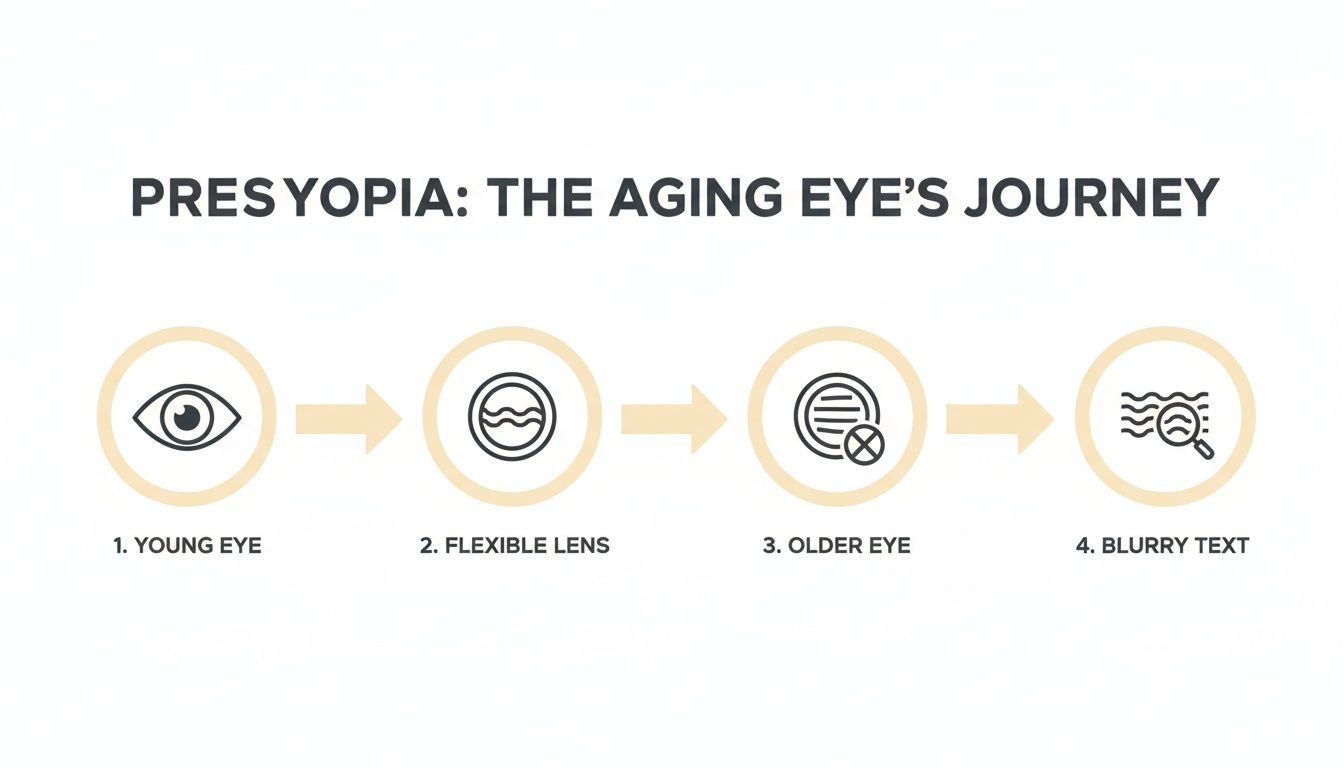
You can see how the lens, once young and flexible, stiffens over time. This change is what leads to that frustratingly blurry close-up vision that sends us looking for reading glasses in the first place.
Finding Your Estimated Strength
Alright, now for the test itself. Without any glasses on, start reading the chart from the top and work your way down. The first line you can read clearly and comfortably—without having to squint or strain your eyes—is a good indicator of the diopter strength you likely need.
For an even better read on the situation, it’s a good idea to test each eye individually.
- First, gently cover your left eye and read the chart with just your right eye.
- Jot down the smallest line you can see clearly.
- Now, swap hands and cover your right eye to test your left.
Important Takeaway: This at-home test is an excellent starting point for finding a comfortable strength. However, it's not a substitute for a professional diagnosis.
A self-test like this is useful, but it can’t spot underlying issues like astigmatism, nor can it tell you if each eye needs a different prescription. For a truly precise fit that ensures your long-term comfort and vision health, nothing beats the accuracy of our detailed eye exams in Glendale Heights.
The Hidden Downsides Of Off-The-Shelf Readers
Grabbing a pair of readers from a drugstore spinner rack is tempting. It's fast, easy, and seems like a quick fix. But that convenience often comes with a hidden cost to your comfort and vision clarity.
The biggest problem with these glasses is their "one-size-fits-all" design. They operate on a major assumption: that both of your eyes are perfectly identical.
When One Size Fails To Fit All
The reality is, most of us don't have perfectly matched eyes. It's incredibly common for each eye to need a slightly different prescription. When you put on a pair of readers with the same power in both lenses, you're often forcing one eye to work harder than the other to keep things in focus. This constant struggle can lead to nagging eye strain, fatigue, and even headaches.
You can learn more about how the wrong glasses can lead to discomfort by checking out our guide on headaches and eye fatigue.
Assuming both of your eyes need the same correction is a common mistake that can lead to persistent eye strain and headaches.
Another issue is that off-the-shelf readers only correct one thing: presbyopia. They do absolutely nothing for other common vision problems like astigmatism, which is a slight imperfection in your eye's curvature that blurs vision at any distance. If you have even a mild case of astigmatism, no pair of drugstore readers will ever give you truly crisp, clear vision.
Your vision needs also change depending on what you're doing. The power you need to comfortably read a book (14-16 inches away) is different from the power you need for your computer screen (20-24 inches away). This is where a professional fitting shines, opening up options like dedicated computer glasses or custom progressive lenses.
The Value Of A Professional Fitting
A proper eye exam gives you a prescription tailored specifically to each eye's unique needs. Studies show that a person’s self-selected power can be off from their actual prescription by 0.25 to 0.75 diopters or even more. While some people get by just fine with standardized readers, many others would see a significant improvement in comfort and clarity from a personalized prescription.
Think of it this way: investing in a professional fitting with the best optometrist in Glendale Heights isn't just about buying glasses. It's an investment in your long-term eye health and your daily comfort.
Choosing The Right Frames And Lenses For Your Lifestyle
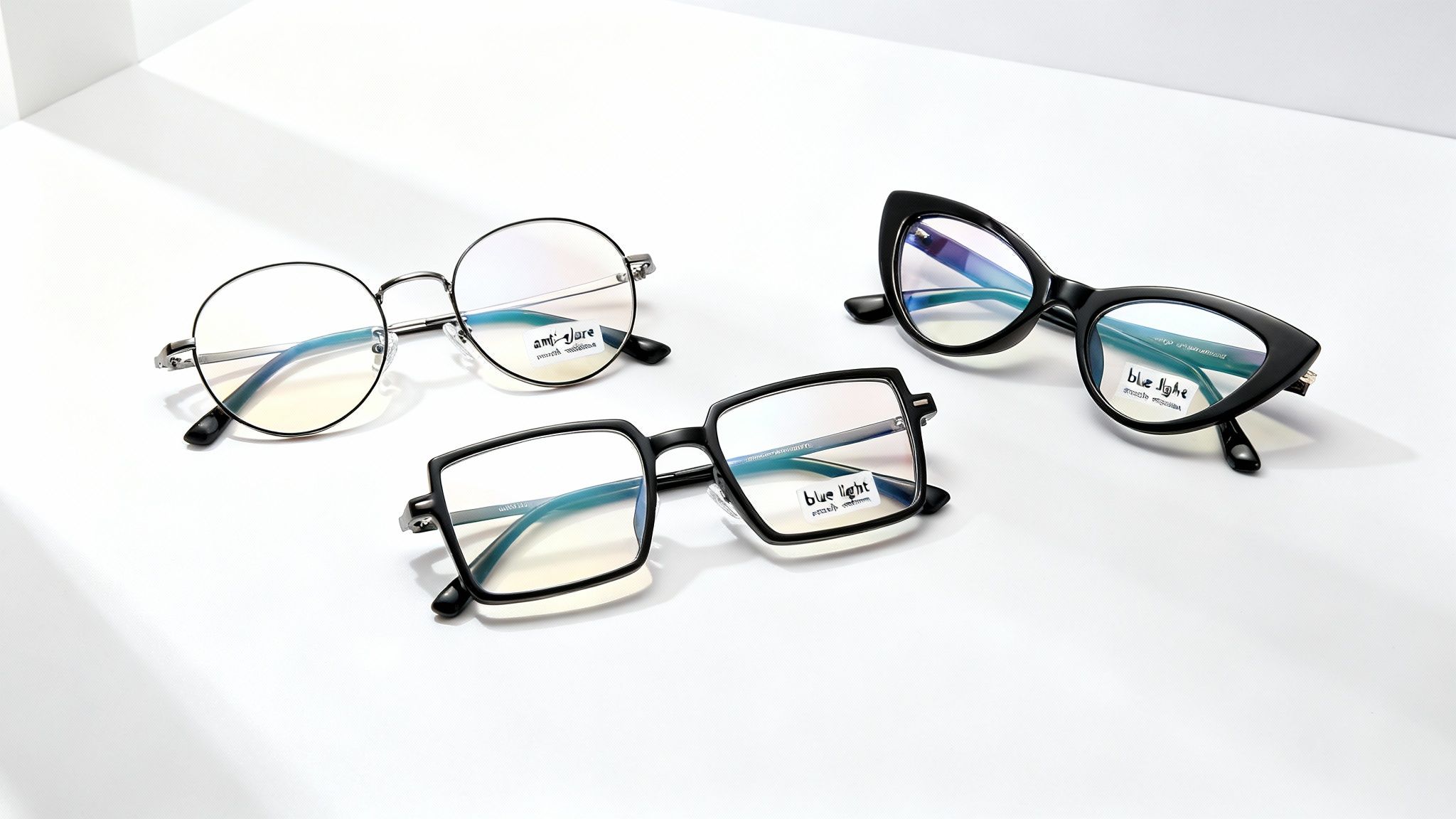
Once we've nailed down your prescription, the fun part begins—picking out the perfect frames and lenses that truly fit your day-to-day life. Think of your prescription as the foundation. The real magic happens when we add modern lens technologies to enhance your comfort and vision.
Ever been bothered by the blinding halos from oncoming headlights while driving at night? An anti-glare coating can make a huge difference. Or maybe you end your workday with that gritty, strained feeling in your eyes after hours on the computer. That's where blue light filtering lenses come in. These aren't just add-ons; they're smart solutions for the visual demands we face every day.
Beyond The Prescription: Lens Enhancements That Matter
The right lens features can completely change your experience with glasses. Here are a few options we often recommend to our patients here in Glendale Heights:
- Anti-Glare (AR) Coatings: These coatings cut down on distracting reflections from all angles, giving you sharper, clearer vision. It's especially noticeable when you're driving at night or working under office lights.
- Blue Light Filtering: If you spend a good chunk of your day looking at screens, this is for you. It helps ease the symptoms of digital eye strain and many people find it helps regulate their sleep cycle.
- Scratch-Resistant Treatments: Let's be honest, life happens. This hard coating is essential for protecting your lenses from the inevitable bumps and scuffs of daily use, making your investment last longer.
I often tell my patients to think of lenses as the engine of a car and the frames as the body. Both need to be right for you to have the best possible ride.
Finding Frames That Feel Like You
Your glasses are often the first thing people notice, so you should absolutely love wearing them. The right frames don't just hold your lenses; they compliment your face shape and become a part of your personal style. For a deep dive into what might work for you, take a look at our guide on the different types of spectacles frames.
Here at iDoctor, we’ve put a lot of thought into our collection of designer eyeglasses in Glendale Heights. We want to make sure there's something for every taste. Whether you're looking for the classic elegance of Cartier and Gucci or the contemporary vibe of Ray-Ban and Coach, we're here to help you find that perfect pair.
Your Professional Eye Exam in Glendale Heights
At-home tests and age charts are a fantastic starting point, for sure. They can give you a ballpark idea of what you need. But they can’t tell you the whole story about your vision.
The only way to get a truly definitive answer is through a professional, detailed assessment. It’s the only way to be certain your prescription is perfectly accurate for both eyes and to rule out any underlying issues.
An eye exam with us at iDoctor is about so much more than just landing on a diopter number. Think of it as a critical health screening. During your appointment, we can spot the early signs of serious conditions like glaucoma, cataracts, or macular degeneration—often long before you'd notice any symptoms yourself.
The iDoctor Difference
We take a personalized approach that sets the standard of care for our neighbors in Glendale Heights, Carol Stream, and Bloomingdale. We simply don't believe in rushing you through the process.
- Advanced Imaging: We use high-resolution imaging to get a crystal-clear picture of your eye’s internal structures.
- Detailed Appointments: Our 30-minute exam slots give us plenty of time to be thorough, get the prescription just right, and answer all of your questions.
- Precision and Care: We make sure your final prescription isn’t just accurate—it’s built around your individual eyes and the demands of your daily life.
A comprehensive eye exam is the single best investment you can make for your vision. It safeguards your health and guarantees the comfort and clarity you deserve.
After all, a self-test can't measure for astigmatism or tell you if one eye needs a slightly different correction than the other. These are the small details that make a huge difference in preventing eye strain and headaches.
Experience what personalized care feels like. We invite you to schedule your detailed eye exams in Glendale Heights today and let our expert team find the perfect solution for your vision.
Frequently Asked Questions in Glendale Heights
We get a lot of great questions about reading glasses at our Glendale Heights clinic. Here are a few of the most common ones we hear from our patients.
Do I really need an eye exam for reading glasses?
While over-the-counter readers are available, a professional eye exam is the only way to get a precise prescription tailored to each of your eyes. This accuracy prevents the eye strain and headaches that can come from the wrong strength. It's also a crucial health check to screen for conditions like glaucoma or cataracts.
Can I use my vision insurance for designer reading glasses at iDoctor?
Yes, absolutely! iDoctor accepts all major vision insurance plans. Many of our patients from Glendale Heights and surrounding suburbs are delighted to learn they can use their benefits to get high-end frames from brands like Gucci, Tom Ford, and Cartier, making luxury eyewear much more accessible.
Are there reading glasses that work for both my computer and for books?
This is a very common question! The distance to your computer screen is different from the distance you hold a book. Standard readers are for up-close tasks. For computer use, you might need "computer glasses" with an intermediate prescription or progressive lenses that offer clear vision at multiple distances. We can determine the best solution for you during a detailed eye exam.
Ready to find that perfect pair of readers with a prescription that’s genuinely made for you? The team at iDoctor is here to help our Glendale Heights community with thorough eye exams and a hand-picked collection of designer frames. Let's get your vision and style dialed in.
Schedule your appointment today at https://idoctoril.com.