Ever looked at a box of contact lenses and had a bit of sticker shock? If you've wondered, "Why are contacts so expensive?", you're definitely not alone. The short answer for our patients in Glendale Heights is that you’re not just buying a tiny piece of plastic—you're investing in a highly sophisticated medical device, backed by years of scientific research and the essential professional care required to keep your eyes safe and healthy.
The Real Cost of Your Contact Lenses
It's a common question we hear from our patients all over Glendale Heights, from folks living near the Glendale Lakes Golf Club to families in the Queen Bee School District. When you break it down, the price starts to make a lot more sense. You're not just paying for the lens itself, but for the entire ecosystem of technology and expertise that ensures your vision is clear and your eyes stay healthy for the long haul.
A single contact lens goes on quite a journey before it ever reaches your eye. This journey includes several key cost drivers: the high-tech materials used, the incredibly precise manufacturing process, and, of course, the critical role your eye doctor plays in all of this.
This chart gives a great visual breakdown of what's really behind the price tag.
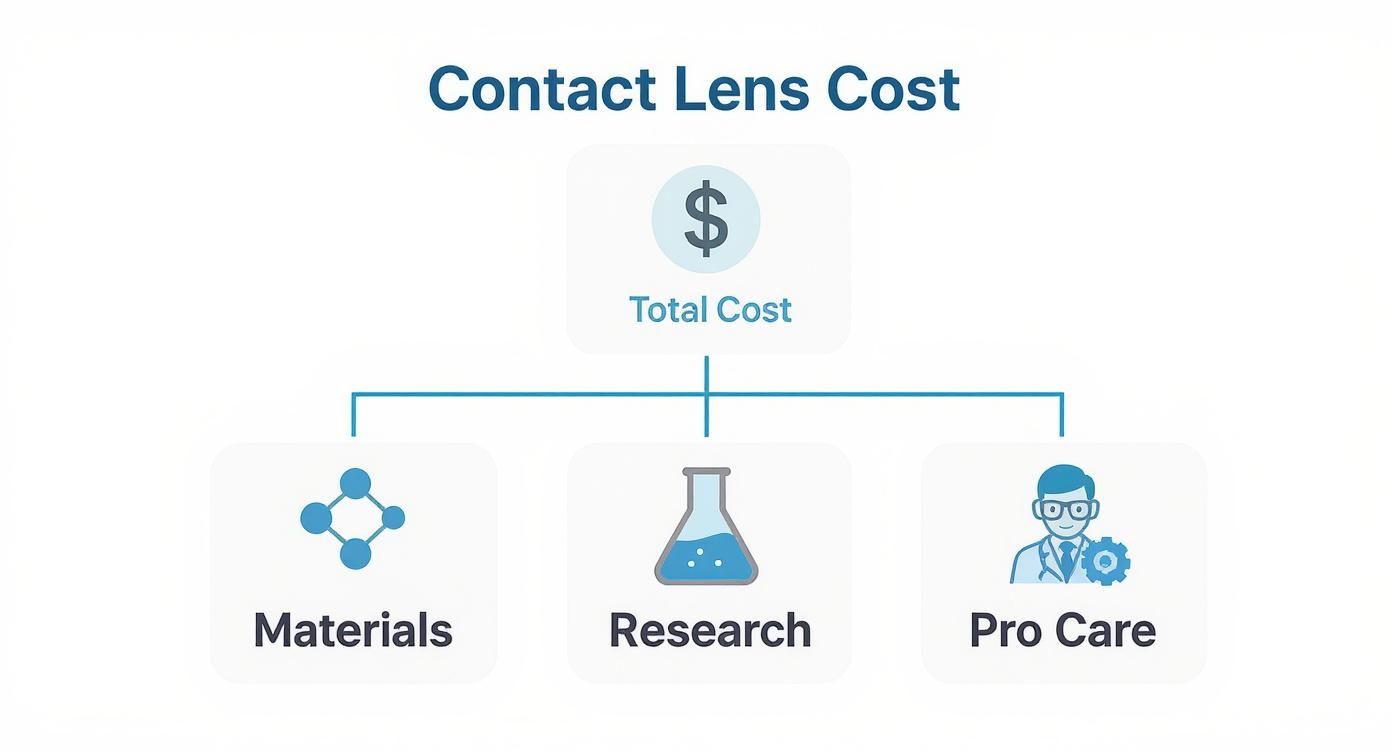
As you can see, the final cost is a blend of advanced materials, extensive R&D, and the professional services that make safe contact lens wear possible. Each piece of the puzzle is crucial.
Understanding the Value Behind the Price
A huge part of the cost is tied to the professional oversight required to wear contacts safely. This involves a specialized fitting and necessary follow-up appointments, which are entirely separate from a routine eye exam.
At iDoctor in Glendale Heights, we want our patients to be informed. When you understand what goes into your contact lenses, you start to see them less as a simple expense and more as a vital investment in clear, comfortable, and healthy vision for years to come.
Ultimately, choosing quality contact lenses with the guidance of a trusted optometrist in Glendale Heights is about protecting your most precious asset—your eyesight.
Let's dig into each of these cost factors in more detail.
Quick Guide to Contact Lens Cost Factors
Before we dive deep, here's a quick summary of the major elements that contribute to the price you pay for contact lenses. This table gives you a snapshot of what's behind the cost.
| Cost Factor | Why It Adds to the Price |
|---|---|
| Material & Technology | Advanced materials like silicone hydrogel allow more oxygen to your eyes, requiring significant R&D investment. |
| Manufacturing Process | Creating a perfectly shaped, sterile, and consistent medical device is a highly precise and expensive process. |
| Prescription Complexity | Lenses for astigmatism (toric) or presbyopia (multifocal) have complex designs that cost more to produce. |
| Replacement Schedule | Daily disposables are more convenient and hygienic but require more lenses per year, increasing the total cost. |
| Fitting & Professional Fees | This covers the optometrist's expertise for a safe fit, training, and follow-ups—a crucial part of the process. |
| Brand & Marketing | Established brands invest heavily in research, development, and marketing, which is reflected in their pricing. |
Each of these factors plays a role in the final price, ensuring you get a product that is not only effective for vision correction but also safe for your eyes.
The Science and Tech Behind Each Lens
Ever wonder what goes into making that tiny, flexible lens you pop in your eye every morning? It's a journey that starts deep in a research lab, and that's where the costs begin to stack up. Contact lenses aren't just simple pieces of plastic; they're sophisticated, highly regulated medical devices engineered to rest safely on your cornea for hours on end. That requires a massive investment in science and technology.
Manufacturers spend millions on Research & Development (R&D) to create materials that feel good and keep your eyes healthy. Take silicone hydrogel, for instance. Its development was a game-changer. This material is incredibly breathable, allowing much-needed oxygen to pass through the lens to your cornea, which is key to preventing dryness and irritation throughout the day. You can learn more about how cutting-edge contact lens technology is improving comfort and clarity in our dedicated post.
Precision Manufacturing and Rigorous Testing
After a material is perfected, the manufacturing process begins—and it's a feat of precision. Lenses are made in sterile, high-tech facilities that can produce millions of units, each one crafted to the exact curvature, diameter, and power needed. This is nothing like stamping out widgets; the slightest imperfection could compromise your vision or comfort.
On top of the complex production, every new contact lens design has to pass a lengthy and expensive approval process with the U.S. Food and Drug Administration (FDA).
This multi-stage process is in place for one reason: your safety. It ensures that every lens sold in the United States, including those we offer our patients in Glendale Heights, meets the highest standards for health and effectiveness.
This absolute commitment to quality control is a fundamental cost built into every single box of lenses. It's a big part of why contacts have a higher price tag than less-regulated consumer products.
The Impact of Market Concentration
Another major piece of the pricing puzzle is the industry itself. The global contact lens market is dominated by just a few huge manufacturers. These companies set the bar for technology and, as a result, for pricing. With such a high level of concentration, there isn't much room for smaller companies to come in and drive prices down.
To give you an idea, just three companies control most of the U.S. market: The Cooper Companies holds about 27.4%, Johnson & Johnson has 26.0%, and Alcon comes in at 19.5%. This kind of industry consolidation makes it incredibly difficult for new players to enter the market and compete, which keeps consumer prices fairly stable—and often high.
How Your Prescription Shapes the Price
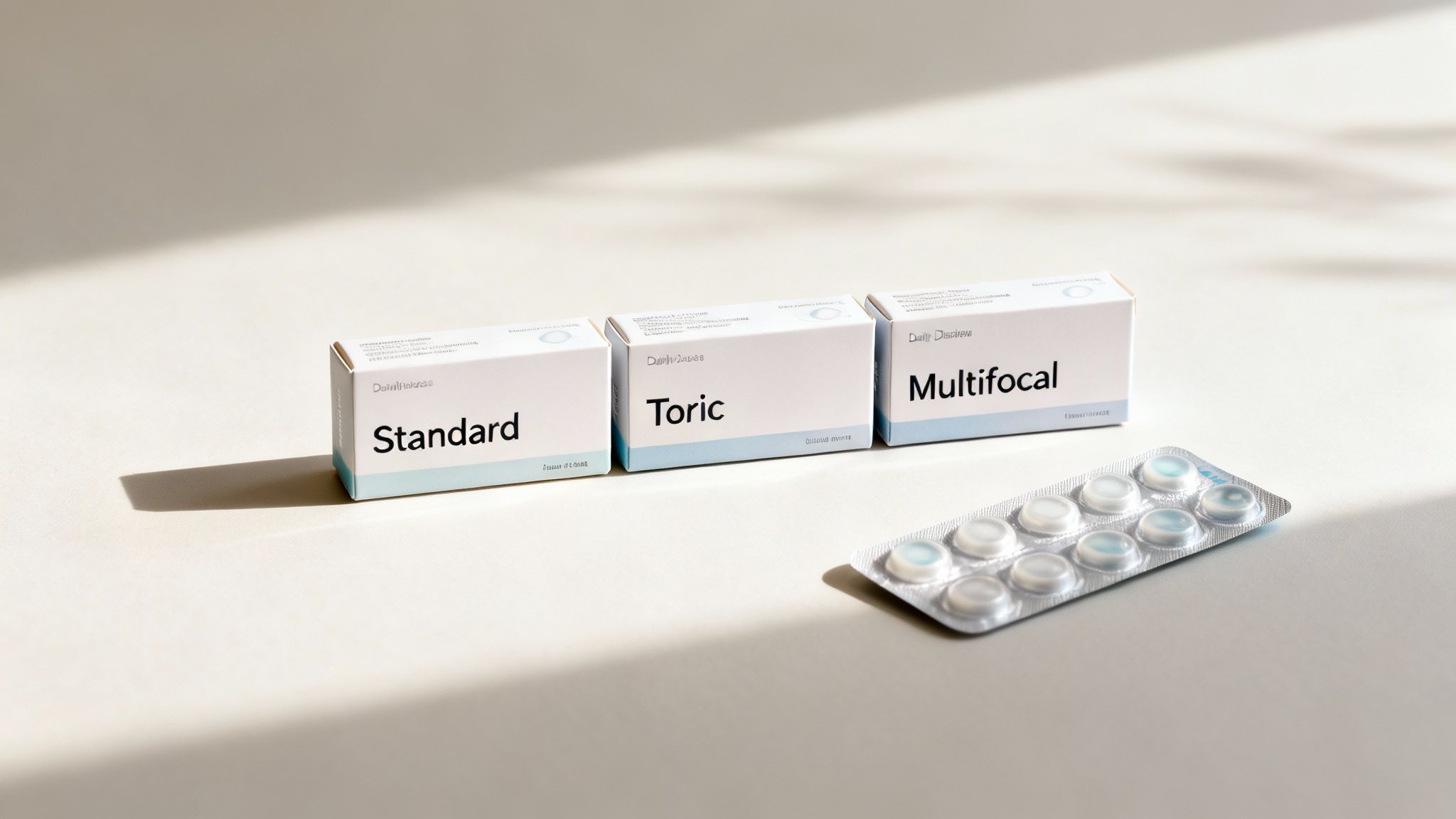
It’s no surprise that not all contact lenses are created equal, and your specific vision needs are one of the biggest factors driving the final cost. The more complex your prescription, the more sophisticated the technology required to correct your vision—and that's a huge reason why contacts can get pricey for some people.
A basic, spherical lens that just corrects simple nearsightedness or farsightedness is the easiest to produce, making it the most affordable option out there. But for many of us, our vision isn't quite that simple.
When Your Vision Needs More
If you have astigmatism, it means your cornea is shaped more like a football than a perfectly round basketball. To correct this, you need a very specific type of lens.
- Toric Lenses for Astigmatism: These lenses are pretty incredible feats of engineering. They have different corrective powers in different parts of the lens and are weighted at the bottom to keep them from rotating on your eye. That stability is key for clear vision, but the specialized design definitely costs more to manufacture.
It’s a similar story for people who develop presbyopia as they get older, which is the condition that makes it tough to read menus or see your phone clearly. This calls for another advanced type of lens.
- Multifocal Lenses for Presbyopia: Think of these like progressive glasses, but in contact lens form. They seamlessly blend multiple prescription zones—for seeing far away, up close, and everything in between—into one tiny, soft lens. As you can imagine, that intricate design comes with a higher price.
The takeaway here is straightforward: the more unique your eye's shape and vision needs are, the more advanced the contact lens technology has to be. That added complexity shows up directly on the price tag. You can dive deeper into the specifics of a contact lens prescription.
The Impact of Wearing Schedule
Beyond the power of your prescription, how often you replace your lenses—your wearing schedule—also has a massive impact on your total annual cost.
- Daily Disposables: These are the gold standard for convenience and eye health. You get a perfectly fresh, sterile pair every single day. The catch? You’re buying 730 individual lenses a year, which makes this the most expensive option upfront.
- Bi-Weekly or Monthly Lenses: These are much easier on the wallet since you use far fewer lenses over the course of a year. The trade-off is that you have to be disciplined about cleaning and storing them every night, which also means factoring in the ongoing cost of contact lens solution.
Why Your Eye Doctor Is Part of the Cost
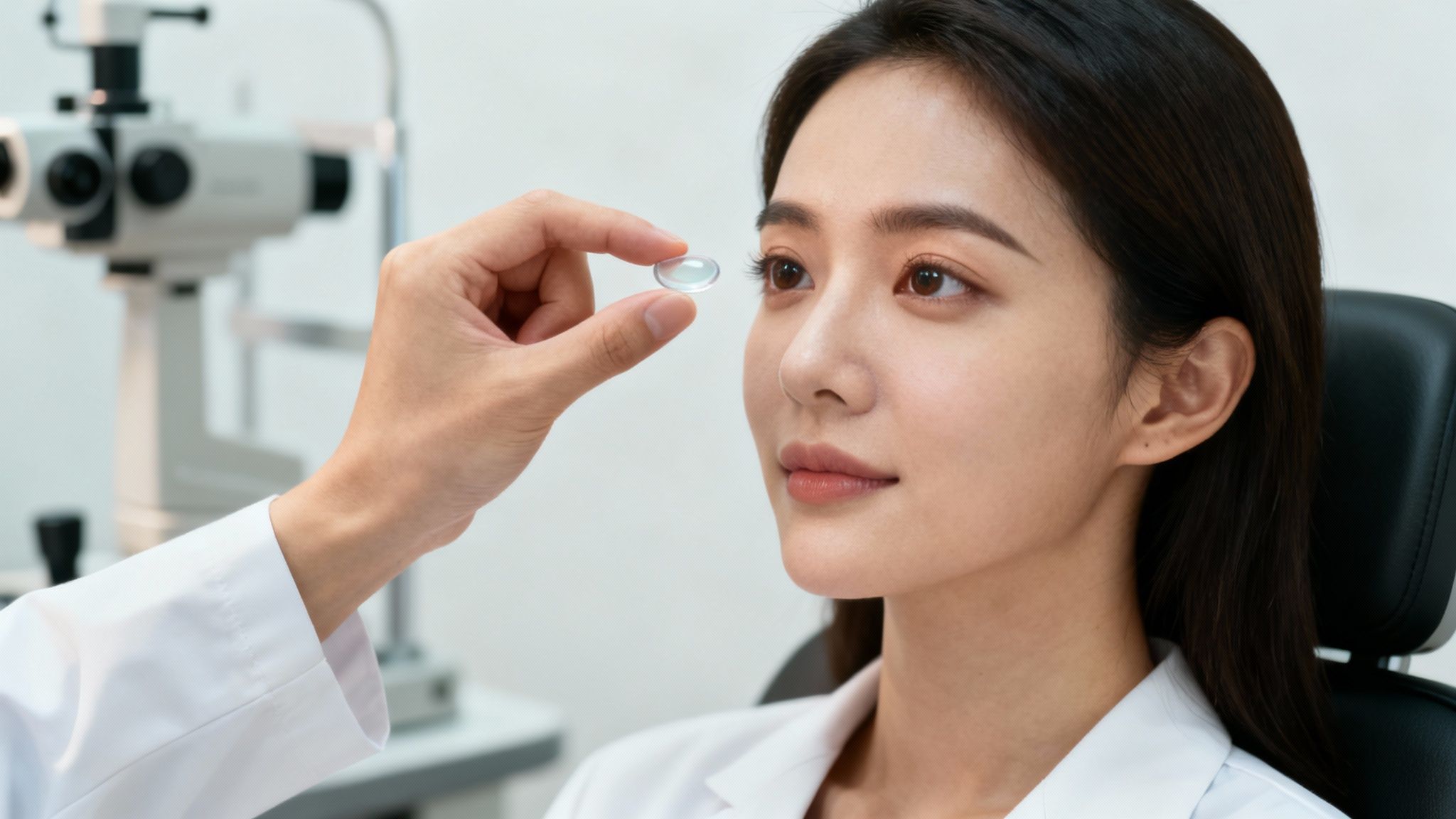
When you look at the price of contact lenses, it’s easy to just see the cost of the little plastic discs themselves. But a huge piece of that puzzle is the medical expertise and professional care that make wearing them safe and effective in the first place. You’re not just buying a product off a shelf; you're investing in ongoing care from your optometrist.
This all starts with the contact lens fitting. Many people think this is just part of a regular eye exam for glasses, but it’s a completely separate and more complex medical service. The fitting fee covers the specialized knowledge, advanced equipment, and extra time needed to match a medical device—the contact lens—perfectly to your unique eyes.
The Fitting Process: What You’re Actually Paying For
A proper fitting isn't just a nice-to-have; it's absolutely critical for your eye health. A lens that doesn't fit correctly can cause everything from nagging discomfort and blurry vision to serious problems like corneal abrasions or sight-threatening infections.
Here’s a breakdown of what that vital service includes:
- Precise Measurements: Your doctor takes specific measurements of your eye's surface, like its curvature (base curve) and diameter. This ensures the lens drapes over your cornea perfectly—not too tight, not too loose.
- Vision Assessment: We don't just hand you lenses with your glasses prescription. We put trial lenses on your eyes and test your vision to see if any adjustments are needed for the sharpest clarity.
- Trial Lenses: The fee covers the diagnostic lenses you’ll wear for a short period. This lets you "test drive" them in the real world to make sure they feel comfortable and work well before you buy a full supply.
- Follow-Up Visits: We'll have you come back for a check-up to see how your eyes are handling the lenses. We’re looking for any subtle signs of irritation or lack of oxygen that could cause issues down the road.
- Patient Training: Especially if you're new to contacts, we'll spend time teaching you the right way to insert, remove, and clean your lenses to keep your eyes healthy.
This whole process is designed to protect your vision. We dive even deeper into this in our guide to understanding the contact lens fitting process.
Think of it like getting a custom-tailored suit. An off-the-rack one might do the job, but a tailored suit is measured and cut specifically for your body, ensuring a perfect, comfortable fit. A contact lens fitting does the same thing for your eyes—it’s a personalized medical service, not a one-size-fits-all product.
A Comparison of Services
To really see the difference in cost and care, it helps to compare what happens in a fitting versus a standard eye exam. Many of our patients in Glendale Heights are surprised to learn about these extra steps, which are legally required to get a valid contact lens prescription.
Take a look at what separates the two appointments.
Contact Lens Fitting vs. Standard Eye Exam
The table below breaks down the additional services in a contact lens fitting that go beyond a regular exam, which explains the difference in cost.
| Service Component | Included in Standard Eye Exam | Included in Contact Lens Fitting |
|---|---|---|
| Vision Prescription Check | ✅ | ✅ |
| Ocular Health Evaluation | ✅ | ✅ |
| Corneal Curvature Measurement | ❌ | ✅ |
| Lens Diameter Sizing | ❌ | ✅ |
| Trial Lens Dispensing | ❌ | ✅ |
| Insertion & Removal Training | ❌ | ✅ |
| Follow-Up Lens Assessment | ❌ | ✅ |
Ultimately, this fee is an investment in your optometrist's skill and professional responsibility. It’s what guarantees your contacts will improve your vision without putting your eye health at risk.
The Business Behind the Box: What Else Drives the Price?
It’s not just the fancy polymers and high-tech manufacturing that set the price of your contact lenses. The business side of the eyewear world has a huge say, too. Think about the major brands you know and trust—they spend a fortune on marketing and advertising to build that reputation. Those costs inevitably get baked into the final price you see.
Then there’s the journey each little box of lenses takes to get to you. It’s a multi-step process, moving from the factory to a regional distributor, and finally to our office right here in Glendale Heights. Each stop along that supply chain adds a small margin. This complex system ensures a safe and reliable supply, but it also adds a few dollars to the bottom line.
Supply, Demand, and the Insurance Factor
The simple economics of supply and demand also play a role. Contact lenses are more popular than ever. In fact, the U.S. market was worth a staggering $2.96 billion in 2023 and is expected to hit $8.8 billion by 2033. This booming demand, fueled by a greater awareness of vision correction options, helps keep prices firm. You can read more about the latest contact lens market trends on KenResearch.com.
At iDoctor, our job is to cut through the noise. As a leading eye doctor in Glendale Heights, we focus on providing real value by giving you a perfect fit and helping you untangle your insurance benefits so you get every penny's worth.
And that brings us to the last piece of the puzzle: vision insurance. Insurance is fantastic for helping cover costs, but there's a lot of administrative work that happens behind the curtain. Our team spends time verifying your coverage, managing claims, and navigating the different rules for each insurance provider, all to make sure you get your full benefits. We're experts at this stuff, and since we accept all major vision insurance plans, we’re here to help you understand what your plan covers for both your fitting and your lenses.
To get a head start, take a look at our guide on navigating vision insurance in Glendale Heights. Our goal is to ensure your investment in clear, comfortable vision goes as far as possible.
Smart Ways to Manage Your Contact Lens Costs
Alright, so we've unpacked why contact lenses have the price tag they do. But knowing the "why" is only half the battle—the real question is, what can you do about it?
Investing in quality lenses is non-negotiable for your eye health, but that doesn't mean you can't be smart about the cost. With a little bit of know-how and a proactive approach, you can absolutely make your contacts more affordable without cutting corners on safety.
The single best place to start is your vision insurance. Most plans set aside an annual allowance just for contact lenses and the necessary fitting appointments. At iDoctor, we deal with major insurance providers every single day. We know the ins and outs and can help you make sense of your benefits to get every dollar's worth out of your plan.
Finding Savings Without Sacrificing Health
Insurance is a big piece of the puzzle, but there are other great ways to save. We always tell our patients to ask about manufacturer rebates, which are especially common when you buy a full year's supply of lenses at once. These deals can be surprisingly good and often make the annual purchase your most budget-friendly move.
Another thing to think about is your wearing schedule. This is a conversation you should definitely have with your optometrist because it’s where convenience, health, and your wallet all intersect.
- Daily Disposables: You can't beat them for hygiene and convenience. They are, however, the priciest option over the course of a year.
- Bi-Weekly or Monthly Lenses: These require more discipline with cleaning, but since you’re buying fewer lenses, they tend to be much easier on the budget.
A quick chat about your daily routine and budget can help us figure out if a different type of lens might work better for you.
If you take away just one piece of advice, let it be this: never try to save money by skipping your annual eye exam or overwearing your lenses. Trying to make a two-week lens last a month might seem like a clever way to cut costs, but it's a fast track to painful infections and serious eye problems. The cost and danger of treating those complications are far greater than the few dollars you'd save.
At the end of the day, managing the cost of contact lenses comes down to partnering with a professional who puts your health first. When you work with the best optometrist in Glendale Heights, use your insurance wisely, and stick to your prescribed schedule, you get clear, comfortable vision that doesn't break the bank. It all starts with investing in detailed eye exams in Glendale Heights—that’s the true foundation for both healthy eyes and long-term savings.
Frequently Asked Questions About Contact Lenses in Glendale Heights
We get it. When you're thinking about contact lenses, the numbers matter. To help clear things up, here are some straight-talking answers to the questions we hear most often from our patients here at our Glendale Heights boutique.
Why can’t I just use my glasses prescription for contacts?
This is a fantastic and very common question. A prescription for glasses is designed for a lens that sits about 12 millimeters away from your eye. A contact lens, however, sits directly on your eye. That small distance completely changes the power needed to focus light correctly. Because of this, we need different measurements that a standard eye exam doesn't cover, like the exact curvature of your cornea. This requires a separate, dedicated contact lens fitting to get a legally valid prescription that ensures both clear vision and a safe fit.
Are designer eyeglasses a cheaper option than contacts?
It really depends on your lifestyle, prescription, and insurance. For some, a one-time purchase of designer eyeglasses in Glendale Heights from a brand like Cartier or Tom Ford might seem more economical than buying a year's supply of daily disposable contacts. For others, especially those with simpler prescriptions, contacts can be quite affordable. Many of our patients from Carol Stream and Bloomingdale love having both stylish glasses for home and the freedom of contacts for sports or days out. We can help you compare the long-term costs of each option.
Do you accept my vision insurance for contact lenses?
Yes, absolutely! At iDoctor, we are proud to accept all major vision insurance plans. Our team is fantastic at helping patients from Glendale Heights and the surrounding Chicagoland suburbs make the most of their benefits. We handle the paperwork and direct billing for you, ensuring your plan covers as much as possible for your contact lens exam, fitting, and the lenses themselves. Making your eye care affordable and straightforward is our priority.
Ready to find the perfect contact lenses that fit your vision, lifestyle, and budget? The team at iDoctor is here in Glendale Heights with the expert care and personalized advice you deserve.
Schedule your contact lens fitting in Glendale Heights today!