Just like every other part of your body, your eyes change as you get older. It’s a natural process, and for most people in Glendale Heights, the first signs start showing up after the age of 40. You might notice you're holding your phone a little further away to read a text, or maybe you need to turn on an extra lamp to see the newspaper clearly. These are often the first, completely normal, whispers of age-related vision changes. At iDoctor, your local optometry boutique, we're here to guide you through every step of this journey.
How Your Vision Evolves Over Time
For many of us here in Glendale Heights, it starts subtly. Maybe you’re grabbing a bite and realize the menu is a blur unless you hold it at arm's length. Or you find yourself squinting at road signs on Army Trail Road. These moments are incredibly common and usually signal the beginning of what eye doctors call presbyopia.
Understanding what's happening inside your eyes is the first step to protecting your sight for the long haul. While some of these shifts are just a minor inconvenience, others can be early warnings for more serious conditions that need an expert’s attention from the best optometrist in Glendale Heights.
Key Vision Changes to Monitor
As the years go by, certain eye conditions become much more common. Knowing what to look for is half the battle.
- Presbyopia: This is the one almost everyone gets, usually starting in their early to mid-40s. It’s simply the loss of your ability to focus on things up close, and it happens because the lens inside your eye loses its flexibility over time.
- Cataracts: This is when the naturally clear lens of your eye starts to get cloudy. The world can begin to look hazy or muted, a bit like looking through a foggy car window on a chilly morning.
- Increased Glaucoma Risk: Your risk for glaucoma, a disease that silently damages your optic nerve, goes up significantly with age. The tricky part is that it often has no symptoms at all in the early stages, making regular exams critical.
- Age-Related Macular Degeneration (AMD): AMD is a leading cause of vision loss and impacts your sharp, central vision—the very vision you rely on to see faces, read, and drive.
This chart gives you a quick visual breakdown of these common conditions, illustrating how presbyopia, cataracts, and AMD each present their own unique challenges to your sight.
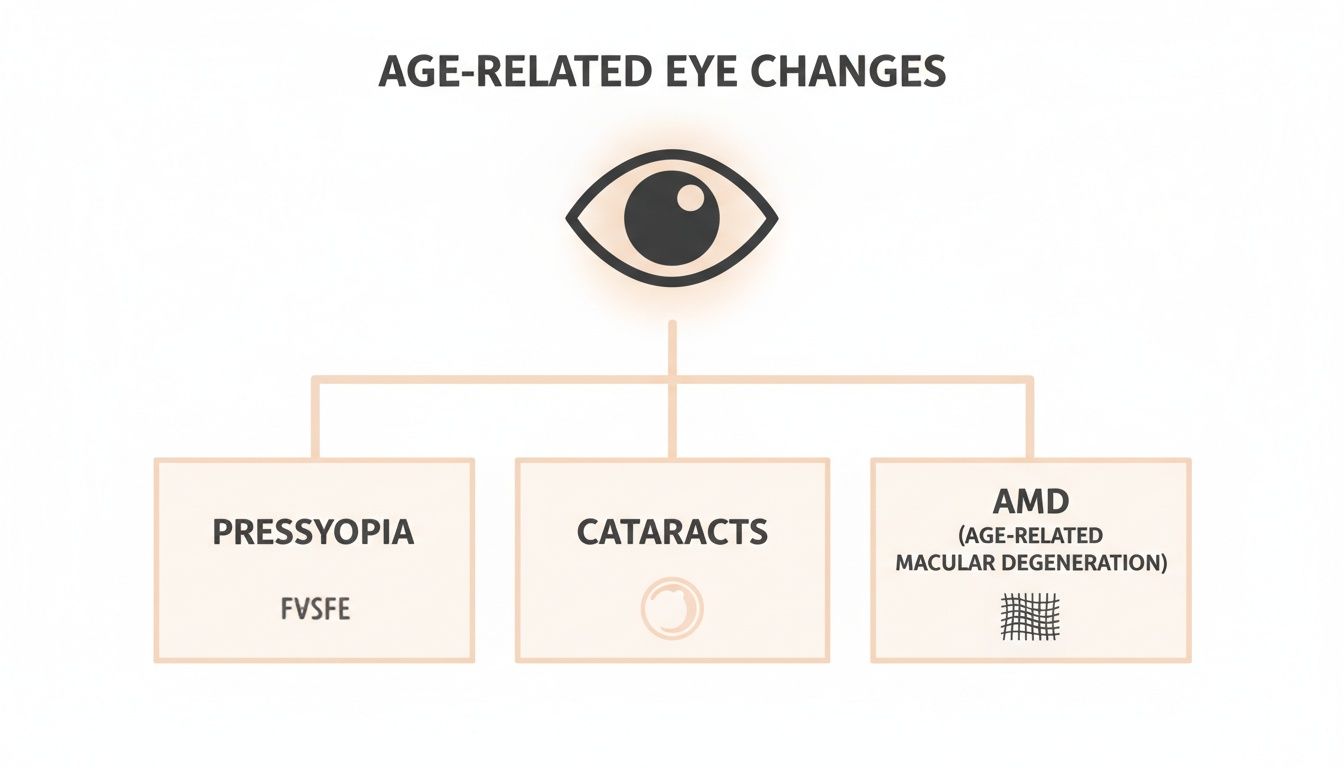
As you can see, each condition affects a different aspect of your vision, from the up-close focusing power lost in presbyopia to the central detail stolen by AMD. This is why a one-size-fits-all approach just doesn't work; each requires a specific diagnosis and management plan.
If there’s one thing to take away from all this, it’s that early detection is your absolute best defense. Catching these conditions before they cause permanent damage is the key to preserving your vision.
The following table provides a quick reference for these common conditions, helping you recognize the signs early.
Common Age-Related Eye Conditions at a Glance
| Condition | What It Is | Typical Age of Onset | Common Symptoms |
|---|---|---|---|
| Presbyopia | The natural hardening of the eye's lens, making it difficult to focus on close objects. | 40-50 | Blurry near vision, holding reading material farther away, eye strain, headaches. |
| Cataracts | The clouding of the eye's natural lens, which lies behind the iris and pupil. | 60+ | Blurry or dim vision, faded colors, halos around lights, increased glare sensitivity. |
| Glaucoma | A group of diseases that damage the optic nerve, often due to high eye pressure. | 60+ (risk increases with age) | Often no early symptoms; gradual loss of peripheral (side) vision in later stages. |
| AMD | Deterioration of the macula, the central part of the retina, leading to central vision loss. | 50+ | Distorted or wavy straight lines, blurry central vision, dark or blank spots in your field of view. |
Knowing what might be coming is empowering. To dig a little deeper, you can learn more about common eye disorders in our detailed guide.
Partnering with an expert optometrist means you'll have an expert in your corner, helping you navigate these changes. At iDoctor, that's exactly what we're here for—to provide that expert care and give you complete peace of mind.
Understanding Presbyopia and Blurry Close-Up Vision
If you’ve recently crossed the 40-year mark and suddenly find yourself holding your phone at arm's length just to read a text, you’re in good company. This is the classic, tell-tale sign of presbyopia, a completely normal change that happens to our eyes as we get older. It’s not a disease, but simply a sign that the lens inside your eye is maturing.

Think of your eye’s natural lens like a brand-new, flexible camera lens. In your youth, it can change shape in an instant, effortlessly focusing on things up close and far away. As the years go by, that lens naturally becomes a bit stiffer and loses some of its youthful elasticity. This makes it much harder to snap into focus for close-up tasks.
The Tell-Tale Signs of Presbyopia
While the change itself is gradual, the symptoms can feel like they pop up almost overnight. You might start noticing a few classic clues:
- The "Arm's-Length" Move: This is the most common sign—holding menus, books, or your phone farther and farther away just to get the text to look clear.
- Blurry Close-Up Vision: Small print, especially in dim lighting, becomes a fuzzy, frustrating challenge.
- Eye Strain and Headaches: After reading, sewing, or working on a computer, you might find your eyes feel tired and achy, or you might even get a headache.
- Needing Brighter Light: You're constantly turning on more lamps or moving closer to a window to see fine details you used to see easily.
These symptoms can get in the way of simple daily tasks, from reading a recipe to sending a quick email. It's usually at this point that people start looking for an eye doctor in Glendale Heights to get things sorted out.
The important thing to remember is that presbyopia happens to almost everyone. It's a universal part of aging, but that doesn't mean you have to put up with the frustration. Modern solutions can bring back clear, comfortable vision at every distance.
Modern Solutions for Clearer Near Vision
The good news is that managing presbyopia is simpler and more stylish than ever. The days of being stuck with clunky, obvious bifocals as your only choice are long gone. Here at iDoctor, we help you find solutions that fit your lifestyle perfectly.
Multifocal Eyeglasses:
These modern lenses offer a smooth, seamless transition between different prescription powers. You can see clearly up close, at an intermediate distance (like a computer screen), and far away, all without those distracting lines on your lenses. Imagine pairing this technology with a search for Gucci glasses near me—you get sharp vision in a sophisticated, high-fashion frame from our curated collection.
Progressive Contact Lenses:
If you'd rather not wear glasses, multifocal contact lenses provide the same amazing benefits. They're designed with different zones for near, intermediate, and distance vision, giving you the freedom to see clearly without ever reaching for a pair of reading glasses.
Figuring out the best path forward depends on your unique needs. Some people are perfectly happy with a simple pair of readers for specific tasks, while others love the all-in-one convenience of progressive lenses. To learn more about your options, our guide on how to tell if you need bifocals is a great place to start.
Our detailed eye exams in Glendale Heights are the key to pinpointing the exact stage of your presbyopia, allowing us to recommend the perfect solution to get you seeing clearly again.
Understanding Cataracts and Glaucoma as You Age
While needing reading glasses is a universal rite of passage, some age-related eye changes are more serious and demand our attention. Two of the biggest players are cataracts and glaucoma. They can significantly impact your vision if they aren't caught and managed, which is why understanding what they are—and the importance of early detection—is the best way to protect your sight for the long haul.

It’s no secret that vision impairment and getting older often go hand-in-hand. An in-depth study looking at vision trends from 1990 to 2019 confirmed that vision problems climb sharply for those 65 and over. Much of this increase was driven by conditions like cataracts, which saw their prevalence jump by nearly 7%. These numbers tell a clear story: as we live longer, proactive eye care becomes absolutely essential. You can explore the full research on aging and vision trends on PMC for more details.
What Are Cataracts?
Have you ever tried to look through a window that's getting foggy? That’s a pretty good analogy for what it’s like to develop a cataract. It’s simply a clouding of your eye's natural lens—the part that focuses light to help you see things clearly.
When we’re young, this lens is perfectly transparent. But over the years, the proteins inside it can begin to clump together, creating a small cloudy patch. The process is typically very slow, but as the cataract grows, it starts to block light from reaching the back of your eye, leading to some telltale symptoms.
Common signs of cataracts include:
- Blurry or dim vision: Your world might look a bit hazy, like you’re looking through a smudged camera lens.
- Faded colors: Bright, vibrant colors may start to seem dull or have a yellowish tint.
- Glare and halos: You might find yourself squinting more in bright light or seeing halos around headlights at night.
The good news is that cataracts are very treatable. We can help you understand all your options and monitor their development. To get a better handle on the condition, you can learn more about our approach to cataract management and treatment.
The Silent Threat of Glaucoma
While cataracts make their presence known with blurry vision, glaucoma has earned its nickname as the "silent thief of sight." This disease causes damage to your optic nerve, which acts like a data cable sending visual information from your eye to your brain. This damage is most often caused by a gradual increase in pressure inside the eye.
What makes glaucoma so tricky is that it usually has no symptoms in the early stages. The very first vision loss happens in your peripheral (side) vision, and it can be so gradual you don't notice it until irreversible damage has already been done. By the time most people are aware of a problem, the disease is quite advanced.
Glaucoma is the perfect example of why you should never wait for symptoms to show up before getting an eye exam. Regular check-ups are the only way to catch this condition early enough to prevent permanent vision loss.
Early Detection is Your Best Defense
For both cataracts and glaucoma, catching them early is everything. This is where a comprehensive eye exam with an expert eye doctor in Glendale Heights becomes your most powerful tool. At iDoctor, our 30-minute exams are designed to go far beyond just updating your glasses prescription.
We use advanced, high-resolution imaging to get a detailed look at the structures deep inside your eye. This technology lets us spot the very earliest signs of a cataract forming or detect subtle changes in your optic nerve that could point to glaucoma—long before you’d ever notice a thing on your own.
Whether you live near Camera Park or are a regular on Bloomingdale Road, our clinic is here to be your local partner in proactive eye care. By diagnosing these conditions early, we can build a personalized plan to manage them effectively, protecting your vision and preserving your quality of life for years to come.
Protecting Your Sight from Macular Degeneration
As we get older, our eyes change, but some of those changes are more serious than others. One condition that absolutely needs your attention is Age-Related Macular Degeneration, or AMD. It's a leading cause of vision loss in older adults, and it targets the most vital part of your retina: the macula.
Think of your macula as the high-definition camera sensor right in the center of your vision. It’s what you rely on to read fine print, recognize the faces of loved ones, and drive a car. When AMD damages it, that sharp, central vision starts to fade.

Globally, AMD is a primary cause of irreversible blindness for people aged 50 and over. To put that in perspective, in 2020 alone, AMD caused blindness in an estimated 1.85 million people worldwide, with millions more suffering from serious vision problems. These aren't just statistics; they represent a real threat to quality of life, making it crucial to understand the condition and how to fight back. You can read more about the global impact of AMD on Nature.com.
The Two Types of AMD
It's helpful to know that AMD isn't just one thing—it comes in two distinct forms. Knowing the difference helps explain the risks and why regular monitoring by a professional is so important.
- Dry AMD: This is the one you’re most likely to encounter, accounting for 80-90% of all cases. It's a slow-burn process where the light-sensitive cells in the macula gradually thin and break down, causing your central vision to become blurry over time.
- Wet AMD: Though much less common, Wet AMD is far more aggressive and is responsible for most of the severe vision loss associated with the disease. It involves abnormal blood vessels forming under the retina. These vessels are fragile and often leak blood or fluid, causing rapid and severe damage to the macula.
Key Symptoms to Watch For
While some eye conditions like glaucoma can sneak up on you without warning, AMD usually sends out some clear distress signals related to your central vision. Catching these early gives you the best chance to intervene.
Be on the lookout for:
- Straight lines suddenly looking wavy or bent (think doorframes or power lines).
- A blurry, fuzzy, or dark spot appearing in the middle of your vision.
- Diminished central vision in one or both of your eyes.
- Finding it harder to recognize faces.
If you ever look at a straight line and it appears distorted or crooked, treat it as a red flag. This is a hallmark symptom of AMD and means you should call your optometrist immediately.
Proactive Care and Early Detection
When it comes to a condition like macular degeneration, being proactive is your best defense. Risk factors like smoking, diet, and a family history of AMD certainly play a role, but your most powerful tool is a consistent, detailed eye exam. To get a complete picture of the condition, you can learn more about macular degeneration in our in-depth article.
Here at iDoctor, we don't just check your prescription. We use high-resolution imaging to get a crystal-clear look at your macula. This technology lets us spot the earliest warning signs—like tiny yellow deposits called drusen—long before you'd ever notice a change in your vision yourself. Catching it that early allows us to map out a plan with lifestyle advice and a close monitoring schedule to protect your precious sight for years to come.
Your Action Plan for Lifelong Healthy Vision
Knowing what happens to your eyes as you get older is one thing. Actually doing something about it? That's how you protect your vision for life. Putting a simple, practical plan in place today is the key to preserving your sight for all your tomorrows—especially once you hit 40.
And it’s more important now than ever. Experts predict a staggering 55% surge in global vision loss over the next 30 years, largely because we're living longer and our modern lifestyles take a toll. This really drives home the need to get ahead of conditions like cataracts and macular degeneration. You can discover more insights about these global vision trends on Statista.com.
Prioritize Regular Eye Exams
If you do only one thing, make it this: schedule regular eye exams. Think of it like preventative maintenance for your most precious sense. A professional evaluation can spot silent problems like glaucoma long before they cause damage you can't undo.
We recommend booking one of our detailed eye exams in Glendale Heights every one to two years once you're over 40. In just about 30 minutes, we use high-resolution imaging to get a complete picture of your eye health, giving you true peace of mind.
Build an Eye-Healthy Lifestyle
Your daily habits have a massive impact on your long-term vision. Making small, consistent choices can build a powerful defense against the changes that come with age.
Here’s where to start:
- Eat for Your Eyes: Fill your plate with leafy greens like spinach and kale. They're packed with lutein and zeaxanthin. Don't forget fish like salmon, which is loaded with omega-3 fatty acids that support your retinal health.
- Guard Against UV Rays: Never underestimate the sun. Always wear sunglasses that block 100% of UV rays. Our collections from brands like Ray-Ban and Gucci prove that you don't have to sacrifice style for serious protection.
- Manage Your Overall Health: Conditions like diabetes and high blood pressure can directly harm your eyes. Partnering with your primary care doctor to keep them in check is a huge part of protecting your sight.
- Quit Smoking: There's no way around it—smoking drastically increases your risk for cataracts and AMD. Quitting is one of the best things you can possibly do for your eyes.
Your vision is a partnership between you and your eye doctor. Your daily choices protect your eyes from the outside, while our expert care safeguards them from the inside.
Manage Common Discomforts
Sometimes, it's the little things that get in the way of clear, comfortable vision. For a common issue like dry eye, simple at-home remedies can bring a lot of relief.
Many people find that a warm compress helps soothe irritation. For an easy and effective option, you might consider dry eye heat therapy using an eye mask to help manage your symptoms day-to-day.
Whether you're driving down Army Trail Road or live near Camera Park, the team at iDoctor is right here in your community. We’re your dedicated partners in proactive eye care, ready to provide the personalized guidance and expert treatment you deserve to keep your vision clear for years to come.
Frequently Asked Questions About Aging Eyes in Glendale Heights
It's completely normal to have questions as you notice your eyes changing over the years. We get it. To help put your mind at ease, we've put together some answers to the concerns we hear most often from our patients here in Glendale Heights. Think of this as a quick chat with your trusted, approachable eye doctor.
How often should I get an eye exam after age 40?
Once you hit 40, we strongly recommend a comprehensive eye exam every one to two years, even if your vision seems perfectly fine. Why? Because many serious eye conditions, like glaucoma, often have no early symptoms. Our detailed exams can detect these issues before they cause lasting damage. If you have risk factors like diabetes or a family history of eye disease, we may recommend more frequent visits.
Are designer eyeglasses in Glendale Heights covered by my insurance?
Yes, absolutely! At iDoctor, we are an independent optometry boutique that proudly accepts all major vision insurance plans. We want luxury eyewear from brands like Cartier, Tom Ford, and Prada to be accessible. Our friendly team is skilled at helping you understand and maximize your benefits, so you can choose the perfect pair of designer eyeglasses in Glendale Heights with confidence.
Where can I find contact lenses in Glendale Heights?
You can find a complete range of contact lenses right here at iDoctor. During a contact lens fitting, we’ll determine the best type for your eyes and lifestyle—whether you need lenses for astigmatism, multifocal lenses for presbyopia, or daily disposables for convenience. We ensure a comfortable fit and clear vision, making us your one-stop shop for contact lenses in Glendale Heights.
Your eyesight is priceless. As the premier eye doctor in Glendale Heights, our team at iDoctor is committed to giving you personalized, expert care in a warm and professional setting. Whether it's time for a thorough 30-minute exam, you're searching for stylish Cartier or Oliver Peoples frames, or you want to talk about contact lenses, we're here to help you enjoy clear vision for life.